

Chasing Domain Rating as the primary link quality filter is how practitioners end up with strong DR and weak rankings. DA and DR measure site-wide link popularity — they don’t measure topical entity relevance, which is the dimension Google’s Knowledge Graph actually uses to evaluate what a backlink means for your brand entity. A link from a DA 40 publication in your exact vertical strengthens that entity association. A DA 80 link from an unrelated industry passes PageRank and nothing else.
That gap explains why some link building campaigns produce solid DR growth but underwhelming ranking movement. This cluster covers the entity relevance dimension of link quality — how to identify topically relevant sources, score prospects before outreach, and build the kind of backlink profile that strengthens Knowledge Graph presence and AI search citation frequency. It’s the entity-specific layer the Link Building in 2026: Digital PR, Entity Authority & AI Citation Strategies pillar delegates here.
Running a six-month campaign for a UK fintech client using Ahrefs and the Knowledge Graph API, DR grew from 31 to 47 across the campaign period. Entity impression growth tracked topically relevant link acquisition — not total link volume. Links from fintech, payments, and FCA regulatory publications moved entity signals. Links from general business and marketing publications didn’t. By month three, the pattern was undeniable: we stopped prioritising the highest-DR sources and started prioritising the highest entity-relevance sources. DR still grew. Entity impressions grew faster.
Post Summary
- Entity authority backlinks are links from topically relevant sources that Google has already associated with your topic area in its Knowledge Graph — distinct from generic high-DR links
- Google’s Knowledge Graph evaluates links on entity relevance alongside domain authority — a DA 40 topically aligned source can outperform a DA 80 unrelated one for entity signal
- Identifying entity-relevant link sources requires cross-referencing Ahrefs Content Explorer with Knowledge Graph entity associations — not just DR filters
- AI search engines including ChatGPT, Perplexity, and Google AI Overviews cite sources with strong topical entity authority — entity-relevant backlinks directly influence AI citation frequency
- A UK fintech campaign showed entity impressions tracked topically relevant link acquisition, not total DR growth — entity relevance is the separating variable
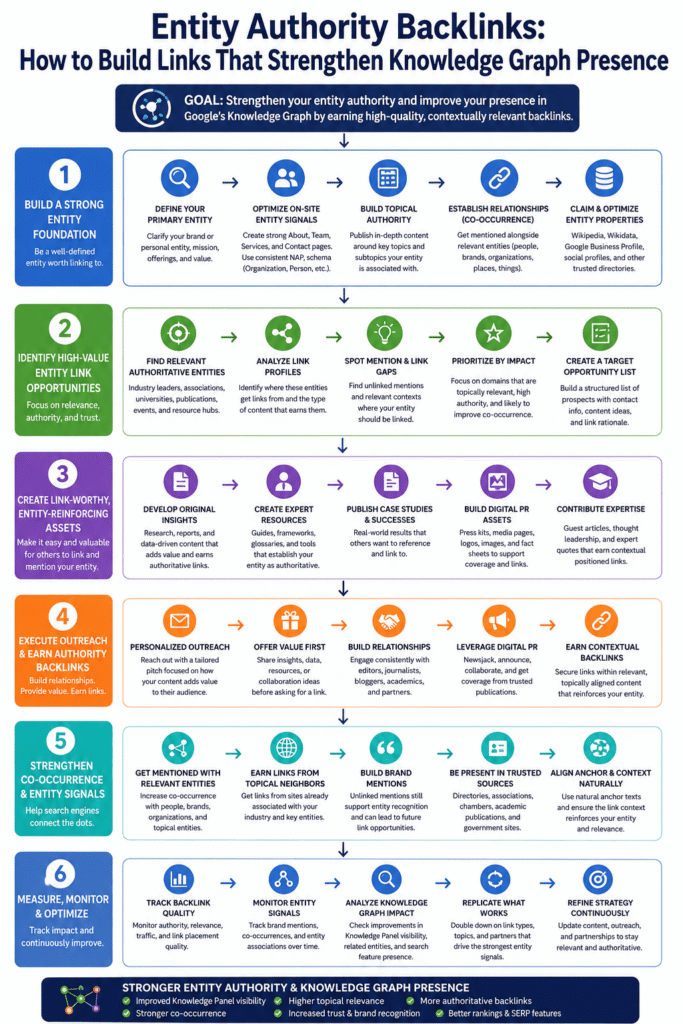
Table of Contents
ToggleWhat Entity Authority Backlinks Actually Are
An entity authority backlink is a link from a source Google’s Knowledge Graph has already associated with your topic area. Its value isn’t defined by the linking site’s DA. It’s defined by the topical co-citation relationship between the linking domain and your target entity.
Google’s Knowledge Graph maps entities — brands, people, concepts, locations — and their associations. When a publication consistently covering fintech links to a fintech brand, that link doesn’t just pass PageRank. It reinforces the entity association between the brand and the fintech topic cluster (Source: Google, 2012).
Do that repeatedly, from enough topically relevant sources, and Google’s understanding of what your brand entity is becomes more precise and more confident. Worth flagging: that precision has a direct downstream effect on AI search. ChatGPT, Perplexity, and Google’s AI Overviews all weight topical entity authority when selecting sources to cite — entity authority backlinks are the off-page mechanism that builds that weight.
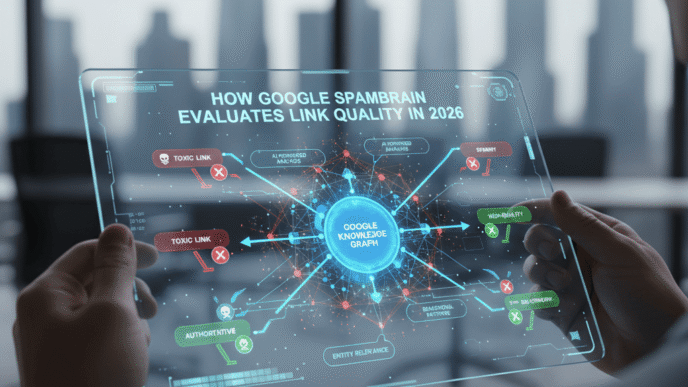
Generic high-DR links don’t achieve this. A link from a DA 80 general news publication covering everything from sports to cryptocurrency passes link equity — but doesn’t meaningfully strengthen the entity association between your brand and your specific topic area. SpamBrain’s naturalness evaluation includes topical relevance as one of its three simultaneous quality dimensions (Source: Google Search Central, 2022). A backlink profile rich in entity-irrelevant sources passes the DA filter and fails the entity relevance filter at the same time.
For the broader framework linking entity authority to digital PR and AI citation strategy, see the Link Building in 2026: Digital PR, Entity Authority & AI Citation Strategies pillar.
Why DA-First Link Building Misses the Entity Relevance Dimension
Most link building advice ranks prospects by DA or DR. That’s the wrong primary filter — and the campaigns it produces are why practitioners see DR growth without corresponding ranking improvement.
The DA-first model made sense in a ranking environment where PageRank flow was the dominant off-page signal. It still produces DR growth. What it increasingly fails to produce is entity authority growth — and those are different outcomes with different ranking effects.
Three shifts have changed the calculus:
1. SpamBrain evaluates topical relevance simultaneously with link naturalness SpamBrain’s December 2022 update moved beyond detecting purchased links to flagging unnatural linking patterns — including topically incoherent backlink profiles (Source: Google Search Central, 2022). A fintech site accumulating links primarily from fashion, travel, and lifestyle publications builds a profile that clears DA thresholds and fails the topical coherence test.
2. AI search citation weights entity authority over raw domain popularity Sources cited in AI Overviews, ChatGPT responses, and Perplexity answers aren’t simply the highest-DR sites in a topic area. They’re sites with documented, consistent topical entity authority — confirmed by publication history, link profile topical coherence, and Knowledge Graph entity associations.
3. Knowledge Graph entity confidence affects featured snippet and knowledge panel eligibility Sites with strong entity authority — confirmed by topically relevant referring domains — are more likely to trigger Knowledge Graph-driven SERP features for branded and semi-branded queries. DA-first link building doesn’t move this signal. Entity-relevant link building does.
Pro Tip: In Ahrefs Site Explorer, pull your referring domains report and sort by topical relevance — cross-reference which linking domains share category tags or consistent topic coverage with your primary keyword cluster. The ratio of topically relevant to topically irrelevant referring domains is a faster diagnostic of entity authority health than raw DR. If fewer than 40% of your referring domains are topically aligned, the entity authority problem is in the link acquisition strategy, not the content.
How to Identify Entity-Relevant Link Sources
Entity-relevant link sources are publications Google has already associated with your topic area — either through their own Knowledge Graph entity associations or through consistent publication history on your subject.
Three methods work in combination:
Method 1 — Ahrefs Content Explorer topic filter
Search your primary topic keyword in Ahrefs Content Explorer. Filter: DR 30+, published last 12 months, one page per domain, English. Export the results. These publications are actively producing content in your topic area — confirmed editorial interest, not database guesswork. Cross-reference against your existing referring domains to spot the gap: publications covering your topic that don’t yet link to you.
Method 2 — Competitor backlink topical audit
Pull referring domains for 3–5 direct topical competitors in Ahrefs. Export their link lists. Filter for domains appearing in at least two competitors’ profiles — these publications are already operating as entity-authority sources in your topic area. They’ve linked to multiple players in the space; they’re topically primed.
Method 3 — Knowledge Graph entity co-citation check
Search your brand entity or primary topic in Google’s Knowledge Graph. Identify which publications appear in the “described by source” and “mentioned in” fields for your entity. These sources are already Knowledge Graph-associated with your topic area — links from them carry the strongest entity relevance signal available.
All three methods together produce a tiered prospect list: Tier 1 (Knowledge Graph-associated), Tier 2 (competitor-verified topically relevant), Tier 3 (Content Explorer-confirmed topically active). Run outreach in that order, not by DR ranking.
Entity Relevance Scoring: How to Evaluate a Link Source Before Outreach
Not all topically relevant sources are equally valuable for entity authority. The part most guides skip is giving practitioners a scoring framework that runs before outreach investment — not after. Score each prospect against four criteria before writing a single email.
| Criterion | What to Assess | Score 1 | Score 2 | Score 3 |
|---|---|---|---|---|
| Topic coverage depth | Volume of articles on your specific topic | 1–5 articles in last year | 6–20 articles in last year | 20+ articles, consistent history |
| Entity co-citation density | Does their topical content cite entities you want to be associated with? | Occasional co-citation | Regular co-citation | Dense, consistent co-citation |
| Outbound link behaviour | Do they link to external sources in topical content? | Rarely links out | Sometimes links out | Consistently links out in topic coverage |
| Publication recency | Is the publication still actively covering your topic? | No new content in 12+ months | 1–3 new pieces in last 6 months | Active publication — monthly or more |
Score each prospect 1–3 on each criterion. Total of 10–12 = Tier 1 priority. 7–9 = Tier 2. Below 7 = deprioritise regardless of DR.
A publication with a total score of 6 and DR 80 is a weaker entity authority target than a publication with a score of 11 and DR 35. That’s the reorder most DA-first link builders never make.
How Entity Authority Backlinks Affect AI Search Citation Frequency
AI search engines don’t rank sources by DA. They weight sources by topical authority coherence — a function of entity relevance, publication consistency, and structured data signals. Entity authority backlinks build the off-page component of that weighting directly.
The mechanism runs in three steps:
Step 1 — Entity-relevant links strengthen Knowledge Graph confidence Each topically relevant link from a co-citation-dense source adds to Google’s confidence in your brand entity’s topical associations. Higher confidence produces stronger entity authority, which produces more reliable appearance in Knowledge Graph-driven SERP features.
Step 2 — Strong entity authority increases AI citation candidacy AI Overviews, ChatGPT, and Perplexity draw on sources assessed as authoritative in a topic area. Entity authority — evidenced by topically relevant referring domains, consistent on-page topical coverage, and structured data — is one of the primary signals those systems use to evaluate which sources get cited (Source: Ahrefs, 2024).
Step 3 — AI citations generate secondary link acquisition When a brand is cited in AI search results, journalists and content creators researching the topic encounter that citation and frequently follow it — producing secondary link acquisition from their own coverage. Entity authority backlinks initiate the loop; AI citations sustain it.
In the UK fintech campaign, entity impression growth was first visible in Google Search Console’s branded query impressions — searches for the brand name alongside terms like “FCA” and “digital payments” — before it appeared in AI citation tracking. The topically relevant editorial links were building entity associations that surfaced in branded query visibility weeks before the AI search signal became measurable (and yes, that ordering surprised us — we’d expected the ranking signal to arrive first).
Building Entity Authority Backlinks: The Practical Outreach Sequence
Outreach for entity authority link building differs from generic editorial outreach in one load-bearing respect: the pitch leads with topical alignment, not story novelty.
Stage 1 — Entity alignment hook
Open the outreach email with a direct statement of topical fit: “You’ve covered [specific topic] consistently — I have [data/expert commentary/resource] that adds to that coverage.” This framing signals immediately that you’ve read their content, understand their editorial territory, and are offering something that belongs there. Journalists and editors covering a specific beat respond better to pitches that demonstrate that recognition than to generic story angles pitched blind.
Stage 2 — Entity-specific value offer
The value offered must be entity-specific — data, commentary, or a resource only a topically authoritative source could provide. Generic industry statistics that any publication already has don’t establish entity relevance. First-hand data from a named sector practitioner, specific regulatory commentary, or a case study from within the exact vertical does.
Stage 3 — Internal link request
Once a link is placed, the follow-up should request that it point to the specific page on your site most topically aligned to the linking article’s content — not the homepage, not a generic resource page, but the page with the deepest relevance to the anchor context. This is where entity authority campaigns routinely lose signal: the link is earned but directed to the wrong destination.
For the full journalist outreach and pitch construction process that runs in parallel with this entity-first targeting strategy, see Digital PR Link Building: How to Earn Editorial Links at Scale in 2026.
Frequently Asked Questions
What are entity authority backlinks and why do they differ from standard backlinks? Entity authority backlinks are links from topically relevant sources that Google has already associated with your topic area in its Knowledge Graph. Their primary value is entity association reinforcement — strengthening Google’s confidence in your brand entity’s topical relevance — rather than PageRank flow alone. A DA 40 source with deep topical alignment produces a stronger entity authority signal than a DA 80 source with no topical connection to your sector.
How does entity relevance affect AI search citation frequency? AI search engines including Google AI Overviews, ChatGPT, and Perplexity weight topical entity authority when selecting sources to cite. Sources with strong entity authority — confirmed by topically relevant referring domains, consistent publication history, and structured data — are cited more frequently than high-DR sources with weak entity associations. Entity authority backlinks build the off-page component of that topical authority signal directly.
How do I identify which backlinks are entity-relevant for my site? Three methods work together: Ahrefs Content Explorer filtered by your primary topic keyword identifies active publishers in your space; competitor backlink audits surface publications already linking to multiple topical competitors; and Google Knowledge Graph checks identify sources already co-citation-dense in your topic area. Prospects scoring high across all three are Tier 1 entity authority targets.
Does DA still matter if entity relevance is the primary filter? Yes — DA functions as a floor filter, not the primary one. A topically relevant source with DA below 20 or significant spam indicators isn’t a worthwhile target regardless of entity relevance. Use DA 30+ as a minimum threshold and entity relevance scoring as the primary ranking criterion above that floor.
How long does it take for entity authority backlinks to affect Knowledge Graph signals? Knowledge Graph entity association updates aren’t instantaneous. In the UK fintech campaign, measurable entity signal changes — visible in branded query impression patterns in Google Search Console — appeared 6–8 weeks after topically relevant editorial links began accumulating. Full entity confidence updates, visible as Knowledge Graph panel changes or AI citation candidacy shifts, typically take 3–6 months of consistent entity-relevant link acquisition.
What to Do Next
The entity relevance dimension is what separates link building campaigns that grow DR from those that grow both DR and topical authority. Each section above maps to a concrete action — and none of them require a six-figure media database.
The Link Building in 2026: Digital PR, Entity Authority & AI Citation Strategies pillar maps the full strategic picture. This cluster covers the entity-specific layer within it. The next cluster in this series — Digital PR Link Building: How to Earn Editorial Links at Scale in 2026 — covers journalist outreach execution, which runs in parallel with entity-first link targeting.
Open Ahrefs Content Explorer now. Search your primary topic keyword. Filter by DR 30+, published last 12 months, one page per domain. Export the first 20 results. Cross-reference against your referring domains. Every gap — a publication covering your topic that doesn’t link to you — is a Tier 2 entity authority prospect. Score each one against the four criteria in the table above before writing a single outreach email.
References
Ahrefs. Link Building for SEO.” Ahrefs, 2024. https://ahrefs.com/seo/link-building Supports: Entity authority as a component of topical authority weighting in AI search citation; DR as a relative quality filter.
Google Search Central. December 2022 Link Spam Update.” Google Search Central Blog, 2022. https://developers.google.com/search/blog/2022/12/december-22-link-spam-update Supports: SpamBrain’s topical relevance dimension in link naturalness evaluation; three simultaneous quality dimensions applied.
Google. “Introducing the Knowledge Graph: Things, Not Strings.” Google Blog, 2012. https://blog.google/products/search/introducing-knowledge-graph-things-not/ Supports: Knowledge Graph entity association mechanics and how topically relevant links reinforce entity confidence.
Search Engine Journal. Ask An SEO: Digital PR Or Traditional Link Building, Which Is Better?” Search Engine Journal, 2025. https://www.searchenginejournal.com/ask-an-seo-digital-pr-or-traditional-link-building-which-is-better/553879/ Supports: Distinction between brand PR and SEO-specific link acquisition; topical relevance as a link quality dimension.
Wikidata. “Wikidata: A Free, Collaborative Knowledge Base.” Wikidata, 2024. https://www.wikidata.org/wiki/Wikidata:Introduction Supports: Structured entity data as a Knowledge Graph signal; entity co-citation and sameAs relationship building.