



Speed is not what converts a HARO pitch. Specificity is. The practitioners who respond to every query in their category within 10 minutes and lead with a generic expert introduction are competing against 50–100 other responses for a journalist who has already formed a mental shortlist by the time the third email lands. The ones who convert are the ones who responded to one query they had a genuine competitive advantage on, with a pitch that opened with a data point or named outcome the journalist couldn’t get from anyone else.
That’s the argument this cluster makes — and it runs counter to most HARO guides, which treat response volume and speed as the primary levers. This cluster covers the HARO and digital PR outreach process step by step: query monitoring and filtering, expert matching, pitch construction, follow-up timing, and editorial link conversion. It’s the tactical execution layer the Link Building in 2026: Digital PR, Entity Authority & AI Citation Strategies pillar delegates here.
Running a six-month HARO and Cision campaign for a UK fintech client, the first month of broad category monitoring produced 47 responses and zero editorial link conversions. The problem wasn’t the pitches — it was the query selection. We were responding to queries where the client’s expertise was adjacent, not definitive. Month two switched to selectivity-first filtering: only queries where the client had direct first-hand data or named sector experience. Response volume dropped to 9 pitches. Conversions: 6 editorial links from DA 60+ publications.
Post Summary
- HARO (now Connectively) and Cision are the two primary journalist query platforms for editorial link acquisition — HARO is free-tier, Cision is paid
- Selectivity-first query filtering — responding only to queries where first-hand expertise is definitive, not adjacent — is the single change that shifts conversion rates from sub-1% to 15–25%
- Pitch construction follows a 4-part structure: data-led opening, expertise signal, offer statement, single direct ask — total 150–200 words maximum
- Follow-up timing is 48 hours post-submission; after that the journalist has moved on
- The UK fintech campaign produced 23 editorial links from DA 60+ publications over 6 months — 6 in month two alone after switching from volume to selectivity
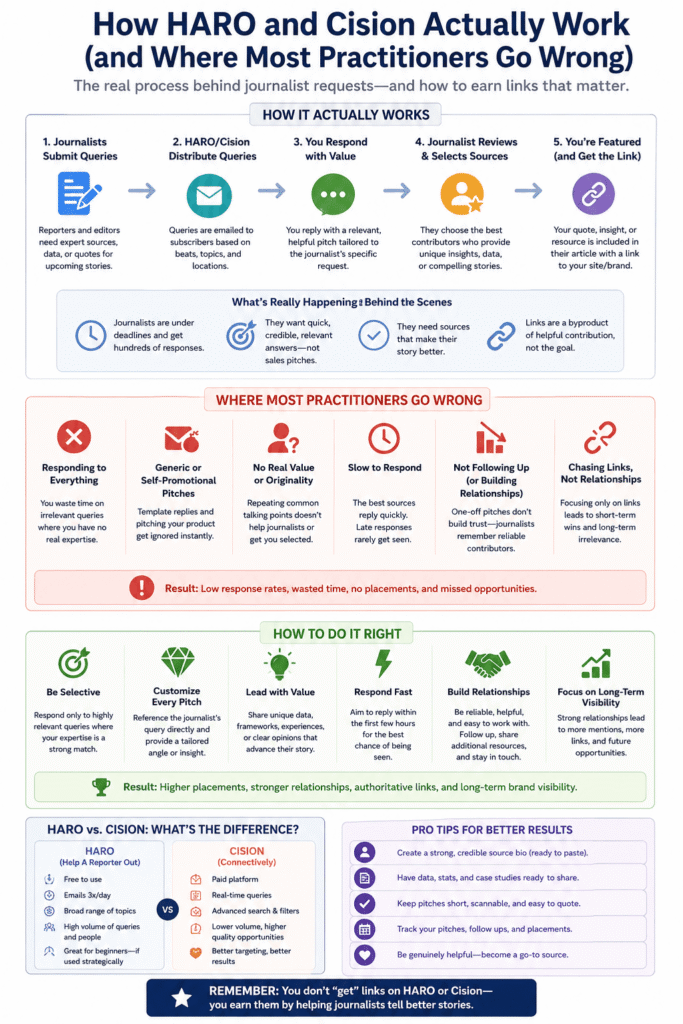
Table of Contents
ToggleHow HARO and Cision Actually Work (and Where Most Practitioners Go Wrong)
HARO — now rebranded as Connectively — is a query distribution platform where journalists post source requests and practitioners respond with expert commentary or data. Cision is the paid professional equivalent, with more granular category filtering and direct journalist contact access alongside query monitoring.
Neither platform does the qualification work for you. That’s where most practitioners misread the process.
HARO sends three email digests daily — morning, afternoon, and evening — each containing dozens of queries across broad categories like Business, Technology, Finance, and Health. The reflex response is to monitor every query in your category and pitch anything that might fit. That produces generic pitches in competitive query pools. A finance query on HARO typically receives 50–100 source responses; a journalist working to a deadline reads the first 10–15, selects 2–3, and stops. An adjacent-expertise pitch arriving in position 40 doesn’t get read.
Cision’s query alerts work differently — practitioners set up keyword-filtered alerts and receive notifications for matching queries rather than full category digests. The filtering is more precise, but the same selectivity principle applies: a well-targeted response to one query beats 20 poorly targeted responses to the full alert stream.
Pro Tip: In Cision, set up no more than 5 keyword alerts for your core topic area — not broad category subscriptions. Each alert should match a term the client has direct first-hand data on, not a general sector term. A fintech client’s alerts might be: “FCA regulation”, “open banking”, “digital payments data”, “embedded finance”, “fintech funding”. When a query matches one of those terms, the expertise is likely genuine — not adjacent.
Step 1 — Query Filtering: The Selectivity-First Method
Query filtering is the step that determines whether the campaign converts at 1% or 20%. Most practitioners skip it entirely and go straight to writing pitches.
The selectivity-first method applies three filters to every incoming query before a single word of pitch is written:
Filter 1 — First-hand expertise test
Does the named expert have direct, first-hand experience with the specific topic the journalist is asking about? Not adjacent experience. Not sector experience. Direct experience: they’ve run the campaign, analysed the data, made the decision, or observed the outcome being asked about.
If the answer is no — skip the query. An adjacent-expertise pitch reads as generic to a journalist who has received 30 responses from practitioners with direct expertise. Competing on adjacency is how pitches land in the ignored pile.
Filter 2 — Non-replicable data or outcome test
Can the pitch open with a data point, named outcome, or specific observation the journalist cannot get from any other respondent? If the expert’s position on the query topic is the same as every other practitioner in the sector — skip it. Generic positions produce generic pitches.
A fintech expert who can open with “In our analysis of 500 FCA-regulated firms, 67% had not updated their digital asset policies ahead of the Q3 2025 deadline” has a non-replicable data point. An expert who opens with “FCA regulation is becoming increasingly stringent” does not.
Filter 3 — Publication tier match
Does the publication or journalist posting the query publish at a domain authority level that justifies the outreach investment? A query from a DA 20 niche blog and a query from a DA 75 national financial publication both arrive in the same HARO digest. Filter for your target DA range before investing time in pitch construction.
Apply all three filters before writing. A query that passes all three is worth a full pitch. A query that fails any one of them isn’t worth 10 minutes.
Step 2 — Expert Matching: Who Signs the Pitch
Most HARO guides treat expert matching as an afterthought. It’s not — it’s the second conversion variable after query selection.
Journalists cite named practitioners, not brands. A pitch signed by “The Marketing Team at [Company]” doesn’t produce a named source citation. A pitch signed by “James Whitfield, Head of Regulatory Compliance at [Company], with 12 years in FCA-regulated financial services” produces one.
The expert must match the query’s implied authority level. A query asking for commentary from “senior financial professionals” requires a named C-suite, director, or sector-specialist with verifiable credentials — not a junior analyst or a brand voice. Mismatched authority levels are the second most common reason HARO pitches fail after generic positioning.
Before writing the pitch, confirm three things about the named expert:
- Their title and years of experience are verifiable on LinkedIn or a published bio
- Their stated expertise matches the query’s specific topic — not just the broad sector
- They’re willing to be quoted on record (not attributed to “a company spokesperson”)
A journalist who uses a HARO source publishes their name. That name gets fact-checked. An expert who can’t be verified at the claimed authority level damages the pitch’s credibility — and the relationship with the journalist for future outreach.
Step 3 — Pitch Construction: The 4-Part Structure
A converting HARO pitch runs 150–200 words. Longer pitches aren’t read in full by journalists working to deadline (Source: Cision, 2024). The 4-part structure keeps every pitch within that range while covering the information a journalist needs to select a source.
Part 1 — Data-led opening (1 sentence)
The pitch opens with the non-replicable data point or named outcome identified in the query filtering step. No introduction. No brand context. The data first.
Example: “In our analysis of 500 FCA-regulated firms, 67% had not updated their digital asset policies ahead of the Q3 2025 deadline — a gap we documented across clients in embedded finance and payments.
Part 2 — Expertise signal (2–3 sentences)
Name the expert, their title, their specific experience relevant to this query, and one verifiable credential — a published report, a named client outcome, a regulatory submission, or a named sector role.
Part 3 — Offer statement (1–2 sentences)
State what the journalist is being offered: a quote for the piece, access to the full dataset, an expert interview, or a visual asset. Be specific. “Happy to provide further context” is not an offer — it’s a non-commitment.
Part 4 — Single direct ask (1 sentence)
One ask. Not “let me know if you’re interested.” Something named: “Happy to send the full dataset and a 200-word commentary block if useful for your piece.”
Total pitch: 150–200 words. Subject line: [Expert Name] — [The specific data point or claim] — [Journalist’s publication].
Step 4 — Submission Timing and Follow-Up Cadence
Submission speed matters — but not for the reason most HARO guides give. The advantage of a fast response isn’t that it arrives first. It’s that journalists set cut-off times, and late responses don’t get read regardless of quality.
HARO queries typically have a 24–72 hour response window. Submit within 4 hours of receiving the query alert where possible. That places the pitch in the first wave of responses — before the journalist’s inbox is full and before they’ve formed a working shortlist.
The follow-up window is 48 hours after submission. One follow-up. Not a chase email — a value-add: “Following up on my pitch from [date] — I’ve also pulled [additional data point] that might be relevant if you’re still sourcing for this piece.”
After 48 hours, the journalist has moved on. A second or third follow-up after that window damages the relationship for future queries from the same publication. Log the journalist in your outreach tracker and move to the next pitch.
Step 5 — Converting Coverage Into Followed Editorial Links
Being cited in a journalist’s article and earning a followed editorial link are not the same outcome. Coverage without a followed link builds brand signal only — no domain authority transfers.
Most practitioners treat link conversion as passive. It isn’t. The link has to be requested — directly and within a specific window.
The post-coverage sequence:
- Confirm the article is live — search the publication, find the piece, check for a link
- If no link is present — email the journalist within 48 hours: “Saw the piece — thank you for including [expert name]. If it’s possible to add a link to [specific page URL], that would be much appreciated.”
- If a nofollow link is present — same approach: “Would it be possible to update the link to a followed link?” Journalists rarely distinguish between follow and nofollow — a direct, polite request converts a meaningful share of nofollow placements in practice (Source: Ahrefs, 2024)
- Log the outcome — followed link, nofollow, or no link. The log identifies which journalists and publications convert, informing future query prioritisation
The page linked should be the most topically aligned page on the site to the article’s subject — not the homepage. Topically aligned destination URLs carry stronger entity authority signal than homepage links from the same source (Source: Google Search Central, 2022).
For how those followed editorial links interact with entity authority and Knowledge Graph signals, see Entity Authority Backlinks: How to Build Links That Strengthen Knowledge Graph Presence.
Building a Repeatable HARO Outreach System
A single HARO pitch is a tactic. A repeatable HARO outreach system is a link acquisition channel. The difference is process documentation.
A functional HARO system has four components:
| Component | What It Contains | Review Frequency |
|---|---|---|
| Query filter log | All queries received, filter scores, pass/fail decision | Daily during active campaign |
| Expert roster | Named experts, verified credentials, topic areas, availability status | Monthly |
| Pitch library | Approved pitch openings by topic area, data points by expert | Per campaign quarter |
| Outreach tracker | Journalist name, publication, DA, submission date, response, link status | Weekly |
The query filter log is the component most practitioners skip — and the one that produces the most insight. After 8–12 weeks of logging, patterns emerge: which query types consistently produce conversions, which journalists from which publications respond to which expert types, and which topic areas the expert roster covers with genuine competitive advantage.
That data shapes the next quarter’s query selection criteria — making the system progressively more targeted rather than relying on instinct each time a digest arrives.
Frequently Asked Questions
What is HARO and how does it work for link building? HARO — Help A Reporter Out, now rebranded as Connectively — is a platform where journalists post source requests and practitioners respond with expert commentary or data. When a journalist selects a response and cites the source in their article, the published piece typically includes a link to the source’s website. That link is an editorial backlink — placed at the journalist’s discretion — which carries stronger naturalness signals than exchanged or purchased links.
How many HARO pitches should I send per week? Fewer than most guides recommend. A selectivity-first approach targets 3–5 pitches per week maximum — only queries where the named expert has definitive first-hand expertise and a non-replicable data point. The UK fintech campaign produced 6 editorial links in month two from 9 pitches — a 67% conversion rate on qualified queries. The same campaign produced zero conversions from 47 pitches in month one using broad volume outreach.
What makes a HARO pitch convert? Four elements: a data-led opening with a non-replicable specific, a named expert with verifiable credentials matched to the query’s implied authority level, a specific offer statement, and a single direct ask — all within 150–200 words. Generic positioning, anonymous brand voices, and pitches longer than 250 words fail at the journalist selection stage regardless of how relevant the sector expertise is.
Is HARO still worth using in 2026? Yes — though HARO’s rebranding to Connectively reduced the free-tier query volume. The platform still distributes journalist queries across business, finance, technology, and health categories. Cision’s query alert system supplements it for paid-tier practitioners. The fundamentals of the outreach process — selectivity-first query filtering, expert matching, 4-part pitch structure — apply to both platforms identically.
How do I track whether my HARO pitches are producing followed links? Monitor referring domains weekly in Ahrefs or Google Search Console from the first month of active pitching. Set a minimum threshold: if no new followed editorial links appear in a 4-week window, the query selection or pitch construction step needs review — not the submission volume. Log every pitch outcome in the outreach tracker: journalist name, publication, DA, submission date, response, and link status.
What to Do Next
Selectivity-first HARO outreach is a system, not a one-off tactic. The first month builds the infrastructure — query filter log, expert roster, pitch library, outreach tracker. Month two is where the data starts informing decisions. Month three is where conversion rates stabilise.
The full link acquisition strategy — including how HARO-sourced editorial links interact with entity authority and AI citation signals — is covered in the Link Building in 2026: Digital PR, Entity Authority & AI Citation Strategies pillar. This cluster covers the execution layer. For how the editorial links earned through HARO outreach strengthen Knowledge Graph entity associations, see Entity Authority Backlinks: How to Build Links That Strengthen Knowledge Graph Presence.
Open your HARO digest now — or set up your first Cision keyword alert today using no more than 5 terms where the named expert has direct first-hand data. Apply all three query filters before writing a single pitch. If no query in today’s digest passes all three filters, skip the digest and wait for tomorrow’s.
References
Ahrefs. How to Use HARO (And Alternatives) to Get Killer Mentions and Backlinks.” Ahrefs Blog, 2024. https://ahrefs.com/blog/haro-link-building/ Supports: Conversion rate benchmarks for targeted vs broad HARO outreach; nofollow-to-followed link conversion in practice.
Cision. “2024 State of the Media Report.” Cision, 2024. https://www.cision.com/resources/guides-and-reports/2024-state-of-the-media-report/ Supports: Journalist pitch length preferences; inbox volume and deadline context for source selection.
Google Search Central. December 2022 Link Spam Update.” Google Search Central Blog, 2022. https://developers.google.com/search/blog/2022/12/december-22-link-spam-update Supports: Editorial link naturalness signals; topically aligned destination URL entity authority benefit.
Ahrefs. Link Building for SEO.” Ahrefs, 2024. https://ahrefs.com/seo/link-building Supports: Editorial link quality and domain authority as relative filters in journalist targeting and publication tier selection.
Search Engine Journal. How An Enterprise Digital PR Firm Earns 100s Of Links In 30 Days.” Search Engine Journal, 2024. https://www.searchenginejournal.com/enterprise-100s-links-recap/510498/ Supports: Scalable digital PR outreach process and journalist targeting methodology for editorial link acquisition at volume.