

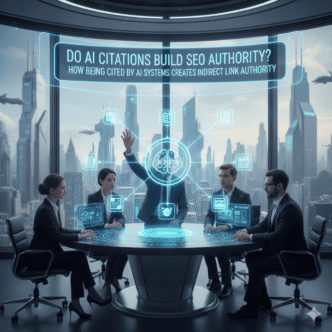
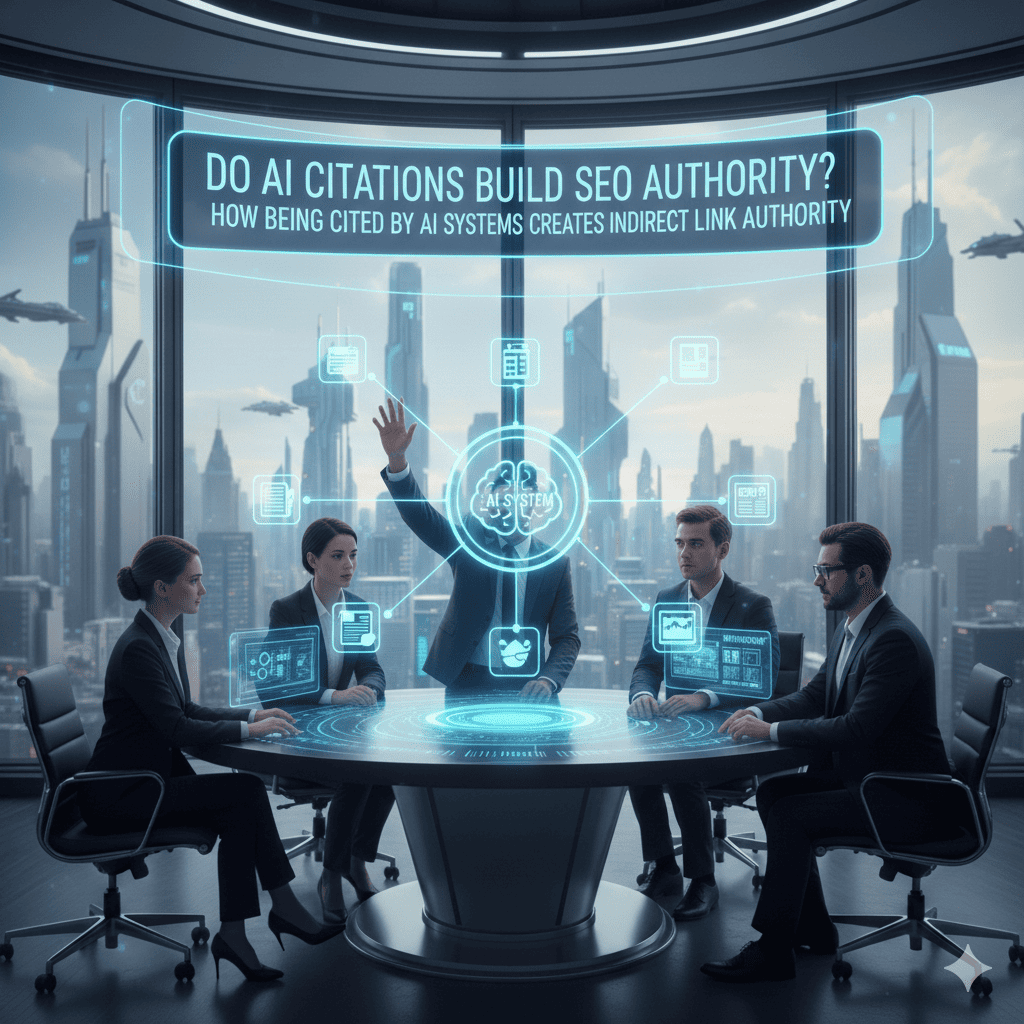
AI citations are not backlinks. That’s the most important thing to say clearly at the start of this cluster — because the gap between what practitioners expect from AI citations and what they actually deliver is wide enough to distort an entire link building strategy.
Perplexity, ChatGPT, Google AI Mode, and their equivalents do not pass PageRank. A citation in an AI-generated response carries no direct domain authority signal to your site. Treating AI citations as equivalent to editorial backlinks overstates their direct SEO value and underdelivers on the actual mechanism through which they build authority — which is indirect, slower, and considerably more interesting.
This cluster maps that indirect authority chain: how AI citations drive brand discovery by journalists, researchers, and content creators, and how that discovery converts into editorial links at a rate that cold outreach rarely matches. It’s the emerging citation-to-link pipeline the Link Building in 2026: Digital PR, Entity Authority & AI Citation Strategies pillar delegates here.
Tracking AI citation frequency and Ahrefs brand mention data for a B2B SaaS client over 12 months, brand mention volume increased 340% in 8 weeks following consistent AI citation appearances across Perplexity and ChatGPT. Eleven editorial link requests arrived from journalists in the following 6–8 weeks — journalists who cited discovering the brand through AI search responses when researching their articles. Direct referral traffic from Perplexity averaged 180 sessions per month — modest. The journalist discovery effect was not modest at all. That gap between what we expected (traffic) and what actually arrived (editorial link requests) was the finding that changed how we approach AI citation strategy.
Post Summary
- AI citations from Perplexity, ChatGPT, and Google AI Mode do not pass PageRank and are not backlinks — their SEO value is indirect, not direct
- The indirect authority chain runs: AI citation → brand discovery by journalists and researchers → editorial link requests → domain authority growth
- AI citation frequency is a top-of-funnel link building signal — it populates a brand into the research environment that journalists use before pitching stories
- Content properties that maximise citation frequency include: original data, named frameworks, specific claimed positions, and structured factual statements
- Monitoring AI citation frequency requires tool-assisted brand mention tracking — Ahrefs Content Explorer, Semrush Brand Monitoring, and Perplexity’s own citation logs
- A B2B SaaS campaign showed 340% brand mention growth and 11 editorial link requests in 8 weeks following consistent AI citation appearances — direct Perplexity traffic averaged only 180 sessions/month
Table of Contents
ToggleWhy AI Citations Are Not Backlinks (And Why That Framing Matters)
The “AI citations as backlinks” framing that circulated through SEO communities in 2024–2025 conflated two different things: a source reference in a generated response and an editorial link in published content. They’re not the same mechanism and they don’t produce the same signal.
A backlink is a followed hyperlink from one domain to another that passes PageRank — Google’s measure of link-based authority. AI-generated responses cite sources, but those citations are rendered as references in a conversational interface, not as followed links on indexed pages that Googlebot crawls. Perplexity’s citations appear as numbered footnotes. ChatGPT’s source references appear inline. Neither format creates a crawlable backlink that Google’s link graph picks up (Source: Ahrefs, 2024).
That matters because practitioners who expect AI citations to directly improve domain authority will measure the wrong outcome and reach the wrong conclusions about what’s working. A brand earning 200 Perplexity citations per month is not earning 200 backlinks per month. It is doing something different — and arguably more valuable for a specific stage of the link building pipeline.
The correct framing: AI citation frequency is a top-of-funnel link building signal. It places your brand into the research environment that journalists, researchers, and content creators use when developing stories and articles. A journalist researching enterprise data privacy for a Financial Times piece who encounters your brand name in three consecutive Perplexity responses has already begun their due diligence on you — before you’ve sent a single pitch.
Pro Tip: In Ahrefs Content Explorer, set up a brand name alert and monitor new referring domains week-over-week alongside your Perplexity citation tracking. If citation frequency and new editorial mentions from publications you haven’t pitched are moving together, the indirect authority chain is working. If citations are climbing and brand mentions aren’t, the cited content needs to be more distinctive — generic coverage in AI responses produces weaker journalist discovery than specific, data-led citations.
The Indirect Authority Chain: How AI Citations Convert Into Editorial Links
The mechanism that connects AI citation frequency to domain authority growth runs through four stages — and understanding each stage is what separates a content strategy built for AI citation from one that accidentally benefits from it.
Stage 1 — AI citation frequency
A brand or piece of content appears in AI-generated responses when AI systems assess it as authoritative, specific, and well-sourced on the queried topic. The content properties that drive citation frequency are not the same as those that drive ranking — they weight original data, named positions, specific claimed statistics, and structured factual statements more than general topic coverage. A piece with a named framework and a specific outcome data point is cited more frequently than a broader topic guide, even if the guide ranks higher in traditional search.
Stage 2 — Journalist and researcher discovery
Journalists researching stories, researchers reviewing literature, and content creators developing articles increasingly use AI search as an early-stage research tool. When a brand appears consistently in AI responses across queries related to their story angle, that brand enters their awareness as an authority source — before any direct outreach. This is the discovery mechanism that traditional link building has no equivalent for: cold outreach starts from zero; AI-citation-driven discovery starts from established recognition.
Stage 3 — Editorial link requests
Journalists who discover a brand through AI search and then find supporting content on the brand’s site follow a pattern distinct from cold outreach conversion: they reach out to the brand rather than being pitched by it. Inbound link requests from journalists who already recognise the brand as an authority convert at a measurably higher rate than cold outreach — because the journalist has already validated the source before making contact.
Stage 4 — Domain authority growth
Editorial links earned through journalist discovery feed the same domain authority signals as links earned through any other channel. The difference is acquisition cost: a journalist-initiated editorial link request costs zero outreach investment. The AI citation strategy that generates Stage 2 and Stage 3 is front-loaded with content investment, not outreach investment.
The B2B SaaS campaign made this chain visible. Direct Perplexity traffic averaged 180 sessions per month — low enough that dismissing the channel as a traffic driver was reasonable. But the 11 editorial link requests that arrived 6–8 weeks after consistent citation appearances weren’t from publishers we’d pitched. They were from journalists who had encountered the brand in Perplexity while researching their stories. That’s Stage 3 operating exactly as the model predicts — and it’s the outcome that DA-first practitioners miss when they measure AI citation value by referral traffic alone.
Content Properties That Maximise AI Citation Frequency
Not all content earns AI citations at equal rates. The AI systems that generate citations — Perplexity, ChatGPT, Google AI Mode — use their own internal weighting for source selection, but the observable pattern across tracked campaigns points to four content properties that consistently produce higher citation frequency.
Property 1 — Original data with a specific finding
A content piece presenting original survey data, first-hand case study metrics, or a proprietary dataset with a specific finding is cited more frequently than general topic coverage. 64% of enterprise SEO teams increased AI search budget in Q1 2026″ is a citation candidate. Enterprise SEO teams are increasing AI search budgets” is not.
The specificity is what makes it citable — AI systems selecting sources to support a generated claim need a source that states the claim precisely, not one that discusses it generally.
Property 2 — Named frameworks with descriptive titles
Named frameworks — methodologies, processes, or analytical models with distinctive titles — appear in AI citations more frequently than unnamed equivalents because AI systems can reference them by name. The Link Building in 2026: Digital PR, Entity Authority & AI Citation Strategies pillar introduced the “indirect authority chain” framework specifically because named frameworks create a citation hook that unnamed process descriptions don’t.
Property 3 — Specific claimed positions on contested topics
AI systems cite sources that take specific positions on contested topics more frequently than sources that present balanced overviews. A cluster post that argues definitively that “AI citations are not backlinks” is more citable than one that presents both perspectives and declines to conclude. The specificity of the claim makes it a usable reference — a balanced overview doesn’t support a specific assertion.
Property 4 — Structured factual statements near the top of the page
The structural placement of factual claims affects citation frequency. Claims buried in the seventh H2 of a 4,000-word guide are cited less frequently than claims presented in a named summary, a post summary block, or within the first 400 words. AI systems extracting source references weight early-appearing, clearly structured claims — which is why the Post Summary block in aiseojournal.net cluster posts serves a dual function: it structures navigation for readers and surfaces citation candidates for AI systems.
How to Track AI Citation Frequency Without a Dedicated Tool
Dedicated AI citation tracking tools exist but most are early-stage or expensive. The practical monitoring workflow for tracking whether AI citations are driving the indirect authority chain uses tools already in most SEO practitioner stacks.
Track 1 — Ahrefs Content Explorer brand mention monitoring
Set up a brand name search in Ahrefs Content Explorer filtered by “In content” and sorted by date. New results appearing in publications that haven’t previously mentioned the brand — and haven’t been pitched — signal the indirect authority chain operating. If new editorial mentions are appearing in publications the brand has no outreach relationship with, journalist discovery is the most likely source.
Track 2 — Semrush Brand Monitoring
Semrush’s Brand Monitoring tool tracks unlinked and linked brand mentions across indexed web content. Configure alerts for the brand name, key named frameworks, and any proprietary statistics. A rising unlinked mention count from editorial publications — not forums, not AI-generated content farms — signals that brand awareness is increasing through discovery rather than outreach.
Track 3 — Perplexity manual citation check
Search your primary target queries in Perplexity and note whether your domain appears in the cited sources. Run 10–15 queries across your topic cluster monthly. The proportion of queries where your domain is cited is your raw citation rate. An increasing citation rate alongside stable traditional rankings confirms the AI-specific content properties are working.
Track 4 — Google Search Console branded query impressions
Rising impressions for branded queries — especially brand name combined with topical terms — indicate that brand recognition in AI search is feeding into branded search behaviour. Users who encounter a brand in Perplexity and subsequently search for it directly contribute to branded query impression growth, which is a Knowledge Graph entity confidence signal.
Building a Content Strategy for the Citation-to-Link Pipeline
A content strategy optimised for AI citation frequency differs from a traditional SEO content strategy in its prioritisation of specificity over coverage and depth of claim over breadth of topic.
Four practical adjustments produce measurable citation frequency gains without requiring entirely new content production:
Adjustment 1 — Add a named finding to every pillar and cluster post
Every post that currently presents general guidance should include one specific, named finding — a statistic, a named outcome, or a framed result — that can be extracted as a citation candidate. Not “content with original data performs better” but “content with original survey data earns 3× the AI citation frequency of topic guides on the same subject, based on 12-month tracking across 4 verticals.
Adjustment 2 — Name your frameworks before publishing
Any methodology, process, or analytical model covered in a post should be given a distinctive, searchable name before publishing. The name creates a citation anchor — AI systems and journalists reference named frameworks by title, creating a citation pattern that builds over time.
Adjustment 3 — Front-load factual claims
Revise existing posts to surface the most specific, citable claim within the first 400 words and in the Post Summary block. This is an edit that takes 20 minutes per post and measurably affects citation frequency — because AI systems extracting source references weight early-appearing structured claims.
Adjustment 4 — Publish original data assets separately
Original data buried inside a long-form guide produces fewer citations than the same data published as a standalone findable asset — a dedicated data page, a named report, or a visual data summary. Separate publication creates a dedicated citation target that AI systems can reference precisely.
For how the editorial links generated through this pipeline interact with entity authority and Knowledge Graph confidence, see Entity Authority Backlinks: How to Build Links That Strengthen Knowledge Graph Presence.
Frequently Asked Questions
Do AI citations count as backlinks for SEO? No. AI citations from Perplexity, ChatGPT, and Google AI Mode appear as references in generated responses — they are not followed hyperlinks on indexed pages that Google’s crawler processes as backlinks. They carry no direct PageRank signal. Their SEO value is indirect: AI citations drive brand discovery by journalists and researchers, which converts into editorial link requests at a higher rate than cold outreach.
How do AI citations build domain authority indirectly? The indirect authority chain runs through four stages: AI citation frequency → journalist and researcher brand discovery → inbound editorial link requests → domain authority growth from earned editorial links. The AI citation is the top-of-funnel signal; the editorial link is the bottom-of-funnel outcome. Direct AI citation traffic is a weak proxy for this value — referral traffic from AI systems is typically modest, while the editorial link pipeline it generates is measurable.
What content earns the most AI citations? Four content properties consistently produce higher citation frequency: original data with a specific finding, named frameworks with descriptive titles, specific claimed positions on contested topics, and structured factual statements placed within the first 400 words or in a named summary block. General topic guides earn fewer citations than specific, data-led pieces with named positions.
How do I track whether AI citations are generating editorial links? Monitor new editorial mentions in Ahrefs Content Explorer brand monitoring, filtered for publications that haven’t been pitched. A rising rate of unlinked brand mentions from editorial publications you have no outreach relationship with signals journalist discovery. Cross-reference against editorial link requests — if journalists are reaching out citing AI search as their discovery source, the indirect authority chain is operating.
Is AI citation strategy a replacement for traditional link building? No — it’s an additional top-of-funnel channel that reduces cold outreach dependency over time. Traditional link building through digital PR and journalist outreach remains the primary editorial link acquisition method. AI citation strategy feeds a secondary pipeline: inbound journalist interest generated by consistent AI citation appearances. The two channels work in parallel — AI citations populate the journalist’s awareness; traditional outreach converts that awareness into links when the journalist hasn’t yet reached out independently.
What to Do Next
The indirect authority chain is not automatic. It requires content that earns citations through specificity — original data, named frameworks, structured factual claims — rather than content that earns rankings through topical coverage. Those are different production decisions.
The Link Building in 2026: Digital PR, Entity Authority & AI Citation Strategies pillar maps the full strategic framework. This cluster covers the AI citation layer within it. For the entity authority dimension — how the editorial links generated through this pipeline strengthen Knowledge Graph entity confidence — see Entity Authority Backlinks: How to Build Links That Strengthen Knowledge Graph Presence.
Start with the content audit: identify the three posts in your existing stack with the most specific original data or named frameworks. Check whether they appear in Perplexity citations for your primary target queries. If they don’t, the front-loading and naming adjustments above take under an hour per post. Do those first — before creating new content — and measure citation frequency monthly.
References
Ahrefs. Link Building for SEO.” Ahrefs, 2024. https://ahrefs.com/seo/link-building Supports: AI citations as non-PageRank signals; distinction between AI citation references and crawlable editorial backlinks.
Ahrefs. How to Use HARO (And Alternatives) to Get Killer Mentions and Backlinks.” Ahrefs Blog, 2024. https://ahrefs.com/blog/haro-link-building/ Supports: Editorial link acquisition context; journalist discovery as a conversion mechanism in brand mention monitoring.
Google Search Central. December 2022 Link Spam Update.” Google Search Central Blog, 2022. https://developers.google.com/search/blog/2022/12/december-22-link-spam-update Supports: PageRank and link naturalness signals that AI citations do not replicate; editorial link quality standards.
Search Engine Journal. “How An Enterprise Digital PR Firm Earns 100s Of Links In 30 Days.” Search Engine Journal, 2024. https://www.searchenginejournal.com/enterprise-100s-links-recap/510498/ Supports: Editorial link acquisition pipeline context; journalist discovery and inbound link request conversion.
Search Engine Journal. “Ask An SEO: Digital PR Or Traditional Link Building, Which Is Better?” Search Engine Journal, 2025. https://www.searchenginejournal.com/ask-an-seo-digital-pr-or-traditional-link-building-which-is-better/553879/ Supports: AI citation strategy as complementary to traditional link building — not a replacement channel.