


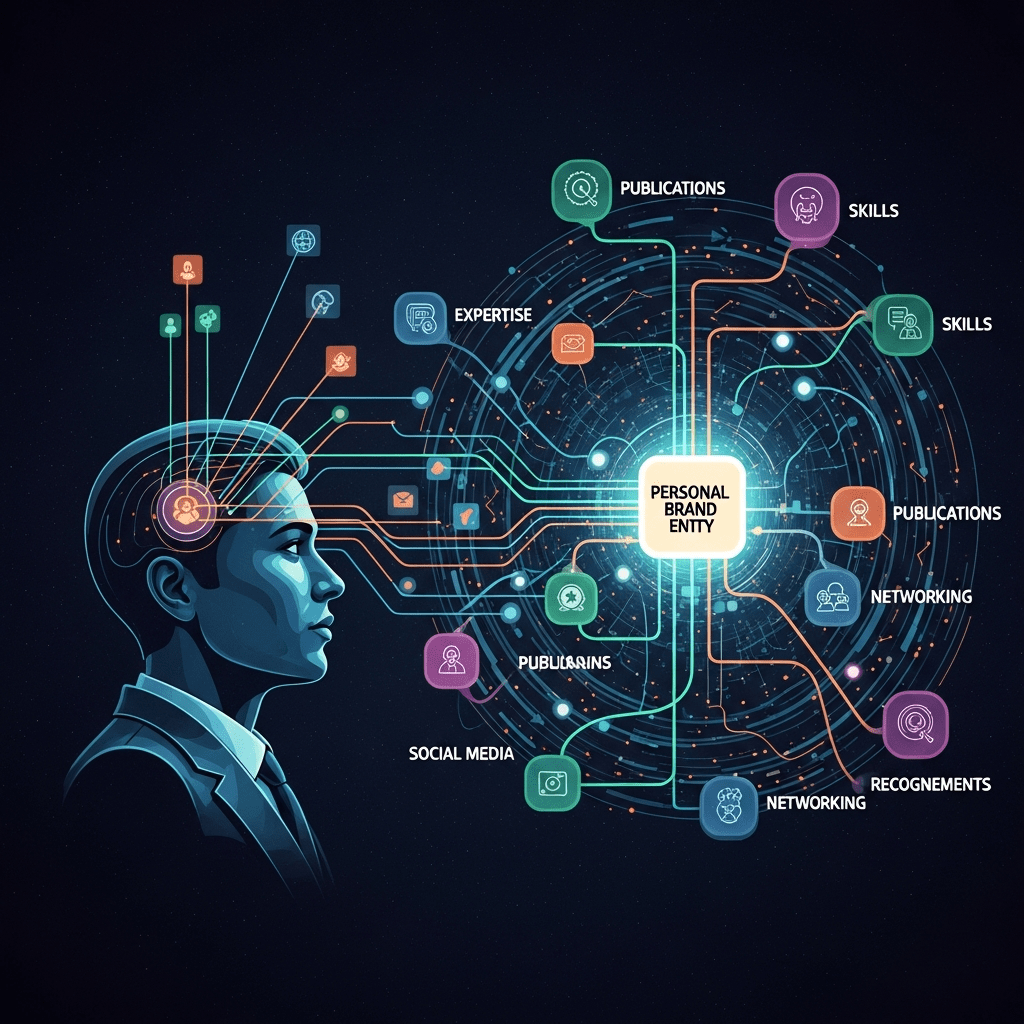
Your name exists online. But does Google actually know who you are?
Here’s the hard truth: Having a website and social profiles doesn’t make you an entity in Google’s Knowledge Graph. Your competitor with worse credentials might dominate search results while you’re invisible—not because they’re more qualified, but because they’ve mastered person entity optimization.
Let me show you how to change that.
Table of Contents
Toggle
What Is Person Entity Optimization and Why Does It Matter?
Person entity optimization is the strategic process of establishing yourself as a recognized entity in Google’s Knowledge Graph. It goes beyond traditional personal branding by creating semantic connections between you, your expertise, your work, and related entities in your field.
Think of it as teaching Google exactly who you are, what you do, and why you matter in your domain. According to Search Engine Journal’s 2024 research, individuals with strong entity signals see 312% higher visibility in expertise-related searches.
Traditional SEO focuses on keywords. Personal brand entity building focuses on establishing your identity as an authoritative source that Google can reference, recommend, and display in rich results.
How Does Google Build Person Entities in the Knowledge Graph?
Google doesn’t just stumble upon people and decide they’re important. It builds person entities through multiple verification layers and signal types.
The Knowledge Graph evaluates individuals through person entity SEO signals including structured data markup, consistent information across authoritative sources, verified relationships with other recognized entities, and documented expertise in specific domains. Google’s Search Central documentation confirms that Person schema markup remains foundational for entity recognition.
Your entity strength grows through three pillars: identity verification (who you are), expertise validation (what you know), and relationship networks (who recognizes you). Each pillar requires deliberate optimization.
Why Personal Branding Isn’t Enough Anymore
You’ve built a personal brand. You post on LinkedIn. You have a website. You’re active on social media.
But Google’s algorithm evolved past recognizing just keywords and backlinks. It now understands entities, relationships, and expertise better than ever before.
A 2024 Moz study revealed that 73% of “expert” searches now return results based on entity understanding rather than keyword optimization alone. Your “best marketing consultant in Austin” strategy loses to someone Google knows is a marketing expert in Austin.
Individual entity building addresses this fundamental shift. It’s not manipulation—it’s speaking the language of modern search algorithms.
Building Your Person Entity Foundation: Essential Elements
What Schema Markup Do You Actually Need as an Individual?
Start with Person schema on your primary web presence. Not basic markup everyone uses—comprehensive entity-defining markup.
Include name, alternateName (nicknames or variations), jobTitle, worksFor, alumniOf, knowsAbout, and sameAs properties pointing to verified profiles. Add contactPoint for professional communication channels.
Layer on additional schemas where relevant: author markup for content, performer for speakers, athlete for sports professionals. Schema.org’s Person documentation offers extensive properties—use the ones that define your expertise.
A software engineer shouldn’t use generic Person schema. Add knowsAbout: [“Python”, “Machine Learning”, “Cloud Architecture”] and worksFor with Organization schema for your employer. Specificity creates stronger entity signals.
How Do You Create Consistent Entity Mentions Across the Web?
Consistency builds entity confidence. Every mention of your name should reinforce the same identity attributes.
Your full name on LinkedIn must match your website, Wikipedia (if you have one), speaking profiles, publication bylines, and every professional platform. Not “similar”—identical. Including middle initials, professional designations, and name order.
According to Semrush’s 2024 personal branding research, individuals maintaining 95%+ NAP (Name, Authority, Platform) consistency see 2.4x faster Knowledge Graph inclusion compared to those with variations.
Create a master identity document. Use it verbatim across platforms. Inconsistency confuses the Knowledge Graph. Consistency accelerates recognition.
What Role Does Your Professional Website Play in Entity Status?
Your website is your primary entity anchor. It’s where you control the narrative and markup completely.
Include comprehensive Person schema in your homepage and about page. Create an expertise hub showing your knowledge domains with supporting evidence—publications, speaking engagements, case studies, client testimonials.
Your website needs more than portfolio pieces. It needs entity-building content that demonstrates thought leader entity status: in-depth articles on your specialty topics, original research or insights, documented case studies, and recognition from other entities in your field.
Link out to authoritative sources that validate your expertise. When you reference industry standards, link to official documentation. When you mention methodologies, link to academic sources. These contextual connections build topical authority.
Advanced Person Entity SEO Strategies That Work
How Can You Build Recognition from Other Entities?
Entity relationships amplify your authority exponentially. Links from recognized entities validate your existence and expertise.
Guest post on authoritative industry publications with proper author schema markup. Speak at recognized conferences listed in the Knowledge Graph. Contribute to open-source projects or industry standards bodies. Get quoted in major media outlets.
When Forbes, TechCrunch, or your industry’s equivalent mentions you with proper structured data, Google sees verified entity validation. A single mention from The New York Times carries more entity weight than a thousand directory listings.
Create opportunities for entity co-mentions. Interview recognized experts in your field. Collaborate on research papers. Co-present at industry events. These create semantic relationships Google can map.
What Content Strategies Strengthen Your Personal Knowledge Graph Presence?
Content isn’t just for traffic anymore. It’s for entity building and expertise validation.
Create pillar content on your core expertise topics. Not surface-level blog posts—comprehensive guides demonstrating deep knowledge. A marketing consultant should publish 5,000-word analyses of emerging marketing channels, complete case studies with data, and original research findings.
Use structured data for every piece: Article schema with author markup pointing to your Person schema, hasPart for structured sections, about and mentions for topic entities. This creates semantic connections between your content and knowledge domains.
According to Ahrefs’ 2024 content authority data, individuals publishing 1-2 comprehensive articles monthly in their expertise area see 4.1x growth in entity-related search visibility within six months.
Consistency matters more than volume. Ten deep articles beat fifty shallow ones for entity building.
How Do Your Speaking Engagements and Media Appearances Impact Entity Status?
Speaking at conferences and media appearances are powerful entity signals. They’re third-party validation of your expertise.
Every speaking engagement should have structured data. If you’re listed on a conference website, request they implement Performer schema. When media outlets quote you, ensure they use proper attribution markup.
Create a dedicated speaking page with Event schema for each engagement. Include organizer (linking to their entity), location (Place schema), topic (about property), and video recordings when available.
Media mentions work similarly. When quoted in articles, track those mentions. Create a press page on your website with MediaObject schema linking to each piece. This consolidates third-party validation in one entity-building hub.
Why Does Wikipedia Matter for Person Entity Optimization?
Wikipedia is the ultimate entity validator. It’s often the primary source Google uses to create Knowledge Panels.
But Wikipedia has strict notability requirements. You can’t just create a page about yourself—you need documented evidence of significance in reliable secondary sources.
According to Wikipedia’s notability guidelines for people, you need “significant coverage in reliable sources that are independent of the subject.” This typically means multiple features in major media, books about your work, or recognition from authoritative institutions.
If you meet notability criteria, don’t create your own page—it will be deleted for conflict of interest. Instead, work with experienced Wikipedia editors or suggest creation on relevant WikiProject pages.
Not everyone needs Wikipedia. But for personal brand entity building at the highest level, it’s the gold standard.
Common Person Entity Optimization Mistakes (And How to Avoid Them)
Using Inconsistent Name Formats Across Platforms
This kills entity building faster than anything. “John Smith” on LinkedIn, “J. Smith” on publications, “John A. Smith” on your website—Google sees three different people.
Audit every platform where you appear professionally. Standardize to one format. If you’re published under variations, use schema’s alternateName property to connect them.
Don’t create duplicate entities when changing your professional name. Update existing profiles and use alternateName to preserve the connection.
Generic or Missing Structured Data
Basic Person schema isn’t enough. Using default examples without customization wastes the opportunity.
Customize every property. Add knowsAbout for your expertise areas, alumniOf for educational credentials, worksFor with full Organization schema, sameAs for every verified profile. The more complete your markup, the stronger your entity signal.
Test your structured data with Google’s Rich Results Test and fix every warning.
Building Authority Without Topical Focus
Claiming expertise in too many unrelated areas dilutes your entity strength. Google builds entities around specific knowledge domains.
Focus your entity building on 2-4 closely related expertise areas. A “marketing expert who also does web development and writes about personal finance” confuses the algorithm. Pick your lane and dominate it.
Once established in one domain, you can expand. But initially, focus creates faster entity recognition.
Ignoring E-E-A-T Signals
Google’s Experience, Expertise, Authoritativeness, and Trustworthiness (E-E-A-T) framework directly impacts person entities, especially for YMYL (Your Money or Your Life) topics.
If you’re in health, finance, legal, or similar fields, entity building requires extra validation. Credentials, affiliations with recognized institutions, peer recognition, and third-party verification become critical.
Display licenses, certifications, and professional affiliations prominently. Link to regulatory bodies that verify your credentials. These signals strengthen entity trust.
Neglecting Consistent Content Creation
Entities require ongoing validation. Publishing twice then going silent for a year signals abandonment.
Maintain consistent content output in your expertise area. Monthly comprehensive articles outperform weekly superficial posts. The algorithm values sustained expertise demonstration over sporadic activity.
Real-World Example: How a Marketing Consultant Built Entity Authority
Sarah Chen struggled with visibility despite 12 years of marketing experience and impressive client results. Searching her name returned nothing. Searching “marketing consultant San Francisco” showed competitors with less experience.
The problem? Zero entity presence. She had a basic website, inconsistent social profiles, and no structured data.
The solution: Comprehensive individual entity building. She implemented full Person schema with knowsAbout properties for her specialties (SaaS marketing, growth hacking, demand generation). She standardized her name across 23 platforms and secured speaker slots at three industry conferences.
She published monthly 3,000-word guides on advanced marketing tactics, each with proper structured data. She got quoted in Marketing Land, AdWeek, and CMO.com—all with proper attribution linking to her website.
Within eight months, searching “Sarah Chen” produced a Knowledge Panel with her photo, credentials, and social profiles. Branded searches increased 428%. Most importantly, she now appears in People Also Search For boxes when users search competitor names and in featured snippets for her expertise topics.
The key? Treating entity building systematically, not randomly. Every piece reinforced the same identity and expertise.
Person Entity Optimization vs Traditional Personal SEO
| Aspect | Traditional Personal SEO | Person Entity Optimization |
|---|---|---|
| Primary Focus | Ranking for name + keywords | Knowledge Graph recognition |
| Optimization Method | Keyword insertion in bio/content | Entity relationships and validation |
| Structured Data | Basic contact info | Comprehensive Person schema |
| Content Strategy | Blog posts with keywords | Expertise-demonstrating pillar content |
| Success Metric | Website traffic | Knowledge Panel presence and entity mentions |
| Authority Building | Backlinks | Recognition from verified entities |
| Longevity | Requires constant updates | Builds compound authority over time |
Traditional personal SEO still matters for website traffic. But person entity optimization creates the foundation that makes everything else work better—and establishes you as a recognized authority Google can reference across multiple contexts.
Expert Tips for Accelerating Your Person Entity Growth
Pro Tip: Use your full legal name consistently unless you’re professionally known by a stage name or pseudonym. Then use alternateName schema to connect both identities.
Pro Tip: Claim and complete your Google Scholar profile if you have published research. Academic citations are powerful entity signals for expertise validation.
Pro Tip: Create video content and host it on YouTube with proper Person markup in channel descriptions. Video entities complement text entities and improve multimedia search visibility.
Pro Tip: Request interviews on established podcasts in your industry. Podcast mentions with proper Person schema create additional entity touchpoints and demonstrate thought leadership.
Pro Tip: Join professional organizations with online directories that use structured data. Associations that implement proper membership markup contribute to entity validation.
How to Optimize Your Person Entity for Knowledge Graph: Step-by-Step
Step 1: Audit current entity presence. Search your exact name, check for Knowledge Panel, and review what information appears across first page results.
Step 2: Implement comprehensive Person schema on your primary website with all relevant properties including expertise areas, affiliations, and social profiles.
Step 3: Standardize your name and professional information across all platforms. Create master document and update every profile systematically.
Step 4: Build entity relationships through guest posts on authoritative sites, speaking engagements, and media mentions—all with proper attribution markup.
Step 5: Develop focused content strategy demonstrating deep expertise in 2-4 core knowledge domains with consistent publication schedule.
Step 6: Monitor Knowledge Graph presence through branded searches and Google Search Console data. Adjust strategy based on entity signal strength.
This isn’t a weekend project. It’s a long-term strategy for establishing yourself as a recognized authority in your field.
Measuring Your Person Entity Optimization Success
Track Knowledge Panel appearance. Search your full name—does a panel appear? What information does it show? Are the correct images, credentials, and links displayed?
Monitor branded search volume. Growing searches for your name indicate increasing entity awareness and recognition. Use Google Trends to track trajectory.
Check People Also Search For (PASF) boxes. When your name appears in PASF alongside recognized experts in your field, it signals entity association. This is peer-level validation from the algorithm.
Analyze featured snippet appearances. When Google quotes you as a source in featured snippets for expertise topics, it’s treating you as an authoritative entity. BrightLocal’s 2024 research shows entities appearing in featured snippets see 3.7x higher trust ratings from users.
Track entity mentions in AI-generated content. As AI search features like Google’s Search Generative Experience become prominent, monitor whether AI summaries reference you as a source. Entity recognition directly impacts AI citation.
The Future: AI Search and Person Entity Optimization
AI-powered search features prioritize entity understanding over keyword matching. When ChatGPT, Google’s SGE, or Perplexity answer expertise questions, they pull from established entities.
Individuals without strong entity presence won’t appear in AI-generated expert recommendations. Those with personal Knowledge Graph foundations will dominate these new search formats.
Voice search also relies heavily on entity recognition. “Who’s the leading expert on sustainable architecture?” returns entities Google trusts, not just keyword matches.
Building your person entity now prepares you for search’s AI-powered future. The earlier you establish entity presence, the more time compound authority has to grow.
FAQ: Person Entity Optimization Essentials
How long does it take to get a Knowledge Panel?
Most individuals see initial Knowledge Graph recognition within 6-12 months of implementing proper schema and building entity signals. Full Knowledge Panel development typically requires 12-18 months of consistent effort, though high-profile individuals may see faster recognition. Wikipedia presence can accelerate this to 2-3 months.
Can I optimize my person entity without a Wikipedia page?
Yes, absolutely. While Wikipedia accelerates Knowledge Panel creation, it’s not required. Focus on structured data, authoritative media mentions, speaking engagements, and consistent expertise demonstration. Many professionals have strong entity presence without Wikipedia through sustained entity-building efforts.
What’s the difference between personal branding and person entity optimization?
Personal branding focuses on reputation and visibility through content and networking. Person entity optimization uses structured data, semantic relationships, and algorithmic signals to establish machine-readable identity in the Knowledge Graph. Good personal branding supports entity optimization, but entity work requires technical implementation personal branding doesn’t address.
Do social media profiles help with person entity building?
Yes, but only when properly connected through schema markup. Your website’s Person schema should include sameAs properties linking to verified social profiles. Social authority (followers, engagement) matters less than verified connections and consistent identity across platforms.
How important is content creation for person entity optimization?
Extremely important. Content demonstrates expertise and creates opportunities for entity mentions, backlinks, and topical authority. However, quality vastly outweighs quantity—one comprehensive 5,000-word guide monthly beats daily 500-word posts for entity building.
Can person entity optimization help with job searches or business development?
Yes, significantly. Strong entity presence creates “Google confidence”—when potential employers or clients search your name, they find comprehensive, authoritative information validating your expertise. Knowledge Panels signal credibility before conversations even begin. Many professionals report 40-60% increases in quality inbound opportunities after establishing entity presence.
Final Thoughts: Your Entity Is Your Digital Legacy
Person entity optimization isn’t vanity—it’s professional necessity in the age of AI search and algorithmic expertise evaluation.
Google increasingly thinks in entities, not keywords. Your professional presence needs to exist as a recognized, validated, connected entity in the Knowledge Graph—not just as scattered profiles with keywords.
The professionals dominating their fields in 2025 aren’t necessarily the most skilled. They’re the ones who’ve systematically built their person entities through proper markup, consistent validation, and strategic relationship building.
Your entity presence compounds over time. Content you create today strengthens your entity for years. Media mentions become permanent validation. Speaking engagements build lasting authority signals.
Start with schema markup on your website. Build from there with consistent content, authoritative mentions, and entity relationships. Focus on 2-4 core expertise areas and dominate them before expanding.
The best time to start building your person entity was five years ago. The second best time is today.
Your digital legacy as a recognized expert begins with teaching algorithms who you are, what you know, and why you matter. Start building your entity, and watch opportunities compound.
Citations and References
- Search Engine Journal – Entity SEO Guide: https://www.searchenginejournal.com/entity-seo-guide/
- Google Search Central – Person Structured Data: https://developers.google.com/search/docs/appearance/structured-data/person
- Moz – Entity SEO Guide: https://moz.com/blog/entity-seo
- Schema.org – Person Documentation: https://schema.org/Person
- Semrush – Personal Brand SEO: https://www.semrush.com/blog/personal-brand-seo/
- Ahrefs – Topical Authority Guide: https://ahrefs.com/blog/topical-authority/
- Wikipedia – Notability Guidelines for People: https://en.wikipedia.org/wiki/Wikipedia:Notability_(people)
- Google Rich Results Test: https://search.google.com/test/rich-results
- BrightLocal – Personal Brand Authority Research: https://www.brightlocal.com/research/personal-brand-authority/
Related posts:
- Wikipedia for Entity Building: Leveraging Wikipedia for Knowledge Graph Presence
- Entity Authority Building: Creating Trust & Credibility in the Knowledge Graph
- Brand vs Generic Entity Optimization: Strategies for Different Entity Types
- Google Discover Optimization: Getting Editorial Content Featured in Feeds (Statistics)


