


Last Updated: 27 November 2026 | Originally Published: 27 November 2026
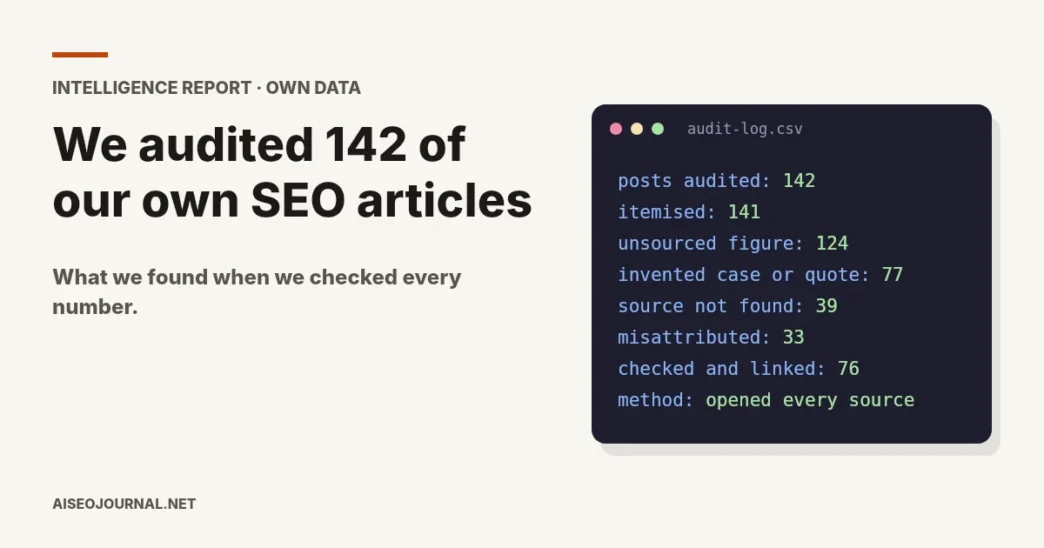
Between 22 and 25 November 2026 we audited 142 of our own SEO articles for unsourced statistics, opening every figure, quote and case study and trying to trace each one to a source. In 124 of the 141 posts we logged in detail (88%), we had to remove or soften at least one figure that had no source. In 91 (65%), we found something worse: a case study, quote or company claim we could not verify, or a figure credited to a study that does not contain it.
This report sets out what we found, why it happens, and the checks we now run before anything is published.
At a glance
| Report card | |
|---|---|
| What we checked | 142 published SEO articles on aiseojournal.net flagged by a scan for unsourced figures (about a quarter of our published posts) |
| When | 22 to 25 November 2026; every source opened by hand |
| Itemised | 141 posts (one post’s fixes were not logged in detail) |
| Headline | 88% had at least one unsourced figure; 65% had invented or untraceable content |
| Confidence | High for the counts; medium for the categories (one editor coded them) |
| Tier | Standard intelligence report, own data |
Table of Contents
ToggleBottom line
Bottom line. CONFIRMED: most of the risky posts we checked carried numbers nobody could trace, and two in three carried something invented or untraceable. Our assessment: the problem is not one bad writer or one bad tool. It is a publishing process that let a confident number through without a link. The fix is a process too: no figure goes live unless an editor has opened its source.
Key findings
- Unsourced figures were almost everywhere (CONFIRMED). 124 of 141 posts (88%) had at least one figure we removed or softened because we could not find a source.
- Invented stories were common (CONFIRMED). 69 posts (49%) carried a case study, client story or first-person result we could not verify. We removed them or relabelled them as illustrative.
- Named sources were often wrong (CONFIRMED). In 39 posts (28%) a figure was credited to a named study or firm that did not contain it; in 33 (23%) a real figure was misattributed or misquoted.
- Quotes failed too (CONFIRMED). 18 posts (13%) carried an expert quote we could not find or that was attributed to the wrong person.
- Some posts were simply out of date or wrong about search (CONFIRMED). 44 (31%) had an outdated fact and 18 (13%) a wrong statement about how search or a tool works.
- There was good news (CONFIRMED). 76 posts (54%) also had at least one figure we could verify and link, and 8 (6%) had no factual problem at all.
Background: what Google says about AI content and accuracy
Google does not object to AI-assisted writing as such. Its February 2023 guidance said so plainly[4], and its current guidance on generative AI content says the tools can help with research and structure[1]. What it does object to is pages made mainly to manipulate rankings: its spam policy on scaled content abuse names generating many pages with AI tools without adding value to users[3].
The same guidance is blunt about accuracy. It notes that generative models predict likely word sequences rather than look up facts, so their output can contain errors, and it tells publishers to check facts before publishing[1]. Google’s own self-assessment for helpful content asks whether a page has clear sourcing and whether it contains easily verified factual errors[2], and its rater guidelines describe trust as how accurate, honest, safe and reliable a page is[5].
Expert quote
“Appropriate use of AI or automation is not against our guidelines.”
Danny Sullivan and Chris Nelson, for the Google Search Quality team, Google Search Central Blog, 8 February 2023[4]
What the evidence shows: unsourced statistics in our own articles
Chart 1 counts posts, not individual claims: a post with ten unsourced percentages counts once in the first row. Most posts had several kinds of problem at once; the typical post had three.
One post can appear in several rows. Source: our evidence-pass log, 22 to 25 November 2026. Hover a bar for the exact share.
Show the numbers as a table
| Problem found | Posts | Share of 141 |
|---|---|---|
| Unsourced figure (removed or softened) | 124 | 88% |
| Invented or unverifiable case study, client story or result | 69 | 49% |
| Outdated fact (retired metric, renamed report, old figure) | 44 | 31% |
| Figure credited to a source that does not contain it | 39 | 28% |
| Real figure misattributed or misquoted | 33 | 23% |
| Unverified or false claim about a named company | 19 | 13% |
| Expert quote not found or wrongly attributed | 18 | 13% |
| Wrong statement about how search or a tool works | 18 | 13% |
| Advice that breaks Google or platform rules | 3 | 2% |
Some of the failures were specific enough to be checkable in seconds, which is what made them worth reporting:
- A guide on backlinks said Google had "confirmed" links were a top-three ranking factor, citing Google itself. Google's Gary Illyes said in 2023 that links had not been top three for some time[11].
- A site-speed guide still taught First Input Delay as a Core Web Vital. Interaction to Next Paint replaced it on 12 March 2024[10].
- An ecommerce article described case studies of three well-known retailers, with results and an invented survey of 1,247 respondents. None of it could be traced. We took the post down.
- An enterprise link-building guide recommended link exchanges, which Google's spam policies treat as link spam when excessive[3]. We rewrote the section.
- A report on AI traffic embedded a dashboard of quotes attributed to two named industry figures. We found no record of either saying those words and removed it.
- Invented or untraceable content: 91 (65%)
- Wrong or misattributed (nothing invented): 17 (12%)
- Unsourced figures only: 22 (16%)
- Outdated fact only: 3 (2%)
- No factual problem found: 8 (6%)
Each post is counted once, in its most serious group. Invented or untraceable = an invented case, quote or company claim, or a figure credited to a source that does not contain it.
Our assessment: the most damaging pattern was not the bare unsourced number. It was the number with a fake source attached, because it looks checked. A reader who sees "(Source: a named firm, 2024)" has no reason to doubt it.
Why unsourced statistics spread
Three forces made this easy to get wrong, and they are not unique to us.
1. Language models produce plausible citations, not verified ones (REPORTED). When Walters and Wilder asked ChatGPT for short literature reviews, 55% of the GPT-3.5 citations and 18% of the GPT-4 citations pointed to works that do not exist, and many real citations had substantive errors[7]. Our own “source not found” row looks like the same failure in a different setting.
2. A confident number reads as authority. Specific figures make a page look researched, so a workflow that rewards long, data-heavy posts pulls numbers in whether or not anyone checked them.
3. AI search now repeats what pages say (CONFIRMED for the features; our assessment for the risk). Pew found that about 18% of Google searches in March 2025 produced an AI summary, and 88% of those summaries cited three or more sources[8]. Bing now reports how often a site is cited in Copilot and its AI summaries[9]. A wrong figure on a cited page can travel further than it used to.
Expert quote
On why the HARO journalist service was relaunched: “journalists need credible, human sources more than ever.”
Brett Farmiloe, Founder and CEO, Featured.com, press release, April 2025[12]
Two scenarios
Scenario A: unsourced figures keep circulating (EXPECTED if nothing changes). Publishers keep shipping round, confident numbers; AI answers and other writers repeat them; the same invented statistic appears in many places and starts to look established. Readers and journalists learn to distrust any figure without a link.
Scenario B: verification becomes the norm (EXPECTED for publishers who adopt it). Editors require an opened source for every figure and label worked examples as examples. Pages get shorter and carry fewer numbers, but the numbers they carry can be quoted. Our assessment: B is the safer bet for any site that wants to be cited, by journalists or by AI answers. We have no traffic data yet to prove it pays; we will report what we see.
What publishers should do
- Open the source before you publish the number. Not the search result about the source: the page that contains the figure. Google’s guidance asks publishers to fact-check AI-generated content before it goes live[1].
- Link it inline, next to the claim. A source list at the bottom does not tell the reader which number came from where.
- Treat “(Source: firm, year)” without a link as a red flag. In our audit that pattern was the most likely to be untraceable.
- Label examples as examples. A worked example is useful; an example dressed as a client result is not.
- Quote only words you have read, with the person’s name, role, where they said it and the date.
- Re-check dated facts (metrics, report names, tool features) whenever you update a post.
The flagger below runs the first pass for you. It is the same set of patterns we used to find the risky posts.
Claim flagger: find the sentences you must source
Paste a draft paragraph. The flagger marks every sentence with the patterns that most often went wrong in our audit: percentages, multipliers, money, named studies, quotes and client results. It does not know if a claim is true; it tells you what to check.
For each flagged sentence: open the source and find the exact figure or words. If you cannot, cut the number or the sentence. Your text stays in this browser tab.
Method, limits and gaps
Method. On 17 November 2026 a scan of our published posts flagged 142 non-news articles with unsourced figures: more than 800 words and no external links, or five or more percentages and fewer than three external links. Between 22 and 25 November one editor worked through them in priority order. For every figure, quote and case study we searched for the source and opened it. If we found it, we kept the claim and linked it; if not, we softened or removed it. Every change was logged, with a backup of the post. For this report one editor coded each log entry into the categories above, then re-read all entries a second time for consistency on 27 November.
Limits. The 142 posts were chosen because they looked risky, so they are not a sample of our whole site, still less of the web. One post (an AI Overview checklist) was fixed but its changes were not itemised, so percentages use 141. Counts are per post, not per claim, and are conservative: where a log entry said a figure was removed but did not say why, we coded it as unsourced rather than invented. One person coded the data, so there is no inter-coder check. “Unsourced” does not mean false: some removed figures may be true but we could not find where they came from.
Gaps. We did not record, post by post, how each draft was produced, so this report cannot say how many problems came from AI drafting rather than human writing. We also have no before-and-after traffic data yet.
Disclosure and corrections. These were our own errors. Each corrected post carries an updated modified date, and the worst post, which we could not fix with real sources, was taken down. If you spot a claim on aiseojournal.net you cannot trace, tell us and we will check it and correct the page.
Frequently asked questions
Does AI-generated content affect SEO?
Google says appropriate use of AI is not against its guidelines. Content made mainly to manipulate rankings, including many AI pages that add no value, can break its spam policy on scaled content abuse.
Is AI copy bad for SEO?
Not by itself. The risk is publishing errors and unsourced claims without review. Google’s guidance asks publishers to fact-check AI-generated content before publishing it.
What is an unsourced statistic?
A number presented as fact with no link or reference a reader can open to check it. In our audit we also counted figures credited to a source that did not contain them.
How do you check a statistic before publishing?
Open the original page, find the exact figure and its date, and link that page next to the claim. If you cannot find it, cut the number or the sentence.
Can I use your data?
Yes. Please link to this report and quote the counts with their limits: 142 posts selected as risky, 141 itemised, coded by one editor.
Check your own top three posts
If you publish SEO content, run the flagger over your three most-visited posts this week and open every source it points to. Our related guides cover information gain, how AI citations work, Google’s E-E-A-T guidelines and digital PR.
How we checked this: own data from our evidence-pass log (22 to 25 November 2026), coded on 27 November 2026. We opened every source below on 27 November 2026 and read the top results and “People also ask” box for “unsourced statistics” and related searches on Google UK. Sources are graded A (primary or official) and B (reputable secondary or company statement).
Sources
- [A] Google Search Central: Google Search's guidance on using generative AI content on your website (updated 1 Oct 2026). Read on 27 November 2026.
- [A] Google Search Central: Creating helpful, reliable, people-first content. Read on 27 November 2026.
- [A] Google Search Central: Spam policies for Google web search (scaled content abuse). Read on 27 November 2026.
- [A] Google Search Central Blog: Google Search's guidance about AI-generated content (Danny Sullivan and Chris Nelson, 8 Feb 2023). Read on 27 November 2026.
- [A] Google: Search Quality Rater Guidelines, an overview (Nov 2023). Read on 27 November 2026.
- [A] Google Search Central: A guide to Google Search ranking systems. Read on 27 November 2026.
- [A] Walters W.H. and Wilder E.I., Fabrication and errors in the bibliographic citations generated by ChatGPT, Scientific Reports 13:14045 (7 Sep 2023), PMC copy. Read on 27 November 2026.
- [A] Pew Research Center: Google users are less likely to click on links when an AI summary appears in the results (22 Jul 2025). Read on 27 November 2026.
- [A] Bing Webmaster Blog: Introducing AI Performance in Bing Webmaster Tools public preview (10 Feb 2026). Read on 27 November 2026.
- [A] web.dev: Interaction to Next Paint becomes a Core Web Vital on March 12 (Jeremy Wagner and Rick Viscomi, 2024). Read on 27 November 2026.
- [B] Search Engine Land: Links are not a top 3 Google Search ranking factor, says Gary Illyes (Danny Goodwin, 2023). Read on 27 November 2026.
- [B] Featured.com press release: Featured.com acquires Help A Reporter Out (HARO) from Cision (Apr 2025). Read on 27 November 2026.