




You’ve been pumping out blog posts for months. Dozens of them. Maybe hundreds. But here’s the frustrating part: Google still treats your site like a random collection of articles rather than the authoritative resource you know it could be.
Sound familiar? That’s because you’re missing the secret sauce that separates amateur blogs from SEO powerhouses: content cluster strategy.
Think of your current blog as a library where books are scattered randomly on the floor. Sure, the books are good, but nobody can find what they need. A content cluster strategy is like organizing that library into clear sections with a catalog system – suddenly, everything makes sense to both visitors and search engines.
Today, I’m showing you exactly how to build topical authority using the hub and spoke content model. This isn’t theory – it’s the same framework that helped HubSpot dominate their niche and continues to work for thousands of smart bloggers today.
Table of Contents
ToggleWhat Exactly Is A Content Cluster Strategy?
Let’s strip away the jargon. A content cluster strategy is an organized approach to content creation where you group related articles around central topic pages.
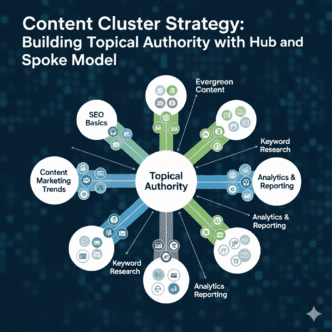
Instead of random posts hoping to rank, you’re building interconnected content ecosystems. Each ecosystem consists of one comprehensive pillar page (the hub) surrounded by multiple detailed cluster posts (the spokes) that dive deep into specific subtopics.
Here’s why this matters: Google’s algorithm has evolved beyond simple keyword matching. Their RankBrain AI and BERT updates mean they now understand topic relationships, context, and semantic connections.
When you organize content into clusters, you’re speaking Google’s language. You’re essentially saying, “Hey, I’m not just mentioning this topic once – I’m the definitive resource on everything related to it.”
Pro Tip: Content clusters aren’t just an SEO tactic – they dramatically improve user experience by making it easier for readers to find comprehensive information on topics they care about.
How Does The Hub And Spoke Content Model Actually Work?
The hub and spoke content model is brilliantly simple once you visualize it. Imagine a bicycle wheel: the hub (center) is your pillar page, and the spokes are your cluster content radiating outward.
Your pillar page is a comprehensive, 3,000-5,000+ word guide covering a broad topic at a high level. It links out to all related cluster posts and serves as the ultimate resource.
Your cluster posts are 1,500-2,500 word articles that explore specific subtopics in detail. Each links back to the pillar page and to other relevant cluster posts, creating a tight web of topical relevance.
Here’s the structure:
Pillar Page: "Complete Guide to Blog SEO"
├── Cluster Post 1: "Keyword Research for Blogs"
├── Cluster Post 2: "On-Page SEO Best Practices"
├── Cluster Post 3: "Internal Linking Strategies"
├── Cluster Post 4: "Content Optimization Techniques"
└── Cluster Post 5: "Technical SEO for Bloggers"
Each cluster post links back to the pillar, and the pillar links to all clusters. This creates what Google sees as a comprehensive topic hub.

Why Does Topic Clusters SEO Matter For Rankings?
Let’s talk cold, hard results. Topic clusters SEO fundamentally changes how Google perceives your site’s authority.
When HubSpot restructured their blog into topic clusters, they saw a 40% increase in organic traffic. That’s not incremental improvement – that’s transformational.
Here’s what happens behind the scenes: when you build comprehensive topic clusters, you’re signaling to Google that you have deep expertise in specific areas. This establishes topical authority – Google’s confidence that you’re a legitimate source for information on that topic.
Traditional SEO focused on individual page rankings. Modern SEO recognizes that topical authority lifts ALL related content. When one piece ranks, it carries others with it through internal linking and contextual relationships.
Think of it like academic credentials. Publishing one paper on marine biology makes you somewhat knowledgeable. Publishing fifty interconnected papers on coral reef ecosystems makes you the go-to expert. Google thinks the same way.
What Makes A Strong Pillar Page Strategy?
Your pillar page strategy is the foundation everything builds upon. Get this wrong, and your entire cluster crumbles.
A strong pillar page has these characteristics:
Comprehensive breadth – Covers the topic broadly without getting lost in minutiae. Think encyclopedia entry, not research paper.
Strategic depth – Goes deep enough to be valuable but leaves room for cluster posts to explore specifics.
Clear structure – Uses headers, sections, and navigation to help readers find exactly what they need.
Internal link hub – Links to every cluster post naturally within the content, not just in a list at the end.
Evergreen foundation – Focuses on timeless principles while cluster posts can tackle trending subtopics.
Here’s what this looks like practically. If your pillar is “Email Marketing for Small Businesses,” it should cover: strategy basics, list building fundamentals, content types, metrics overview, and legal requirements. Each of these becomes a cluster post that goes deep.
The pillar gives readers the 30,000-foot view. Cluster posts provide the ground-level detail. Together, they create comprehensive coverage.
Pro Tip: Your pillar page should be your best content. Invest 2-3x more time creating it than a regular post. This is your flagship – make it incredible.
How Do Content Silos Differ From Content Clusters?
People often confuse content silos with content clusters. They’re related but different approaches with distinct implications.
Content silos are strict topic divisions where content in one category never links to content in another category. Think of them as separate buildings with no connecting hallways.
Content clusters are flexible topic groups that can interconnect with other relevant clusters. They’re buildings connected by bridges – related clusters can reference each other when contextually appropriate.
Here’s the practical difference:
| Aspect | Content Silos | Content Clusters |
|---|---|---|
| Structure | Rigid categories | Flexible hubs |
| Internal Linking | Only within silo | Cross-cluster when relevant |
| Topic Overlap | Avoided | Embraced strategically |
| Best For | E-commerce sites | Content-heavy blogs |
| Flexibility | Low | High |
| User Experience | Can be limiting | More natural discovery |
Content silos work well for large e-commerce sites with distinct product categories. But for blogs building blog SEO authority, clusters offer better flexibility and user experience.
You want your content on “keyword research” to link to relevant content on “content optimization” when appropriate, even if they’re technically different clusters. Natural relationships matter more than rigid boundaries.
How Do You Create Content Clusters For Topical Authority Step By Step?
Ready to build? Here’s your complete roadmap for how to create content clusters for topical authority that actually move the needle.
Step 1: Identify Your Core Topics
Start by brainstorming 3-5 broad topics where you want to be known as an authority. These should align with:
- Your business goals
- Your audience’s needs
- Sufficient search volume to matter
- Your actual expertise (fake it ’til you make it doesn’t work here)
For a digital marketing blog, core topics might include: SEO, Content Marketing, Social Media Strategy, Email Marketing, and Analytics.
Step 2: Research Subtopics
For each core topic, identify 8-15 subtopics that deserve detailed exploration. Use:
- Google’s “People Also Ask” boxes
- AnswerThePublic for question variations
- Ahrefs or Semrush topic research tools
- Competitor analysis (what clusters do they have?)
- Customer questions from sales/support teams
Step 3: Map Your Pillar Pages
Create one pillar page for each core topic. Outline comprehensive coverage including:
- Introduction to the topic
- Key concepts and terminology
- Main strategies or approaches
- Common mistakes
- Future trends
- Resources and next steps
Step 4: Plan Cluster Content
For each pillar, plan 8-15 cluster posts that dive deep into specific subtopics. Each cluster post should:
- Target a specific long-tail keyword
- Provide depth the pillar page doesn’t have space for
- Link back to the pillar naturally
- Connect to related cluster posts
Step 5: Create The Pillar First
Contrary to what many think, build your pillar page BEFORE cluster posts. This gives you:
- A clear roadmap for what clusters you need
- A place to link clusters as you create them
- Immediate ranking opportunity for broad terms
Step 6: Build Clusters Systematically
Create 2-4 cluster posts monthly until you complete each cluster. As you publish, immediately:
- Update the pillar with links to new clusters
- Add internal links from older clusters to new ones
- Maintain a content calendar tracking what’s published and what’s planned
Step 7: Maintain And Update
Clusters aren’t set-and-forget. Quarterly:
- Update statistics and examples
- Add links to newly published content
- Refine internal linking based on analytics data
- Expand successful clusters with additional spokes
This systematic approach to content cluster strategy to improve search rankings fast beats random publishing every time.
What’s The Ideal Size And Scope For Each Content Cluster?
The million-dollar question: how big should each cluster be? Here’s the practical guidance based on what actually works.
Pillar page length: 3,000-6,000 words depending on topic complexity. Comprehensive but not overwhelming.
Cluster post length: 1,500-2,500 words. Deep enough to provide value but focused on one specific aspect.
Number of clusters per pillar: Minimum 8-10 to establish authority. Ideal range is 15-25. More is fine if you have genuinely valuable subtopics.
Total cluster size: A complete cluster (pillar + all spokes) represents 25,000-60,000 words of interconnected content.
But here’s the critical insight: topical relevance building isn’t about hitting arbitrary numbers – it’s about comprehensive coverage. Some topics naturally require more depth than others.
A cluster on “Local SEO” might need 12 posts to cover everything from Google Business Profile to citation building to review management. A cluster on “SEO Title Tags” might only need 6 posts because the topic is narrower.
Let search volume and user needs guide you, not arbitrary targets. Use tools like Ahrefs Content Gap to identify what competitors cover that you don’t.
Pro Tip: Start with a minimum viable cluster (1 pillar + 8 clusters) and expand based on performance. It’s better to have one complete, excellent cluster than three incomplete mediocre ones.
How Should You Plan Internal Linking Within Content Clusters?
Internal linking makes or breaks your cluster strategy. This is where the magic happens – or where everything falls apart.
The hub and spoke content linking pattern follows specific rules:
From Pillar to Clusters:
- Link to EVERY cluster post from the pillar
- Use descriptive anchor text matching cluster keywords
- Place links contextually within relevant sections
- Include a summary section with visual hub showing all clusters
From Clusters to Pillar:
- Every cluster should link back to its pillar at least once
- Link in the introduction (“Part of our comprehensive guide to…”)
- Link again contextually when referencing broader concepts
- Use variations of the pillar’s target keyword as anchor text
Between Cluster Posts:
- Link to related clusters when genuinely relevant
- 2-3 cross-cluster links per post is ideal
- Don’t force connections that don’t exist naturally
- Think: “Would this link help my reader right now?”
Here’s a linking example for a blog SEO content cluster:
Your cluster post on “Long-Tail Keywords” should link to:
- The pillar page (“Complete Guide to Keyword Research”)
- Related cluster “Keyword Difficulty Analysis”
- Related cluster “Search Intent Understanding”
- Perhaps a cluster from another hub like “Content Optimization”
Avoid these common mistakes:
❌ Linking every cluster to every other cluster (creates link soup) ❌ Using the exact same anchor text repeatedly (looks manipulative) ❌ Forgetting to update the pillar as new clusters publish ❌ Creating “orphan” clusters with no links pointing to them
Pro Tip: Create a visual cluster map in Google Sheets tracking which posts link where. This prevents gaps and ensures strategic coverage as your cluster grows.
How Do You Choose Topics For Your Content Cluster Strategy?
Topic selection determines whether your cluster thrives or dies. Here’s how to choose wisely.
Start with business alignment. Your clusters should support your business goals. If you sell project management software, clusters around “team collaboration,” “productivity,” and “project planning” make sense. Clusters about “gardening tips” don’t, even if you personally love gardening.
Analyze search demand. Use keyword research to validate that people actually search for content in your proposed cluster. Tools like:
- Google Keyword Planner
- Ahrefs Keywords Explorer
- Semrush Topic Research
- Google Trends for trend validation
Look for:
- 1,000+ monthly searches for pillar topics
- 100-1,000 monthly searches for cluster topics
- Growing or stable search trends (not declining)
Assess competition realistically. If you’re a brand new blog, competing for “digital marketing” against HubSpot and Moz is delusional. Start with more specific niches like “digital marketing for yoga studios” where you can realistically dominate.
Consider your expertise. Only create clusters where you can provide genuine value. Google’s algorithms are sophisticated enough to detect thin content that just repackages existing information.
Map the customer journey. Create clusters that guide prospects from awareness through consideration to decision. You need:
- Awareness clusters (educational, problem-focused)
- Consideration clusters (solution comparison, how-to guides)
- Decision clusters (product-specific, buying guides)
Your blog SEO strategy should include clusters at each journey stage.
What Role Does Keyword Research Play In Topic Clusters SEO?
Keyword research isn’t just important for topic clusters SEO – it’s the foundation everything builds on. But the approach differs from traditional keyword targeting.
Traditional SEO: Find individual keywords, create one post per keyword, hope it ranks.
Cluster SEO: Research topic families, understand semantic relationships, create comprehensive coverage that ranks for hundreds of related terms.
Here’s the cluster keyword research process:
Phase 1: Core Topic Research
Identify broad, high-volume keywords that could serve as pillar topics. These typically have:
- 10,000+ monthly searches
- High commercial or informational value
- Clear subtopic opportunities
For example: “email marketing” (60,000 searches) versus “email marketing subject lines” (2,000 searches). The first is pillar-worthy, the second is a cluster.
Phase 2: Subtopic Discovery
For each pillar topic, extract 20-30 related keywords using:
- “People Also Ask” extraction
- Related searches at the bottom of Google results
- Ahrefs “Also rank for” feature
- Question-based keywords from AnswerThePublic
Phase 3: Semantic Grouping
Group keywords by search intent and topic similarity. You might find that “email list growth,” “building email lists,” and “grow email subscribers” are essentially the same cluster topic – just different ways people search for it.
Phase 4: Intent Mapping
Assign search intent to each potential cluster:
- Informational: “what is email segmentation”
- Commercial: “best email marketing platforms”
- Transactional: “mailchimp vs convertkit”
- Navigational: “mailchimp login”
Create cluster posts for informational and commercial intent keywords. Your pillar naturally ranks for broader navigational and informational terms.
Pro Tip: Use Surfer SEO or Clearscope to analyze top-ranking content for your target keywords. These tools reveal semantic terms and questions to include in your cluster content for maximum topical relevance.
How Do You Measure Success Of Your Content Cluster Strategy?
You can’t improve what you don’t measure. Here are the metrics that actually matter for content cluster strategy performance.
Pillar Page Performance:
- Organic traffic growth month-over-month
- Keyword rankings for broad topic terms
- Average position improvements over time
- Backlinks earned (pillar pages should attract links naturally)
- Time on page and scroll depth (engagement indicators)
Cluster Post Performance:
- Rankings for specific long-tail keywords
- Traffic contribution to overall cluster traffic
- Internal link click-through rates
- Conversion rates (for commercial intent clusters)
Overall Cluster Metrics:
- Total cluster traffic (pillar + all spokes)
- Keyword portfolio growth (how many terms you rank for)
- Domain authority improvements
- Pages per session from cluster entry points
- Organic visibility scores (from Semrush or Ahrefs)
Benchmark targets based on 6 months post-implementation:
- 100-300% traffic increase to pillar page
- 50-100% increase in total cluster organic traffic
- Ranking position 1-10 for 60%+ of target cluster keywords
- 25-50+ new ranking keywords per cluster
Track these in a dashboard combining Google Analytics, Search Console, and your SEO tool of choice.
Real-world example: After implementing content clusters, Duct Tape Marketing saw their organic traffic grow 55% in 6 months, with 90% of that growth coming from clustered content rather than standalone posts.
What Are Common Mistakes That Kill Content Cluster Effectiveness?
Let’s talk about what NOT to do. These mistakes destroy otherwise solid cluster strategies.
Mistake 1: Creating clusters without keyword research
Flying blind kills clusters. If you’re creating content nobody searches for, you’re wasting time regardless of how well structured it is.
Mistake 2: Weak pillar content
Your pillar can’t just be a table of contents with links. It needs to provide substantial value independently while serving as a hub. Weak pillars mean weak clusters.
Mistake 3: Thin cluster posts
Creating 500-word cluster posts defeats the purpose. You need depth to rank and establish authority. Aim for 1,500+ words minimum.
Mistake 4: Inconsistent publishing
Starting a cluster then abandoning it signals to Google (and readers) that you’re not actually authoritative on the topic. Finish what you start.
Mistake 5: Forgetting to update
Publishing the cluster isn’t the end – it’s the beginning. Clusters need quarterly updates to maintain relevance and rankings.
Mistake 6: Over-optimization
Using the exact same anchor text for every internal link, or stuffing keywords unnaturally, triggers Google’s spam filters. Keep it natural.
Mistake 7: No promotional strategy
Publishing without promotion means your cluster builds authority slowly. Share on social, email your list, reach out for backlinks.
Mistake 8: Ignoring technical SEO
All the cluster strategy in the world won’t save you if your site is slow, not mobile-friendly, or has indexing issues. Technical foundations matter.
Expert Insight: “The biggest mistake I see is bloggers creating ‘hub pages’ that are just lists of links with no actual content. Your pillar needs to be independently valuable, not just a navigation page.” – Brian Dean, Backlinko
How Do Content Clusters Work With Different Blog Types And Niches?
The beauty of content cluster strategy is its flexibility across industries. But implementation nuances vary by niche.
B2B SaaS Blogs:
- Focus on solution-oriented clusters
- Heavy emphasis on comparison and evaluation content
- Longer sales cycles mean more educational clusters
- Case studies as cluster content perform exceptionally well
E-commerce Blogs:
- Product category clusters (broad category as pillar)
- Buying guides and reviews as cluster content
- Strong commercial intent throughout
- Visual content (videos, infographics) crucial
Health/Wellness Blogs:
- YMYL considerations mean E-E-A-T is critical
- Clusters need medical review and citations
- Patient-centric topics work well
- Symptoms, treatments, and conditions as separate clusters
Finance/Investment Blogs:
- Another YMYL category requiring expertise
- Regulatory compliance affects content approach
- Glossary-style clusters work exceptionally well
- Calculator and tool-based content as cluster anchors
Food/Recipe Blogs:
- Technique-based clusters (baking, grilling, etc.)
- Ingredient-focused clusters
- Cuisine-type clusters
- Heavy visual content integration
Technology/Software Blogs:
- Tutorial-heavy clusters
- Version-specific content that needs frequent updating
- Integration and workflow clusters
- Screenshot and video content essential
Your overall blog SEO approach should adapt cluster strategy to your specific niche requirements while maintaining core principles.
How Can You Scale Content Cluster Creation Efficiently?
Creating comprehensive clusters takes time. Here’s how to scale without sacrificing quality.
Build a content production system:
- Batch research – Research 3-5 cluster topics at once, not one at a time
- Template everything – Create outlines for pillar pages and cluster posts
- Schedule strategically – Block dedicated time for cluster work
- Use AI wisely – Let AI draft outlines and first drafts, then add expertise
- Repurpose ruthlessly – Transform webinars, podcasts, and videos into cluster content
Leverage team members:
- Writers focus on drafting
- Subject matter experts add unique insights
- Editors ensure consistency across clusters
- SEO specialists handle keyword optimization and linking
Outsource strategically:
- First drafts to freelance writers (with detailed briefs)
- Visual content creation to designers
- Technical SEO implementation to specialists
- Keep strategy, editing, and expertise in-house
Use content tools:
- Surfer SEO or Clearscope for optimization
- Frase or MarketMuse for content briefs
- Jasper or Claude for first draft assistance (then heavily edit)
- Ahrefs Content Explorer for competitive analysis
Prioritize ruthlessly:
Focus on one cluster at a time until completion. A finished cluster generates ROI. Three half-finished clusters generate zero.
Pro Tip: Create a “cluster completion dashboard” tracking progress. Gamify it – celebrate when each cluster reaches 100%. This maintains momentum better than scattered content creation.
What’s The Relationship Between Content Clusters And Topical Relevance Building?
Let’s connect the strategic dots. Topical relevance building is the goal; content clusters are the vehicle.
Google doesn’t just look at individual pages anymore – they evaluate your site’s overall expertise on topics. This is where Expertise, Experience, Authoritativeness, and Trustworthiness (E-E-A-T) comes in.
Content clusters build topical relevance through:
Comprehensive coverage – You’re not just mentioning a topic; you’re exploring every angle. This signals deep knowledge.
Semantic relationships – Internal links between related content help Google understand how concepts connect in your expertise area.
Entity recognition – Repeatedly covering entities (people, places, things, concepts) in depth establishes you as a source for information about those entities.
Citation networks – When you link to authoritative sources consistently, you’re placing yourself within the knowledge graph for that topic.
User behavior signals – Visitors exploring multiple pages in your cluster signals engagement and value, which Google rewards.
According to Koray Tuğberk GÜBÜR, a topical authority SEO expert: “Topical authority isn’t built through isolated great content – it’s built through comprehensive coverage that demonstrates you understand a topic’s entire ecosystem.”
This is why standalone posts rarely achieve the rankings that cluster content does. Individual excellence < systematic expertise.
Your blog’s SEO foundation should prioritize cluster building over random content creation if you want sustainable rankings.
How Do You Optimize Existing Content Into Content Clusters?
Already have 50, 100, or 200 blog posts? Great! You don’t start from scratch – you reorganize.
Step 1: Content Audit
Export all your blog posts with URLs, titles, word counts, and traffic data. Categorize them by general topic.
Step 2: Identify Natural Clusters
Look for groups of 5-10 posts that naturally relate to a broader topic. These become your clusters.
Step 3: Gap Analysis
For each natural cluster, identify:
- What pillar page topic would unite these posts?
- What subtopics are missing that competitors cover?
- Which existing posts are too thin and need expansion?
Step 4: Create or Upgrade Pillars
Either create new pillar pages or upgrade your best existing post in each cluster to pillar status by:
- Expanding to 3,000+ words
- Adding comprehensive sections
- Creating internal links to all cluster posts
- Improving visual design and navigation
Step 5: Retrofit Internal Links
This is tedious but essential. Go through each post and:
- Add links back to the pillar
- Add 2-3 links to related cluster posts
- Update pillar to link to all clusters
- Remove irrelevant internal links that dilute focus
Step 6: Fill Content Gaps
Create new cluster posts for subtopics you’re missing. Publish 2-4 per month until clusters are complete.
Step 7: Consolidate Thin Content
If you have multiple thin posts on similar topics, consolidate them into one comprehensive cluster post with proper 301 redirects.
Real-world example: When restructuring existing content into clusters, one SaaS company saw average organic traffic increase 112% over 6 months, with previously languishing posts suddenly ranking on page 1 due to improved topical context.
How Does AI Content Creation Fit Into Content Cluster Strategy?
AI is transforming how we create clusters. But there’s a right way and a wrong way to use it.
The wrong way: Generate 20 AI posts, minimal editing, publish as a “cluster.” This creates thin, generic content that Google’s Helpful Content Update destroys.
The right way: Use AI to accelerate the research, outlining, and drafting phases while humans add expertise, examples, and unique insights.
Effective AI workflow for clusters:
Research Phase:
- Use AI to analyze competitor content
- Generate subtopic ideas for clusters
- Identify questions to answer
- Extract semantic keyword variations
Outlining Phase:
- AI creates detailed outlines based on research
- Humans refine for logical flow and comprehensiveness
- Add sections requiring unique expertise
Drafting Phase:
- AI writes first draft following outline
- Humans add: personal experience, case studies, specific examples, original data, expert opinions
- Heavily edit for voice and accuracy
Optimization Phase:
- AI suggests semantic terms to include
- Humans ensure natural integration
- AI checks readability and structure
The 60/40 rule: Aim for 60% human value-add and 40% AI efficiency gain. If the ratio flips, you’re creating content Google will eventually penalize.
Pro Tip: Use AI to create cluster content briefs that extract common elements from top-ranking pages. This ensures comprehensive coverage while you add the unique perspective that makes your content rank.
What Tools And Resources Help Build Content Clusters?
You don’t need expensive tools to build clusters, but these accelerate the process significantly.
Keyword Research & Planning:
- Ahrefs ($129-999/month) – Best all-around for cluster planning
- Semrush ($139-499/month) – Excellent topic research tools
- AnswerThePublic (Free/$99/month) – Question-based subtopic discovery
- Google Keyword Planner (Free) – Basic keyword data
Content Optimization:
- Surfer SEO ($69-239/month) – Content editor with semantic suggestions
- Clearscope ($170-1,200/month) – Enterprise-level content optimization
- Frase ($15-115/month) – Budget-friendly optimization and briefs
Internal Linking:
- Link Whisper (\$77-297/year) – WordPress internal linking suggestions
- Screaming Frog (Free-£149/year) – Audit internal link structure
- Yoast SEO (Free-$99/year) – Basic internal linking suggestions
Project Management:
- Notion (Free-$15/user/month) – Cluster planning and tracking
- Airtable (Free-$20/user/month) – Content calendar with relationships
- Google Sheets (Free) – Simple but effective for small teams
Content Creation:
- Jasper ($49-125/month) – AI writing assistant
- Claude or ChatGPT ($20/month) – AI for research and drafting
- Grammarly ($12-15/month) – Editing and tone consistency
Analytics:
- Google Search Console (Free) – Track rankings and impressions
- Google Analytics (Free) – Traffic and behavior analysis
- Ahrefs Rank Tracker (Included with subscription) – Detailed ranking monitoring
Comparison of top cluster planning tools:
| Tool | Best For | Monthly Cost | Learning Curve | Key Feature |
|---|---|---|---|---|
| Ahrefs | Complete cluster research | $129+ | Medium | Content gap analysis |
| Semrush | Topic research | $139+ | Medium | Topic clusters tool |
| Surfer SEO | Content optimization | $69+ | Low | Real-time optimization |
| Notion | Project planning | Free-$15 | Low | Visual cluster mapping |
| Link Whisper | WordPress linking | $77/year | Very Low | Automated suggestions |
Start with free tools (Search Console, Keyword Planner, Screaming Frog, Notion) and upgrade based on your specific bottlenecks.
How Long Does It Take To See Results From Content Clusters?
Patience is a virtue, especially with cluster strategy. Here’s the realistic timeline.
Months 1-2: Foundation & Setup
- Complete keyword research
- Create pillar page(s)
- Publish first 4-6 cluster posts
- Implement internal linking
- Expected Results: Minimal. You’re building, not harvesting.
Months 3-4: Momentum Building
- Publish remaining cluster posts
- Pillar page starts ranking for broad terms
- Some cluster posts hit page 2-3
- Expected Results: 10-30% traffic increase to cluster content
Months 5-6: Acceleration
- Rankings improve across cluster
- Pillar page reaches page 1 for some terms
- Cluster posts ranking on page 1 for long-tails
- Expected Results: 50-150% traffic increase to cluster content
Months 7-12: Compounding Returns
- Established authority for topic
- Multiple page 1 rankings
- Attracting natural backlinks
- Expected Results: 100-300% total traffic increase to cluster
12+ Months: Sustained Authority
- Dominating topic area
- Featured snippets and position zero rankings
- Competitors citing your content
- Expected Results: Continued growth, market leadership
This timeline assumes:
- Consistent publishing schedule
- High-quality content
- Proper technical SEO foundation
- Reasonable competition level
- Regular content updates
Pro Tip: Don’t build three clusters simultaneously hoping for faster results. Complete one cluster fully before starting another. Finished clusters compound faster than partial ones.
How Do Content Clusters Support Your Overall Blog SEO Strategy?
Let’s zoom out and see how content cluster strategy integrates into your complete blog SEO approach.
Clusters provide SEO leverage through:
Keyword portfolio expansion – Instead of ranking for 5-10 keywords, you rank for 50-100 related terms per cluster.
Link equity distribution – When your pillar earns backlinks, the authority flows to all cluster posts through internal links.
Crawl efficiency – Clear site structure helps Google discover and index all your content faster.
Topical depth signals – Comprehensive coverage tells Google you’re authoritative on the topic, lifting all related content.
User engagement metrics – Visitors exploring multiple cluster posts signal quality to Google’s algorithms.
But clusters don’t replace other SEO fundamentals:
You still need:
- Fast loading times
- Mobile optimization
- Quality backlinks
- Technical SEO health
- Good user experience
- Regular content updates
Think of clusters as the architecture of your content strategy. Architecture matters immensely, but you still need quality materials (content), solid foundation (technical SEO), and good location (backlinks and promotion).
Your complete SEO strategy should allocate:
- 50-60% of content creation to cluster building
- 20-30% to opportunistic trending topics
- 10-20% to updates and refreshes
- 10% to experimental formats
This balance maintains cluster momentum while staying nimble for opportunities.
What’s The Future Of Content Clusters And Topical Authority?
SEO never stands still. Here’s where cluster strategy is heading and how to stay ahead.
AI-powered content understanding is getting sophisticated. Google’s MUM update processes information across languages and formats. Future cluster strategy will need:
- Video content integration
- Multi-format content hubs
- Cross-language topical authority
- More visual and interactive elements
Zero-click searches are increasing. Google shows more answers directly in results. To stay relevant:
- Create content so comprehensive users still click
- Optimize for featured snippets aggressively
- Build clusters that answer follow-up questions
- Focus on commercial intent clusters that can’t be fully answered in SERPs
Entity-based SEO is replacing pure keyword optimization. Google understands entities (people, places, concepts) and their relationships. Future clusters will:
- Focus more on entity coverage than keyword density
- Integrate knowledge graph data
- Build authority around specific entities
- Link to authoritative entity sources
Personalization and intent variation are growing. The same query shows different results to different users. This means:
- Creating clusters that serve multiple intent variations
- More specific, targeted cluster posts
- Better user intent matching
- Dynamic content that adapts to user signals
E-E-A-T requirements are intensifying. Experience, Expertise, Authoritativeness, and Trust matter more every update. Future winning clusters will:
- Include author expertise signals prominently
- Feature original research and data
- Cite authoritative sources extensively
- Demonstrate real-world experience
Pro Tip: Start experimenting with multimedia clusters now. Create pillar pages that integrate written content, video explainers, interactive tools, and downloadable resources. This future-proofs your clusters as search evolves.
FAQs
How many content clusters should a new blog start with?
Start with 1-2 clusters maximum. Master the process with focused effort before expanding. A complete, well-executed cluster beats five partial ones every time.
Can I create content clusters for affiliate marketing sites?
Absolutely. In fact, clusters work exceptionally well for affiliate content. Create pillar pages around product categories with cluster posts for specific products, comparisons, and buying guides. Just ensure comprehensive value beyond pure promotion.
Should every blog post be part of a cluster?
Not necessarily. Aim for 70-80% of content in clusters, with 20-30% as standalone posts covering trending topics, news, or content that doesn’t fit existing clusters. This balance maintains cluster focus while staying flexible.
How do I handle overlapping topics between clusters?
Overlapping is natural and fine. If “email marketing” and “marketing automation” clusters both need to discuss “email sequences,” choose which cluster it primarily belongs to, then link to it from the other cluster when relevant.
Do content clusters work for local SEO?
Yes! Create location-specific clusters. For example, a law firm might have clusters for “personal injury law,” “family law,” etc., with location-specific cluster posts for each service area.
How often should I update cluster content?
Update pillar pages quarterly with new stats, examples, and links to new cluster posts. Update cluster posts annually or when information becomes outdated. Set calendar reminders to maintain consistency.
Final Thoughts: Building Your Content Empire One Cluster At A Time
Here’s the truth about content cluster strategy: it’s not a shortcut. It’s actually more work upfront than random blog posting.
But here’s what makes it worth every hour: clusters create compound SEO growth that individual posts never achieve. Each new cluster post strengthens every other post in the cluster. Each backlink to your pillar elevates all your cluster content. Each ranking improvement cascades through interconnected pages.
The blogs dominating search results in 2025 aren’t publishing more – they’re publishing smarter. They understand that topical authority beats topical breadth every single time.
Your competitors are likely still publishing random posts hoping something sticks. You’re going to build systematic authority that compounds over time, making your site increasingly difficult to compete against.
Start with one cluster. Pick a topic you genuinely know deeply and care about. Research thoroughly. Create an exceptional pillar page. Build out 8-10 comprehensive cluster posts over the next 3-4 months. Link everything strategically. Promote consistently.
Then watch what happens. Because when you give Google exactly what it’s looking for – comprehensive, well-organized, genuinely helpful content that establishes topical expertise – the algorithm rewards you generously.
The question isn’t whether content clusters work. They demonstrably do. The question is: will you have the discipline and patience to build them properly?
Your future SEO success depends on your answer.
Now go build something remarkable. One cluster at a time.