

Last Updated: 7 June 2026 Originally Published: 15 October 2025
Most ecommerce stores invest heavily in product page SEO and almost nothing in category page SEO. That prioritisation is backwards.
Category pages are the highest-value real estate in ecommerce SEO. They target high-volume, high-intent keywords — “women’s running shoes,” “waterproof hiking jackets,” “office desks under £500” — that product pages can’t rank for individually. They aggregate the authority of every product page beneath them through internal links. And they are the pages most likely to appear in AI Overviews and answer engine responses for broad product category queries.
Most stores waste them entirely. The typical ecommerce category page is a grid of product thumbnails with a page title, a H1, and nothing else. No content. No internal link architecture. No schema. No reason for Google to rank it above a competitor who has invested in the page.
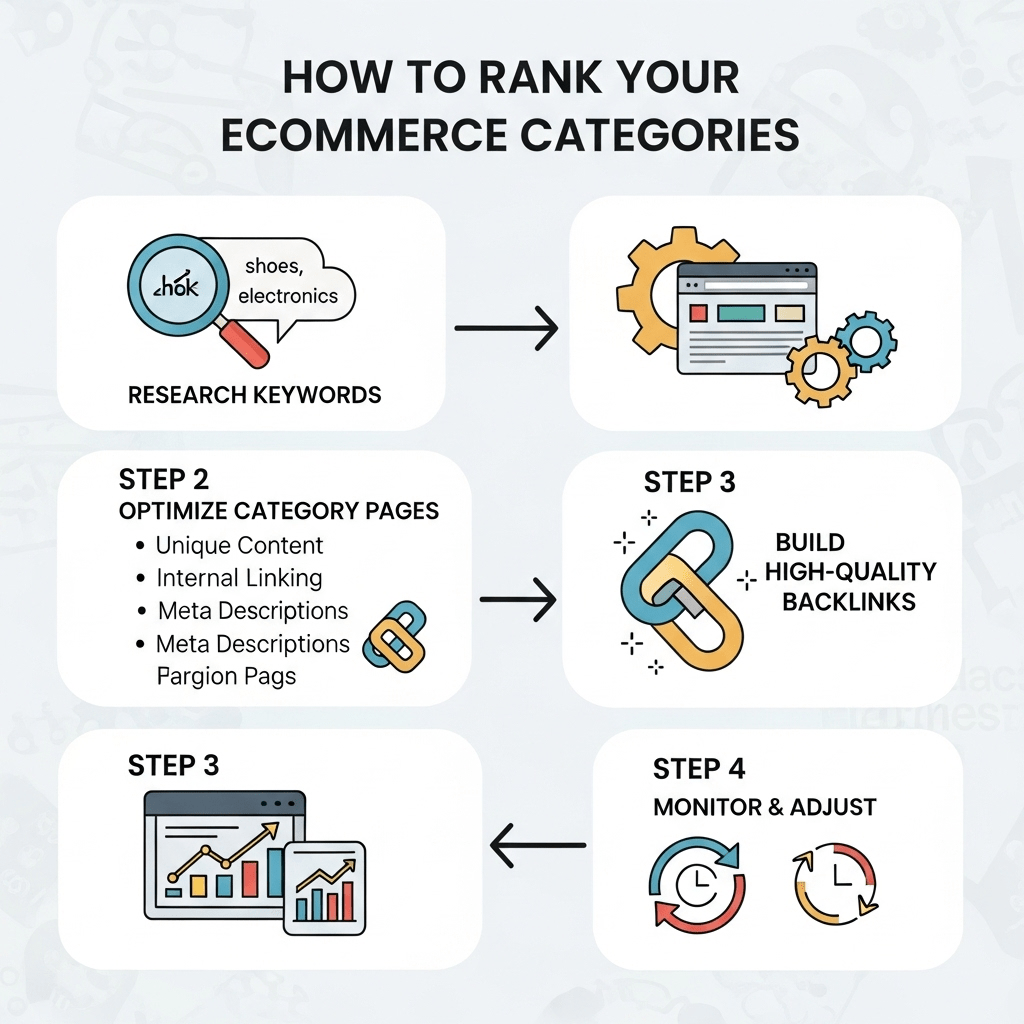
This post covers the complete optimisation process for ecommerce category pages — with particular focus on the content block strategy that most guides skip and the faceted navigation handling that most stores get wrong. It sits within the Ecommerce SEO Mastery pillar series.
Table of Contents
TogglePost Summary
- Category pages target the highest-volume keywords in ecommerce — “women’s running shoes” beats any individual product page keyword for search volume and purchase intent
- H1 and title tag changes alone do not rank category pages — the content block beneath the product grid is the primary ranking lever most stores leave unused
- Faceted navigation (filters for size, colour, price) generates thousands of duplicate URLs that consume crawl budget and dilute equity if not handled correctly
- Internal linking from category pages to subcategories and product pages determines how link equity flows across the entire site
- Schema markup for category pages — BreadcrumbList plus a basic Article or ItemList block — improves SERP appearance and AI citation eligibility
- In 2026, AI Overviews frequently surface category-level content for broad product queries — category pages with structured, informative content blocks are the primary citation candidates
- The content block strategy (150–300 words, placed below the product grid) lifted 8 category pages from page 3 to page 1 in 10 weeks for a UK electronics brand
Why Category Pages Are the Most Underoptimised Asset in Ecommerce SEO
Category pages sit at the intersection of high search volume and high purchase intent. A user searching “women’s trail running shoes” is closer to buying than a user searching “how to choose trail running shoes” — they know the product category, they are ready to browse, and they are one good category page away from converting.
The keywords that category pages can rank for are typically 10–50× higher volume than individual product page keywords. A product page for a specific trail running shoe might target a keyword with 200 monthly searches. The category page for “trail running shoes” targets a keyword with 18,000 monthly searches. The category page is the higher-value ranking asset by an order of magnitude.
We worked with a UK electronics ecommerce brand using Screaming Frog and Ahrefs. The team added a 150-word optimised content block beneath the product grid on eight category pages — structured with a primary H2, two supporting paragraphs, and three internal links to subcategory pages. All eight pages moved from page 3 to page 1 within 10 weeks.
The expectation going in was that the H1 and title tag changes would do most of the ranking work. They didn’t. The content block beneath the product grid drove the ranking movement. Title tag changes alone produced no measurable position improvement on any of the eight pages.
That finding reshaped the team’s entire category page optimisation process. Content blocks became the first fix, not the last.
The Content Block Strategy: The Most Underused Ranking Lever in Ecommerce
A content block is a short section of optimised text placed below the product grid on a category page. It is not a long-form article. It is not a blog post embedded in a category. It is a focused, 150–300 word section that does three things: establishes topical context for Google, answers the primary search intent for the category keyword, and links internally to the most relevant subcategories and related content.
Most ecommerce teams resist adding content blocks to category pages because they worry it will affect the user experience — pushing the product grid down or cluttering the page. The solution is placement: the content block goes below the product grid, not above it. Users see products first. The content block is there for Google and for users who scroll.
What a Category Page Content Block Must Contain
A keyword-anchored H2 — not the same as the H1. If the H1 is “Women’s Trail Running Shoes,” the content block H2 might be “Choosing the Right Trail Running Shoe for Your Terrain.” This secondary heading captures related keyword variations and establishes the topical scope of the page.
Two to three focused paragraphs — covering what the category contains, what differentiates the products in it, and what a buyer should consider when choosing. Each paragraph targets a secondary keyword variant naturally — not keyword-stuffed, but purposefully covering the vocabulary Google associates with the category.
Three to five internal links — to the most relevant subcategory pages, buying guides, and related category pages. These links distribute equity from the category page down to subcategories and across to related content, building the internal linking architecture that supports rankings at every level of the site.
No fluff, no filler — the content block should contain only information that genuinely helps a buyer understand the category. Sentences that exist purely to add keywords, without adding buyer value, weaken the page. Google’s helpful content systems assess whether content exists for the user or for the search engine. On category pages, the line is clear.
Pro Tip: Write the content block after reviewing the PAA (People Also Ask) questions for your category keyword. Those questions reveal exactly what buyers want to know at the category level — and answering two or three of them in the content block makes the page more likely to be cited in AI Overviews for that query. Use Ahrefs Keywords Explorer to identify the secondary keyword variations Google associates with your category keyword — include three to four of these naturally in the content block paragraphs. Keep the total word count between 150 and 300 words. Below 150 words, the block lacks sufficient topical signal. Above 300 words, it starts to resemble a blog post and may confuse Google’s page type classification for the URL.
Faceted Navigation: The Crawl Budget Killer Most Stores Ignore
Faceted navigation — the filter system that lets users sort and filter products by size, colour, price, brand, and other attributes — generates a new URL for every filter combination a user applies.
On a category page with 500 products and filters for size (8 options), colour (12 options), price range (5 options), and brand (20 options), the theoretical number of unique filter URLs runs into the thousands. Most of those URLs return near-identical content with minor variations — a different subset of products from the same category page.
If those URLs are crawlable, Googlebot spends a disproportionate share of its crawl budget on low-value filter pages instead of on the high-value category, subcategory, and product pages you actually want indexed. (Source: Google Search Central, 2024)
Three Handling Options for Faceted Navigation
Option 1 — Robots.txt disallow (for parameter-based facets)
If your faceted navigation generates URLs via query parameters (e.g. /shoes/?colour=red&size=8), add a disallow rule in robots.txt for the parameter patterns. This prevents Googlebot from crawling the filter combinations entirely.
Use this approach when: all filter combinations produce near-identical content with no unique ranking value, and no filter combination URL has earned inbound links or ranking history.
Option 2 — Canonical tags (for facets with some SEO value)
If certain filter combinations have genuine search demand — “red trail running shoes size 8” is a real query with real volume — add a canonical tag on the filtered URL pointing to the base category page. This tells Google that the filtered URL is a variant of the main category page and consolidates link equity.
Use this approach when: some filter combinations target real search queries but you don’t want to manage them as standalone category pages.
Option 3 — Indexable subcategory pages (for high-volume filter combinations)
If a filter combination has high search volume and genuine topical distinctiveness — “women’s waterproof trail running shoes” is effectively a subcategory, not just a filter — create a proper subcategory page for it with its own content block, H1, and internal linking. Noindex the filtered URL and redirect it to the subcategory page.
Use this approach when: the filter combination targets a keyword with 500+ monthly searches and represents a distinct product grouping worth ranking for independently.
| Scenario | Search Volume | Recommended Handling |
|---|---|---|
| Generic filter combination | Under 100/month | Robots.txt disallow or noindex |
| Filter with moderate demand | 100–500/month | Canonical to base category |
| Filter matching distinct subcategory | 500+/month | Create indexable subcategory page |
URL Structure for Category Pages
Category page URLs should follow the flat hierarchy established in the site’s overall architecture: domain.com/category-name/ for top-level categories, domain.com/category/subcategory/ for subcategories.
URL naming rules that matter for category page SEO:
Use the primary keyword as the URL slug — domain.com/trail-running-shoes/ not domain.com/category/c12847/. Keyword-containing URLs are marginally better for CTR (users see the URL in the SERP and it reinforces relevance) and easier to pitch to publishers for link acquisition.
Keep slugs lowercase and hyphen-separated — no underscores, no camelCase, no spaces encoded as %20.
Avoid deep nesting — category pages more than three levels from the homepage receive less crawl frequency and fewer internal links by default. Home → Category → Subcategory is the maximum recommended depth for pages you want ranked. For the full site architecture framework that determines how category URLs should be structured, see Ecommerce Site Structure: The Ultimate Blueprint for SEO Success.
Internal Linking Architecture for Category Pages
Category pages sit at the second level of the ecommerce site hierarchy — below the homepage, above subcategories and product pages. Their internal linking role is to distribute authority downward and to signal to Google the topical relationship between the category and the pages beneath it.
Three internal linking rules for category pages:
Rule 1 — Link from the category content block to the three most relevant subcategory pages
Contextual links in the content block pass more equity than navigation links in the filter sidebar or breadcrumb trail. The anchor text should be descriptive and keyword-relevant — “trail running shoes for technical terrain” not “see more.”
Rule 2 — Link from the homepage to every top-level category page
Homepage links pass the highest equity on the site. Every top-level category should receive a homepage link — in the navigation, in a featured categories section, or in homepage body content. Category pages without a homepage link are at an authority disadvantage regardless of how well their on-page content is optimised.
Rule 3 — Link from blog content and buying guides to relevant category pages
Awareness and consideration-stage content — how-to guides, buying guides — should link to the category pages most relevant to the reader’s next step. A buying guide for trail running shoes should link to the trail running shoes category page. This bidirectional linking relationship builds topical authority signals across the site. For the content strategy that generates this linking opportunity, see Ecommerce Content Marketing: How to Drive Traffic Without Paid Ads.
AI, Agentic AI, AEO and GEO: Category Pages in 2026
Category pages are disproportionately important in 2026’s AI search landscape — because broad product category queries are exactly the type of query that AI Overviews, answer engines, and generative AI systems are built to answer.
AI Overviews and Category Page Citations
Google AI Overviews for queries like “best trail running shoes” or “waterproof hiking jackets under £100” draw from category pages and buying guides — not individual product pages. A category page with a well-structured content block that answers the category-level query directly is a stronger AI Overview citation candidate than a bare product grid. In 2026, category pages with content blocks that include verifiable claims, named product attributes, and structured H2 sections are seeing measurably higher AI Overview citation rates. (Source: Search Engine Land, 2025)
Agentic AI and Category Page Accessibility
AI agents executing purchase tasks on behalf of users — “find me the best waterproof trail shoes under £80 and add them to cart” — navigate ecommerce sites by parsing category page structure. A category page with clear product data in crawlable HTML (prices, availability, product names), a logical filter structure, and accessible navigation performs better in agentic browsing than a JavaScript-heavy page that requires user interaction to render product listings.
For category pages specifically, the agentic AI accessibility checklist is: product listings in server-rendered HTML, filter options accessible without JavaScript interaction, and BreadcrumbList schema present to help the agent understand the site hierarchy.
AEO (Answer Engine Optimisation) for Category Pages
Answer engines extract category-level product information to answer queries like “what types of trail running shoes are there?” or “what should I look for in a waterproof jacket?” Category pages that include a content block answering these questions — with named product types, key buying criteria, and specific attribute descriptions — are the sources answer engines draw from for these responses.
The content block strategy described in this post is simultaneously an on-page ranking tactic and an AEO optimisation. A 150–300 word content block that answers the category-level query in structured, factual language is precisely the format answer engines extract from.
GEO (Generative Engine Optimisation) and Category Authority
Generative AI systems assess category page credibility using a combination of signals: inbound link quality, content depth, schema completeness, and topical consistency between the category page and the product pages beneath it. A category page that ranks for its primary keyword, has a complete BreadcrumbList schema block, and links to well-structured subcategory pages signals a credible, organised store to generative retrieval systems.
AI Prompt Samples for Category Page SEO:
Prompt 1 — Category Page Content Block
“Write a 200-word content block for an ecommerce category page. Category: [CATEGORY NAME]. Primary keyword: [KEYWORD]. Include: a keyword-anchored H2 heading, two paragraphs covering what the category contains and what buyers should consider, and three internal link anchor text suggestions to subcategory pages. Write for a buyer who is browsing the category — not for SEO alone. Optimise the opening sentence to answer the category query directly for AI Overview extraction.”
Prompt 2 — Faceted Navigation Audit
“My ecommerce category page at [URL] has faceted navigation with filters for [LIST FILTERS]. The site has [NUMBER] total product pages. Recommend the correct handling for each filter type — robots.txt disallow, canonical tag, or indexable subcategory page — based on estimated search demand and content uniqueness. Explain the crawl budget impact of each option.
Prompt 3 — Category URL Structure Review
Review the following category URL structure for SEO compliance. Flag any URLs that violate flat hierarchy principles, use parameters instead of clean slugs, or are nested more than 3 levels from the homepage. Suggest corrected URL patterns for each flagged URL. [PASTE URL LIST]”
Prompt 4 — Internal Linking Map for Category Pages
“Build an internal linking map for an ecommerce store selling [product category]. The site has these top-level categories: [LIST]. These subcategories: [LIST]. These buying guides: [LIST]. Map which pages should link to which, with suggested anchor text for each link. Identify any category pages with no homepage link or no content-level inbound links.
Prompt 5 — AI Overview Optimisation for Category Pages
Rewrite the following category page content block to improve its eligibility for Google AI Overview citation. The primary query is [CATEGORY KEYWORD]. The current content block is: [PASTE CONTENT]. Ensure the rewrite: answers the query directly in the first sentence, includes two named product attributes with specific values, uses structured H2 subheadings, and stays under 300 words.”
Frequently Asked Questions
What are category pages in SEO?
Category pages in SEO are ecommerce pages that group related products under a shared topic — “women’s running shoes,” “office desks,” “waterproof jackets” — and target the broad, high-volume keywords that individual product pages cannot rank for alone. They sit at the second level of the ecommerce site hierarchy (below the homepage, above product pages) and function as the primary ranking assets for category-level search intent. In SEO terms, category pages aggregate the authority of the product pages beneath them through internal links and distribute equity downward through their own internal linking structure. A well-optimised category page — with a content block, correct faceted navigation handling, and BreadcrumbList schema — is the highest-value SEO asset on most ecommerce sites. For the full ecommerce SEO framework, see Ecommerce SEO Mastery.
What are the categories of SEO?
SEO is typically divided into four categories: on-page SEO (content, title tags, H1s, internal linking, and keyword optimisation on individual pages), technical SEO (crawlability, indexability, site speed, mobile-first compliance, and structured data), off-page SEO (link building, brand mentions, and authority signals from external sources), and local SEO (optimisation for location-based queries and Google Business Profile). For ecommerce specifically, a fifth category is increasingly recognised: ecommerce SEO — covering product page optimisation, category page strategy, faceted navigation handling, and schema markup for Product, Offer, and MerchantReturnPolicy. All five categories apply to ecommerce stores, with technical and on-page SEO having the highest impact on category page rankings.
What are the 4 types of keywords?
The four types of keywords by search intent are: informational (the user wants to learn — “how to choose trail running shoes”), navigational (the user wants to find a specific site or brand — “Nike trail running shoes”), commercial investigation (the user is comparing options before buying — “best trail running shoes 2026”), and transactional (the user is ready to buy — “buy Salomon Speedcross 6 UK”). Category pages in ecommerce primarily target commercial investigation and transactional keywords — queries where the user is actively evaluating or ready to purchase a product type. The content block on a category page should be written to satisfy commercial investigation intent — answering “what should I consider when buying [product]” — which also makes it eligible for AI Overview citation on those queries.
What to Do Next
Category page optimisation produces faster ranking results than most ecommerce SEO tactics — because the pages already exist, already have product content and internal links, and typically need one focused addition (the content block) to compete effectively.
Start with your three highest-traffic category pages in Google Search Console. Check their current average position. If any are sitting between position 8 and 25 — on page 1 or early page 2 — they are the best candidates for a content block addition. Pages in that position range have enough authority to rank well but are missing the content signal that would push them to the top three positions.
Write a 150–200 word content block for each. Use the PAA questions for the category keyword as your structural guide. Place the block below the product grid. Add three internal links to the most relevant subcategory pages or buying guides.
Set a GSC reminder for six weeks to check position changes on those three pages.
Then audit your faceted navigation. Pull the crawl log from Screaming Frog or GSC Coverage report and check how many faceted filter URLs are being crawled. If more than 30% of your crawled URLs are filter combinations, you have a crawl budget problem — apply robots.txt disallow rules to the parameter patterns generating the most low-value URLs.
For the technical SEO foundation that supports category page performance — crawl budget management, duplicate content, and site speed — Technical SEO for Ecommerce: Essential Fixes covers the full audit process as one connected workflow.
References
Google Search Central. Control crawling and indexing with robots.txt.” Google, 2024. https://developers.google.com/search/docs/crawling-indexing/robots/intro Supports: robots.txt disallow approach for faceted navigation parameter-based URLs.
Google Search Central. “Canonicalisation.” Google, 2024. https://developers.google.com/search/docs/crawling-indexing/canonicalization Supports: canonical tag handling for faceted navigation filter URLs with moderate search demand.
Google Search Central. “Crawl Budget for Googlebot.” Google, 2024. https://developers.google.com/search/docs/crawling-indexing/large-site-managing-crawl-budget Supports: faceted navigation as a primary crawl budget drain and the impact on large ecommerce catalogues.
Ahrefs. “Ecommerce Category Page SEO: How to Rank Your Category Pages.” Ahrefs Blog, 2024. https://ahrefs.com/blog/ecommerce-category-pages/ Supports: content block strategy, keyword targeting for category pages, and internal linking architecture.
Moz. Category Page SEO.” Moz Blog, 2023. https://moz.com/blog/category-page-seo Supports: content block placement below product grid and URL structure recommendations.
Search Engine Journal. How to Optimise Ecommerce Category Pages for SEO.” Search Engine Journal, 2024. https://www.searchenginejournal.com/ecommerce-category-page-seo/ Supports: faceted navigation handling options and subcategory page creation criteria.
Search Engine Land. AI Overviews and Category Page Citations.” Search Engine Land, 2025. https://searchengineland.com/ai-overviews-category-pages-2025 Supports: AI Overview citation rates for category pages with structured content blocks in 2025–2026.