


Last Updated: 27 November 2026 | Originally Published: 18 February 2026
A search intent matrix is a table that lists each keyword group, the intent behind it, the kind of page that satisfies it, and the URL on your site that will serve it. It turns a keyword list into a content plan.
This guide shows how to build one from your own Search Console data, using Google’s own intent categories, and gives you a row builder to fill it in.
Key takeaways
- Group keywords by intent first; one intent needs one page.
- Use Google’s rater categories: Know, Do, Website and Visit-in-person.
- Check the live results before choosing a page type. They show what Google thinks fits.
- Start from your own Search Console queries, not only a keyword tool.
Table of Contents
ToggleWhy a search intent matrix
Google’s Search Quality Rater Guidelines group user intent into Know and Know Simple queries, Do queries, Website queries, Visit-in-person queries, and queries with more than one intent[1]. Those are the columns you need.
Our own data shows why it matters. Press Replay to count it up.
Read the figures as text
- Different searches: 220, showed our pages, 27 Aug to 25 Nov 2026.
- In one intent group: 144, all about checking a site's backlinks.
- Clicks from all of them: 1, the problem was the page, not the keywords.
All 144 searches in that group wanted the same thing: a way to check a site’s backlinks. One page could serve them all. We had been treating them as separate keywords.
How to build a search intent matrix
Build the matrix in five steps:
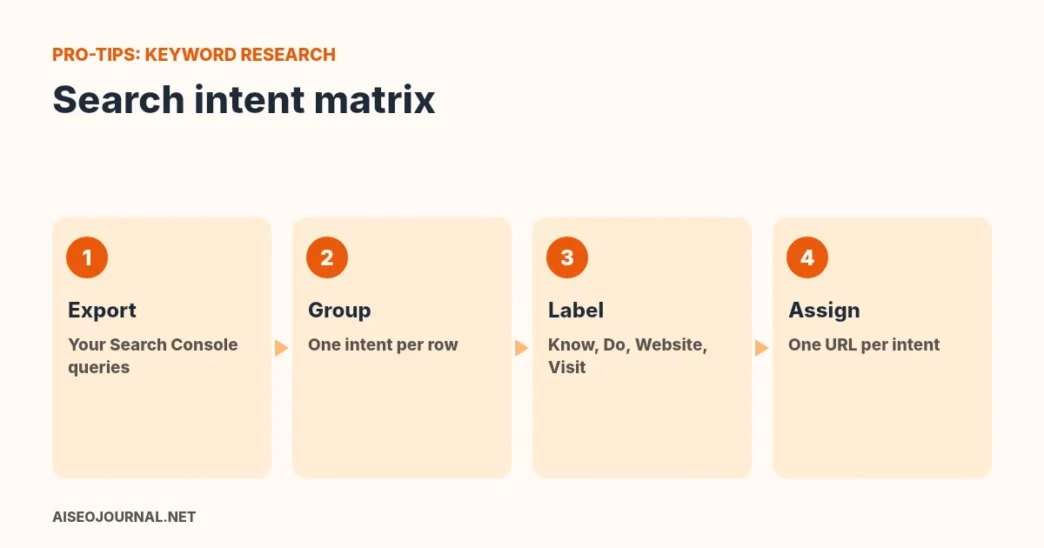
- Export your queries from the Performance report, with impressions and position[2]. Remove brand and site: searches.
- Group them by intent. If one page could answer all of them, they belong in one row.
- Label each group Know, Do, Website or Visit-in-person.
- Check the live results for the main search in each group and note the page type that ranks: a guide, a tool, a product page, a video.
- Assign one URL per row and a next action: write, update, merge or skip.
Fill in rows with the builder below.
Fill in one row at a time and paste it into your spreadsheet. The pipes become columns if you split on |.
One intent per row
Know, Do, Website or Visit-in-person
Guides, tools, product pages, videos, local results
Match what the results show
Existing page or 'new'
Write, update, merge or skip
Your row
Watch out
AI tools can label hundreds of keywords quickly, but they guess the intent from the words. Check a sample against the live results. Google’s own guidance warns against producing lots of content on many topics just to rank[3]; a matrix should cut your list, not inflate it.
Using the matrix
Professional tip
Add a column for “rows that point to the same URL”. If two rows share a URL with different intents, one page is trying to do two jobs; if two URLs share an intent, you have cannibalisation.
Frequently asked questions
What is a search intent matrix?
A table that maps each keyword group to its intent, the page type that satisfies it, and the URL that will serve it. It turns keyword research into a page plan.
What are the four types of search intent?
Google’s rater guidelines use Know (including Know Simple), Do, Website and Visit-in-person, and note that some queries have more than one intent.
How do I find the intent of a keyword?
Search it and look at the results. If they are guides, the intent is to learn; if they are tools or product pages, it is to do or buy; if one brand dominates, it is a website search.
How many keywords should one page target?
As many as share one intent. In our data, 144 searches about checking backlinks all fitted one page.
Build your first ten rows
Related guides: keyword mapping, Search Console keyword research and semantic keyword research.
Export last quarter’s queries today and build the first ten rows. The groups with the most impressions and a position between 8 and 20 are where the matrix pays off first.
How we checked this: we rewrote this guide on 27 November 2026. We opened every source below that day and read the “People also ask” box and top results for “search intent matrix” on Google UK. We did not run lab tests beyond what is described. No People also ask box appeared for this search on 27 November 2026. Our figures come from our Search Console account.
Sources
- Google — Search Quality Rater Guidelines (11 Sep 2025), section on user intent. Read on 27 November 2026.
- Search Console Help — Performance report (Search results). Read on 27 November 2026.
- Google Search Central — Creating helpful, reliable, people-first content (updated 5 Oct 2026). Read on 27 November 2026.