



Internal linking is treated as a content organisation task in most SEO workflows. That’s the wrong frame — and it’s the one that leaves the most accessible ranking improvement on the table.
Pages with strong external link equity that receive no internal links from that equity are leaving PageRank distribution incomplete. A blog post earning 12 editorial backlinks from DA 60+ publications is passing authority into the site — but if the site’s highest-priority commercial pages receive no internal links from that post, the authority arrives at the blog post and stops there. The commercial pages that need ranking improvement never benefit from the external links the brand worked to earn.
A deliberate internal linking strategy that routes authority from high-equity pages to target pages is consistently the fastest way to improve rankings for pages that already have strong content and sufficient on-page optimisation. It doesn’t require new content, new links, or technical changes — it requires a structured audit of where authority is sitting and a mapping of where it needs to go. This cluster covers that audit and that mapping. It’s the internal link building layer the Link Building in 2026: Digital PR, Entity Authority & AI Citation Strategies pillar delegates here.
Running an internal link audit for a UK fashion e-commerce client using Screaming Frog and Ahrefs, 847 pages were crawled. Twenty-three pages with strong external link equity were identified as receiving zero internal links from the site’s commercial category and product pages — the pages where ranking improvement mattered most. Adding strategic internal links from those 23 equity-holding pages produced an average ranking improvement of 4.2 positions across 11 target pages within 6 weeks. No new external links were acquired during that period. The friction was that the initial audit used only Screaming Frog’s link count report — which showed pages were “linked to” — without revealing whether the linking pages carried any external link equity. A page with 50 internal links pointing at it from pages with zero external equity is no better off than a page with no internal links at all. The equity-source audit was the step the standard Screaming Frog report doesn’t surface.
Post Summary
- Internal links distribute PageRank from high-equity pages to target pages — treating internal linking as a navigation task ignores the authority distribution function entirely
- The first step in a strategic internal linking audit is identifying which pages carry external link equity — not which pages receive the most internal links
- Screaming Frog maps link structure; Ahrefs identifies which pages in that structure carry URL Rating (UR) from external backlinks — both tools are required for a complete audit
- Three internal link types carry different authority distribution weights: body copy contextual links, pillar-to-cluster links, and hub page links — footer and sidebar links carry the weakest signal
- A UK fashion e-commerce audit identified 23 high-equity pages with no links to commercial target pages — adding strategic internal links produced 4.2 average position improvement across 11 pages in 6 weeks
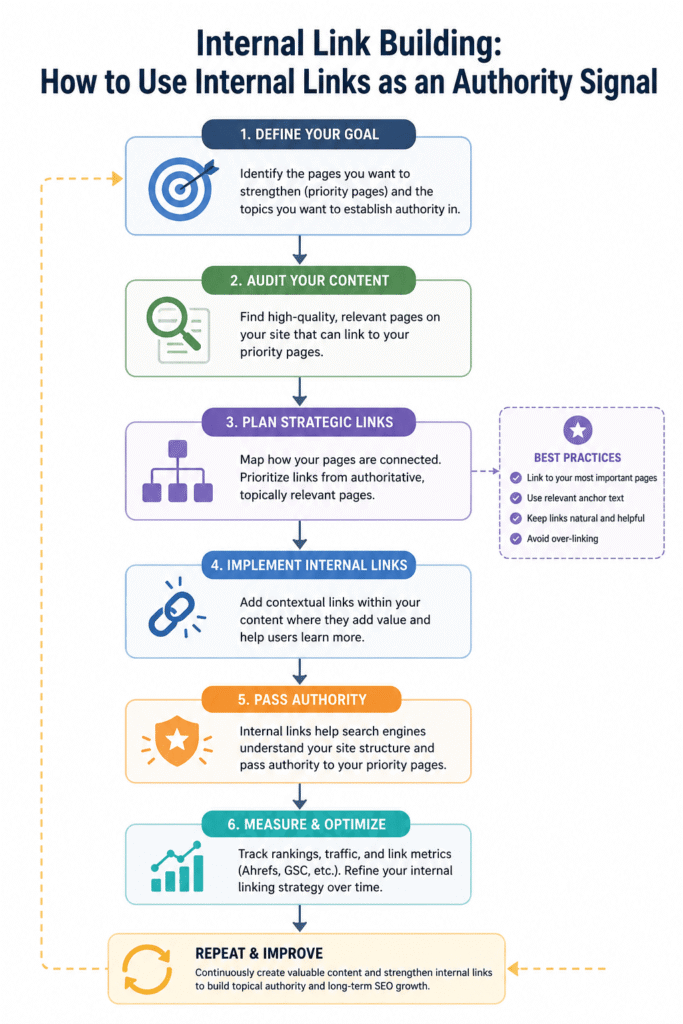
Table of Contents
ToggleWhy Internal Links Are an Authority Distribution Tool, Not a Navigation Tool
Google’s crawl and ranking system treats internal links as authority distribution signals — not just navigation paths. When Googlebot crawls a page with 8 external backlinks pointing at it, that page has accumulated URL Rating from those external links. Every followed internal link from that page passes a portion of its accumulated URL Rating to the destination page (Source: Google Search Central, 2024).
That’s not a metaphor. It’s the mechanism Google’s documentation describes as crawl priority and page importance propagation — the same underlying logic as PageRank, applied within a site’s own link structure. Pages that receive more internal links from high-UR pages accumulate higher internal authority signals, which Google factors into ranking alongside external backlink signals.
The practical implication is direct: a commercial page with strong on-page optimisation but few internal links from high-equity pages is underperforming relative to its content quality. Adding strategic internal links from pages that carry external link equity is the fastest path to ranking improvement for that page — faster than acquiring new external links, faster than on-page revisions, and considerably faster than producing new content.
Worth stating plainly: this only works when the internal links come from pages with genuine external link equity. An internal link from a page with zero external backlinks and UR 0 passes negligible authority. The equity-source audit that identifies which pages have authority to give is the step that makes the rest of the internal linking strategy meaningful.
Pro Tip: In Ahrefs Site Explorer, pull the Top Pages report sorted by UR (URL Rating) — not DR. UR reflects the individual page’s backlink equity, not the domain-wide average. Filter for UR 20+ to identify your highest-equity pages. These are your authority sources for internal linking — the pages that have the most to give and should be reviewed first for internal linking opportunities to your target pages.
Step 1 — The Equity-Source Audit: Which Pages Have Authority to Give
The equity-source audit is the step most internal linking guides skip. Without it, every subsequent decision in the internal linking strategy is made without knowing whether the links being added carry authority or not.
The equity-source audit runs in Ahrefs, not Screaming Frog. Screaming Frog maps the internal link structure — it shows which pages link to which pages and how many internal links each page receives. It doesn’t show which of those pages carries external link equity. Ahrefs’ URL Rating (UR) metric fills that gap.
Equity-source audit workflow:
- In Ahrefs Site Explorer, pull the Top Pages report for your domain. Sort by UR descending. Export the top 50 pages by UR.
- For each page in the top 50, note the UR, the number of external referring domains, and the page type (blog post, resource, news article, product page, category page).
- Cross-reference against your target pages — the commercial or high-priority pages where ranking improvement is the goal.
- For each high-UR page, open it and check: does it currently link to any of your target pages? If not, it’s an internal linking opportunity.
A high-UR blog post that earns no internal link from its content to the most relevant commercial category page is a missed authority distribution opportunity. That’s the gap the equity-source audit surfaces — and it’s the gap Screaming Frog’s link count report doesn’t show.
Step 2 — The Target Page Audit: Which Pages Need Authority
The target page audit identifies which pages in the site have strong content and on-page optimisation but are underperforming in rankings — indicating that authority distribution, not content quality, is the limiting variable.
Target page identification criteria:
| Signal | What It Indicates | Tool |
|---|---|---|
| Position 8–20 for primary keyword | Strong content, insufficient authority signal | Google Search Console |
| High impressions, low CTR | Ranking but not prominently enough | Google Search Console |
| Low UR relative to DR | External equity not reaching the page internally | Ahrefs Site Explorer |
| Few or zero internal links from high-UR pages | Authority isolation — content exists but equity doesn’t reach it | Screaming Frog + Ahrefs cross-reference |
Pages appearing in positions 8–20 with high impression counts are the highest-priority targets. They’re already in Google’s consideration set for the query — they just need authority reinforcement to move from page two into the top 5. An internal link from a high-UR page pointing to them is frequently sufficient to produce that movement, as the UK fashion e-commerce campaign confirmed.
Step 3 — Mapping Authority Flow: Connecting Sources to Targets
With the equity-source audit and target page audit complete, the internal linking map connects high-UR source pages to priority target pages through contextually relevant anchor text.
Three rules govern the mapping:
Rule 1 — Contextual relevance is required An internal link from a high-UR page passes authority and a topical signal. The anchor text and the surrounding content context determine which topic Google associates the target page with through that link. An internal link from a blog post on “sustainable fashion manufacturing” to a category page for “sustainable clothing” passes both authority and topical relevance — reinforcing the target page’s entity associations. A link from the same post to an unrelated product page passes authority without topical signal. Contextual relevance is not optional; it’s what makes the internal link carry both dimensions.
Rule 2 — Body copy links outperform navigation links Google’s Reasonable Surfer patent indicates that links within primary body content receive stronger weighting than links in navigational elements, footers, or sidebars — because users are more likely to click links within content they’re actively reading (Source: Ahrefs, 2023). Build the internal linking map using body copy link placements first. Navigation links and breadcrumbs supplement the structure but don’t replace the authority distribution function of body copy links.
Rule 3 — Limit links per source page Google distributes a fixed PageRank budget from each page across all outgoing links — internal and external. Adding internal links to a page that already has 80+ outgoing links produces diminishing returns because the budget is divided further with each addition. Source pages with fewer than 40 outgoing links are the highest-priority additions to the internal linking map.
Step 4 — Pillar-to-Cluster Internal Linking: The Topical Authority Layer
Beyond individual page-to-page authority routing, internal linking serves a second function in sites using a pillar-and-cluster content architecture: topical authority signalling.
A pillar page — like the Link Building in 2026: Digital PR, Entity Authority & AI Citation Strategies pillar — links to every cluster post in its topic group. Each cluster post links back to the pillar. That bidirectional linking structure tells Google that these pages form a coherent topical cluster — reinforcing the site’s entity authority for the topic area alongside the PageRank distribution function.
For sites already using pillar-and-cluster architecture, the internal linking audit has two components: the equity-source audit (which high-UR pages link to which target pages) and the cluster completeness audit (which cluster posts are missing their pillar backlink or their sibling cross-links).
A cluster post that doesn’t link back to its parent pillar is an incomplete topical authority signal. A pillar page that doesn’t link to all its cluster posts is leaving authority distribution gaps. Both are audit findings that take under 30 minutes per cluster to fix — and both affect topical authority signal strength in Google’s entity relevance evaluation.
For how that entity relevance signal interacts with external link building, see Entity Authority Backlinks: How to Build Links That Strengthen Knowledge Graph Presence.
Step 5 — Monitoring Internal Link Authority Distribution
Adding internal links is not a one-time task. As new content is published, new high-UR pages emerge, and target page priorities shift — the internal linking map needs quarterly review.
Three monitoring checks maintain the system:
Check 1 — New high-UR page identification Every new blog post or resource that earns external links becomes a new potential authority source. Monthly UR review in Ahrefs Top Pages identifies newly equity-rich pages that haven’t yet been added to the internal linking map.
Check 2 — Orphan page detection Screaming Frog’s crawl identifies pages receiving zero internal links — orphan pages that Google may struggle to discover and prioritise. Any target page appearing as an orphan should be treated as an urgent fix: add at least 2–3 internal links from relevant, high-UR pages immediately.
Check 3 — Broken internal link cleanup Internal links pointing to 404 pages create PageRank leakage — the authority budget allocated to those links is lost rather than distributed. Screaming Frog’s broken link report run monthly catches these before they accumulate. Every broken internal link fixed is authority recovered.
Frequently Asked Questions
What are internal links and why do they matter for SEO? Internal links are hyperlinks from one page on a site to another page on the same domain. They matter for SEO in two ways: they help Google discover and crawl pages across the site, and they distribute PageRank — link authority — from pages that have accumulated external backlink equity to pages that need it. A deliberate internal linking strategy routes that authority to the highest-priority target pages rather than leaving it concentrated on pages where ranking improvement is less valuable.
How do internal links pass authority between pages? Google assigns each page a PageRank budget based on the external backlinks pointing at it. That budget is distributed across all outgoing links from the page — internal and external. Each internal link passes a portion of the page’s PageRank budget to its destination, raising the destination page’s authority signal. Body copy links within primary content carry stronger weighting than footer, sidebar, or navigation links because Google’s Reasonable Surfer model weights links by user click probability.
How many internal links should a page have? There’s no fixed limit — Google has stated it can crawl hundreds of links per page. The practical consideration is PageRank dilution: each additional outgoing link reduces the authority passed through every other link. Pages with fewer than 40 total outgoing links are the most valuable internal linking sources. Adding links to pages already carrying 80+ outgoing links produces diminishing authority distribution returns.
What is URL Rating and how does it differ from Domain Rating? URL Rating (UR) is Ahrefs’ metric for the authority of an individual page based on the external backlinks pointing specifically at that URL — not the domain overall. Domain Rating (DR) measures the domain-wide backlink profile strength. For internal linking strategy, UR is the relevant metric: a blog post with UR 32 on a DR 45 domain is a stronger internal linking source than a product page with UR 8 on the same domain, regardless of the domain’s overall DR.
How do I find internal linking opportunities with Ahrefs? In Ahrefs Site Explorer, pull the Top Pages report sorted by URL Rating descending to identify high-equity pages. Then use Ahrefs’ Link Opportunities report in Site Audit — it cross-references pages by keyword rankings and identifies which pages should link to each other based on topical relevance. Cross-reference the Link Opportunities output against your target page list to prioritise additions that route authority from high-UR sources to commercially important destination pages.
What to Do Next
The equity-source audit is the starting point — not a Screaming Frog link count report. Open Ahrefs Site Explorer, pull the Top Pages report sorted by URL Rating descending, and export the top 30 pages. For each page in the top 10, check whether it links to your three highest-priority commercial or target pages. Every page in the top 10 that doesn’t link to a priority target is an internal linking opportunity that costs nothing to implement and takes under 10 minutes per page to add.
Run the Screaming Frog crawl in parallel and cross-reference its orphan page report against your target page list. Any target page appearing as an orphan gets at least 3 internal links added immediately — from the highest-UR pages on the site that have contextual relevance to the orphan’s topic.
The Link Building in 2026: Digital PR, Entity Authority & AI Citation Strategies pillar covers the full strategy this internal linking layer supports. External link building earns the equity; internal linking distributes it.
References
Google Search Central. In-Depth Guide to How Google Search Works.” Google Search Central, 2024. https://developers.google.com/search/docs/fundamentals/how-search-works Supports: PageRank distribution through internal links; crawl priority and page importance propagation mechanics.
Ahrefs. “Internal Links for SEO: An Actionable Guide.” Ahrefs Blog, 2024. https://ahrefs.com/blog/internal-links-for-seo/ Supports: URL Rating as an internal linking equity metric; body copy link weighting; internal link opportunity identification workflow.
Ahrefs. “Here’s Why You Should Prioritize Internal Linking This Year.” Ahrefs Blog, 2023. https://ahrefs.com/blog/prioritize-internal-linking/ Supports: Reasonable Surfer patent and body copy link weighting; PageRank budget distribution across outgoing links; Middleman Method for authority bridging.
Google Search Central. December 2022 Link Spam Update.” Google Search Central Blog, 2022. https://developers.google.com/search/blog/2022/12/december-22-link-spam-update Supports: External link equity as the source of authority internal links distribute; SpamBrain context for why internal linking complements external link acquisition.
Search Engine Journal. Ask An SEO: Digital PR Or Traditional Link Building, Which Is Better?” Search Engine Journal, 2025. https://www.searchenginejournal.com/ask-an-seo-digital-pr-or-traditional-link-building-which-is-better/553879/ Supports: Internal linking as a complementary authority distribution layer to external editorial link building.