

Your site’s buried on page 47 because Google can’t crawl it properly, your indexation is a mess, and you’re losing $50K monthly to technical issues you didn’t even know existed. Manual technical SEO audits take weeks, miss critical problems, and by the time you spot issues, the damage is done. AI for technical SEO changes everything—machine learning catches crawl errors in minutes, predicts indexation problems before they tank rankings, and automates the tedious technical work that used to consume your entire week.
Table of Contents
ToggleWhat Is AI for Technical SEO?
Artificial intelligence in technical SEO means using machine learning algorithms to analyze, monitor, and optimize the technical foundation of your website. Instead of manually checking thousands of pages for issues, AI does it automatically—faster, more accurately, and continuously.
Traditional technical SEO involves crawling sites with tools like Screaming Frog, exporting data to spreadsheets, and manually identifying problems. AI flips this model by learning patterns, detecting anomalies, and predicting issues before they hurt rankings.
Think of it as upgrading from a manual car inspection to having sensors that alert you the moment something goes wrong. AI-powered technical SEO tools don’t just find problems—they understand context, prioritize by business impact, and often suggest fixes automatically.
The Evolution: Manual to AI-Driven Technical SEO
Five years ago, technical SEO meant weekly crawls, monthly audits, and hoping you caught problems before Google did. Tools reported what they found, but humans had to interpret everything and decide what mattered.
Machine learning SEO analysis changed this by recognizing patterns humans miss. AI identifies that 300 product pages developed identical technical issues within 10 minutes—flagging it as a template problem, not 300 individual errors.
The shift accelerated when Google itself started using AI heavily in search algorithms. RankBrain, BERT, MUM—all machine learning systems that understand content and user intent. Fighting AI-powered algorithms with manual processes stopped making sense.
Now 86% of SEO professionals use AI tools in their strategies, with 83% of enterprise teams reporting improved performance after adoption, according to SEOClarity’s 2024 survey. The technology matured from experimental to essential.
Pro Tip: AI technical SEO isn’t about replacing human expertise—it’s about augmenting it. Use AI to handle the repetitive analysis and monitoring, freeing your time for strategy, creative problem-solving, and high-impact optimizations that machines can’t figure out.
Why Traditional Technical SEO Methods Can’t Keep Up
Manual technical audits worked when sites had 100 pages and updated monthly. Modern sites have thousands of pages, deploy updates daily, and operate across multiple platforms and markets.
The scale problem is brutal. A thorough page-level technical audit takes 15-20 minutes per URL. For a 10,000-page site, that’s 2,500+ hours—more than a full year of work for one person.
Speed: AI Processes in Minutes What Takes Humans Weeks
An AI crawler analyzes 10,000 pages in 30-60 minutes, identifying technical issues, scoring them by severity, and prioritizing fixes by business impact. The same work takes a human 3-4 weeks of full-time effort.
But speed isn’t just about saving time—it’s about catching problems before they cause damage. Automated technical SEO monitoring detects a robots.txt misconfiguration within 8 minutes of deployment. Manual checking wouldn’t catch this until your next scheduled audit, days or weeks later.
A SaaS company deployed a CMS update that accidentally blocked their entire documentation section. AI monitoring caught it in 14 minutes and alerted the team. Manual discovery would’ve happened during their weekly Wednesday check—5 days of lost traffic and support ticket chaos.
Accuracy: AI Catches What Humans Overlook
Humans get tired, lose focus, and make mistakes. Page 1,000 of a technical audit receives less attention than page 1, even though it might be equally important.
AI technical SEO audits apply identical criteria to every URL. No fatigue, no shortcuts, no pattern blindness from reviewing thousands of similar pages.
A publishing site had 2,847 broken internal links. Manual review prioritized by link count. AI clustering revealed 89% originated from a single legacy widget—one template fix eliminated 2,532 errors versus weeks of individual URL fixes.
Machine learning also spots correlation patterns humans miss. AI detected that pages with slow server response times (2.8s+) had 34% higher bounce rates, which correlated with 67% drop in conversions on mobile. One technical fix (server optimization) solved what looked like multiple separate problems.
Consistency: Continuous Monitoring vs. Periodic Audits
Manual audits happen weekly, monthly, or quarterly. Problems emerging between audits damage your site until the next check discovers them.
Real-time technical SEO monitoring operates 24/7, detecting issues within minutes. A noindex tag accidentally added to product pages gets caught before Google’s next crawl, preventing deindexation entirely.
According to HubSpot’s 2024 State of AI report, 75% of marketers use AI to reduce time spent on manual tasks like technical audits and monitoring. The time savings average 1 hour daily per person—equivalent to 37 work days annually.
SEOProJournal.com
AI Technical SEO Implementation - Interactive Workflow
AI Technical SEO Implementation Workflow
Click on any node to view detailed information
SEOProJournal.com
Core AI Applications in Technical SEO
AI-powered SEO automation handles specific technical challenges that used to require extensive manual work. Let’s break down the key applications transforming technical SEO workflows.
AI-Powered Crawl Simulation and Analysis
Google crawls your site differently than traditional SEO tools. AI crawl simulators predict Googlebot behavior by analyzing historical crawl patterns, resource consumption, and priority signals.
Traditional crawlers follow every link indiscriminately. AI simulators consider crawl budget allocation, rendering costs, and page importance signals—mimicking how Google actually prioritizes crawling your content.
Intelligent crawl budget optimization identifies where Google wastes crawl resources. An enterprise site discovered Googlebot spending 34% of daily crawl budget on URL parameters from internal site search—generating zero organic traffic. AI calculated this wasted 12,000+ daily crawls that could’ve been used on product pages.
Machine learning models analyze server logs to detect Googlebot’s preferences: which URL structures get crawled most frequently, time gaps between recrawls, and which internal linking paths bots follow most often.
Automated Indexation Monitoring and Alerts
Your best content isn’t ranking because Google can’t index it. AI indexation monitoring detects crawl errors, coverage problems, and technical issues within minutes—before they destroy rankings.
ContentKing and similar platforms check your site continuously, alerting when noindex tags appear on pages that should rank, when robots.txt changes block important sections, or when canonical errors prevent indexation.
Real-time indexation alerts caught a financial services site’s accidental blog section blocking via robots.txt in 18 minutes. Manual monthly audits would’ve discovered this 30 days later—losing $28,000 in estimated organic revenue.
AI learns normal patterns for your site’s index coverage. When indexed page counts drop 8.4% over 48 hours (versus typical 2-3% fluctuation), machine learning flags the anomaly for immediate investigation.
Semrush’s 2024 data shows 68% of businesses achieve higher content marketing ROI after implementing AI monitoring tools. The improvement comes from catching and fixing technical problems before they cascade into traffic losses.
Machine Learning for Site Speed Optimization
Core Web Vitals affect rankings, but identifying what slows your site requires analyzing thousands of performance signals. AI performance analysis pinpoints bottlenecks automatically.
Instead of manually reviewing waterfall charts for every page, machine learning identifies common patterns: render-blocking JavaScript affecting 4,200 pages, oversized images on mobile, third-party scripts causing delays.
A retail site had Core Web Vitals failures on mobile. AI analysis revealed the root cause wasn’t image sizes (the suspected culprit) but render-blocking CSS from their design framework. One configuration change fixed 89% of affected pages.
Predictive performance monitoring alerts when page speed degrades before it reaches critical thresholds. AI detected a gradual CDN performance decline over 10 days, flagging it for investigation before it caused measurable traffic impact.
AI-Driven Internal Linking Optimization
Manual internal linking breaks down at scale. AI analyzes semantic relationships between content, identifies orphaned pages, and suggests contextual links you’d never spot manually.
Automated internal link suggestions use natural language processing to understand topic relationships. When analyzing a page about “JavaScript frameworks,” AI recognizes connections to React tutorials, web performance content, and API integration articles—even if those exact phrases don’t appear.
Machine learning identifies which internal linking patterns drive engagement and conversions. A B2B site’s AI analysis showed internal links between blog content and product pages increased product page traffic by 31%, while links between product categories showed no measurable impact.
An e-commerce platform with 15,000 product URLs used AI to identify 12 distinct URL patterns covering 89% of products, then suggested individual mappings for the remaining 11% with unique structures. Total mapping time: 8 hours versus estimated 300+ hours manually.
Automated Redirect Mapping for Migrations
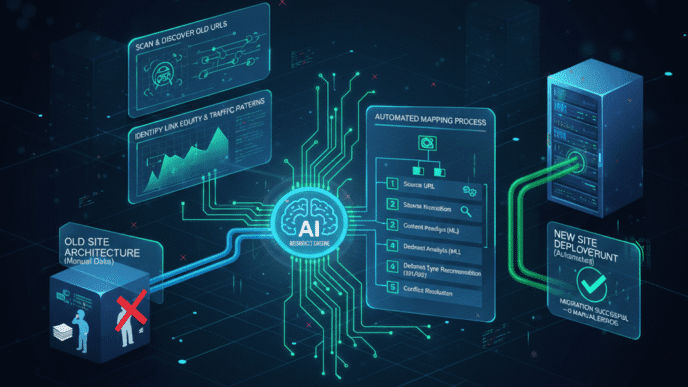
Site migrations terrify SEOs because one wrong redirect mapping tanks rankings for months. AI redirect mapping analyzes content similarity to match old and new URLs accurately—without weeks of manual spreadsheet work.
Traditional redirect creation relies on pattern matching (all /category/* redirects to /new-category/*). This breaks when URL structures don’t align perfectly or when content consolidates.
Machine learning URL matching reads actual page content, recognizing that /2019/03/email-marketing-tips and /resources/email-strategy-guide cover the same topic despite completely different URLs. Content similarity analysis (85%+ threshold) ensures accurate mapping.
A legal services firm migrated 2,800 practice area pages with restructured URLs. AI matched pages with only 40% URL similarity but 85%+ content similarity—correctly mapping despite totally different naming conventions.
AI handles complex scenarios like content consolidation (five old posts merging into one guide), category restructuring (combining similar categories), and identifying pages with no equivalent (suggesting relevant alternatives versus defaulting to homepage).
Log File Analysis and Googlebot Behavior Prediction
Server logs show exactly how Google crawls your site—which pages get visited, crawl frequency, response codes, and bandwidth consumption. Analyzing logs manually is impractical at scale.
AI log file analysis processes millions of log entries, identifying patterns in Googlebot behavior. Machine learning detects when Google stops crawling previously regular pages, when crawl rate drops unexpectedly, or when bots waste time on low-value URLs.
OnCrawl uses AI to correlate crawl data with indexation and ranking changes. Their analysis showed that pages Google crawled more than 5 times monthly maintained better rankings than pages crawled weekly or less.
AI predicts how technical changes affect future crawling. Before launching a site restructure, machine learning models estimate how Google will discover and recrawl the new architecture—preventing migration disasters.
Schema Markup Validation and Generation
Structured data helps Google understand your content, but schema errors hide in templates affecting thousands of pages. AI schema validation catches systemic markup problems instantly.
Traditional validation checks one URL at a time through Google’s Rich Results Test. AI crawls your entire site, validates all structured data, and clusters errors by template—identifying that 4,200 recipe pages miss the “cookTime” property required for recipe cards.
Some advanced tools use automated schema generation based on page content. AI reads a product page, identifies key entities (price, availability, reviews), and suggests appropriate schema markup automatically.
A news publisher had valid schema markup on spot checks but AI detected that 3,800 articles used outdated schema.org vocabulary versions. Updating the template to current standards recovered rich snippets across the entire archive.
Best AI Tools for Technical SEO in 2025
The AI SEO tools market grew from $1.2 billion in 2024 to a projected $4.5 billion by 2033, representing 15.2% CAGR according to Verified Marketer Reports. Here are the platforms leading technical SEO automation.
Screaming Frog SEO Spider (AI-Enhanced)
The industry-standard crawler added AI modules for pattern detection and anomaly identification. Machine learning surfaces actionable insights from crawl data that would take hours to discover manually.
Best for: Large-scale websites (10,000+ pages), complex site migrations, deep technical investigations where raw data analysis is crucial.
Key AI features: Pattern recognition across URL structures, automated issue prioritization by traffic impact, predictive crawl budget analysis.
Pricing: $259/year for unlimited crawling with AI features.
The tool processes vast datasets efficiently—crawling 50,000 pages in under 30 minutes while AI algorithms identify common issues, suggest fix priorities, and flag anomalies deviating from site norms.
Botify Intelligence Platform
Botify combines crawl data, log file analysis, and machine learning to understand how Google actually interacts with your site—not just how it theoretically should.
Best for: Enterprise sites (50,000+ pages) with complex technical requirements, data-driven teams needing deep analytics.
Key AI features: Real-time Googlebot behavior prediction, automated crawl budget optimization, AI-powered migration planning.
Pricing: Custom enterprise (typically $20,000+/year).
Their machine learning models analyze historical crawl patterns to predict how technical changes affect future Google behavior. AI detected that one client’s infinite scroll implementation prevented Google from discovering 40% of their content.
ContentKing: Real-Time SEO Monitoring
ContentKing pioneered continuous monitoring, checking sites 24/7 and alerting within minutes when technical issues appear.
Best for: Sites making frequent updates where timing matters—e-commerce, news publishers, enterprise sites with multiple teams deploying changes.
Key AI features: Instant change detection, automated issue prioritization, pattern recognition for template-level problems.
Pricing: From $199/month for 10,000 URLs.
The platform monitors every page continuously. When a developer accidentally deployed staging robots.txt to production (blocking all documentation), ContentKing alerted within 8 minutes—before significant traffic loss occurred.
Ahrefs Site Audit with AI Insights
Ahrefs integrated machine learning throughout their technical audit tool, providing AI-driven prioritization and automated recommendations.
Best for: SEOs needing comprehensive technical audits with competitive analysis and backlink context.
Key AI features: Automated issue prioritization, content quality scoring, predictive impact analysis.
Pricing: From $129/month (includes full Ahrefs suite).
AI prioritizes issues by combining technical severity with business impact—factoring in organic traffic, keyword rankings, and backlink profiles. A critical error on a zero-traffic page gets lower priority than a minor issue on your highest-converting page.
OnCrawl: AI-Powered Log Analysis
OnCrawl specializes in correlating crawl data with server logs, using machine learning to understand Googlebot’s actual behavior versus theoretical crawlability.
Best for: Large sites (50,000+ pages) where understanding Google’s crawl patterns matters as much as detecting technical issues.
Key AI features: Predictive crawl behavior modeling, automated crawl budget allocation recommendations, AI-powered segmentation.
Pricing: Custom enterprise ($500+/month typically).
Their unique approach identifies pages being crawled by Google but generating no traffic (wasted crawl budget) versus pages receiving traffic but rarely crawled (missed opportunities).
Surfer SEO: Content + Technical Optimization
Surfer expanded beyond on-page content optimization to include AI-powered technical recommendations based on competitor analysis.
Best for: SEO teams optimizing existing content who want technical and content suggestions unified.
Key AI features: Competitive technical analysis, automated internal linking suggestions, performance benchmarking.
Pricing: From $89/month.
AI analyzes top-ranking competitors’ technical implementations and suggests similar optimizations for your content—including internal link structures, schema markup patterns, and page speed configurations.
Comparison: Top AI Technical SEO Tools
| Tool | Best For | Key AI Feature | Pricing | Automation Level |
|---|---|---|---|---|
| Screaming Frog | Large sites (10K+ pages) | Pattern detection | $259/year | Medium – requires analysis |
| Botify | Enterprise (50K+ pages) | Googlebot prediction | Custom ($20K+/yr) | High – automated insights |
| ContentKing | Real-time monitoring | Instant change detection | $199/month | High – continuous alerts |
| Ahrefs | All-in-one SEO | Impact prioritization | $129/month | Medium – guided recommendations |
| OnCrawl | Log file analysis | Crawl behavior modeling | Custom ($500+/mo) | High – predictive analytics |
| Surfer SEO | Content + technical | Competitive benchmarking | $89/month | Medium – suggestion-based |
How to Implement AI in Your Technical SEO Workflow
Starting with AI-powered technical optimization requires strategy beyond just subscribing to tools. Here’s the practical implementation framework.
Step 1: Audit Your Current Technical SEO State
Before implementing AI, establish baselines. Run comprehensive crawls using Screaming Frog or Sitebulb to document current technical health.
Export key metrics: total pages, indexable pages, error counts by type (404s, 500s, redirect chains), average page speed, mobile usability scores, schema markup coverage.
Identify your biggest technical pain points. Are you struggling with crawl budget waste? Indexation problems? Site speed? Internal linking chaos? Focus AI implementation on your most critical issues first.
A financial services company’s baseline audit revealed 23% of pages were orphaned, 11% had zero outbound internal links (dead ends), and their highest-linked pages were legal disclaimers—not money pages. This data informed their AI tool priorities.
Step 2: Choose AI Tools Based on Actual Needs
Don’t buy every AI tool. Select platforms addressing your specific technical challenges and site characteristics.
Small to mid-size sites (under 10,000 pages): Start with Ahrefs or Surfer SEO for integrated technical + content optimization without enterprise complexity.
Large sites (10,000-50,000 pages): Screaming Frog with AI features plus ContentKing for real-time monitoring provides comprehensive coverage.
Enterprise sites (50,000+ pages): Botify or OnCrawl for advanced analytics, log file integration, and predictive modeling.
Consider your team’s technical expertise. Some tools require data analysis skills; others provide simple actionable recommendations. Match tool complexity to your team’s capabilities.
Step 3: Configure Monitoring and Alert Thresholds
AI tools bombard you with alerts if not configured properly. Set intelligent thresholds preventing alert fatigue while catching critical issues.
Critical alerts (homepage down, mass deindexing, robots.txt blocking site): Immediate emergency notifications via SMS, Slack, email to on-call team.
High priority (product pages with issues, key landing pages affected): Email and Slack during business hours to SEO team.
Medium priority (blog posts with problems, minor technical issues): Daily digest email summarizing issues.
Low priority (expected errors, low-traffic pages): Weekly reports for routine maintenance review.
Start with conservative thresholds. If you get 50 daily alerts, your team ignores all of them—including critical ones. Adjust based on actual issue patterns over 2-4 weeks.
Step 4: Integrate AI Insights Into Team Workflows
AI tools provide insights—but humans must act on them. Build processes ensuring AI findings drive actual improvements.
Create a weekly technical SEO review meeting. AI tools generate the agenda: top priority issues discovered, traffic impact analysis, recommended fixes ranked by ROI.
Assign ownership for different issue categories. Developers handle server configuration and rendering problems. Content team fixes thin content flagged by AI. SEO team manages meta tags and schema markup.
Use project management tools (Asana, Jira, Monday) to track AI-identified issues through resolution. Link directly from AI platforms to task management so nothing falls through cracks.
A SaaS company integrated ContentKing alerts into their Slack #engineering channel. Critical technical SEO issues automatically created Jira tickets assigned to relevant developers—no manual triage needed.
Expert Insight: “The teams seeing best results from AI technical SEO aren’t necessarily the most technical—they’re the most organized. Having clear processes for reviewing AI insights, prioritizing fixes, and measuring impact matters more than having the fanciest tools.” — Enterprise SEO Director managing 15 sites
Step 5: Measure Impact and Iterate
Track how AI-recommended technical fixes affect business outcomes—not just technical scores.
Before/after analysis: Document organic traffic, indexed pages, crawl efficiency, and Core Web Vitals before implementing AI recommendations. Measure again 4-8 weeks post-implementation.
Attribution by fix type: Track which technical improvements drive measurable results. A retailer found that AI-recommended canonical fixes increased traffic 23%, while page speed improvements showed only 6% lift—informing future priorities.
Cost-benefit calculation: Compare AI tool costs against prevented revenue loss and recovered traffic. One prevented major technical disaster often justifies years of monitoring costs.
According to Semrush’s 2024 research, 65% of businesses notice better SEO results after implementing AI, while 67% report improved content quality—demonstrating measurable ROI across multiple dimensions.
Common Mistakes When Using AI for Technical SEO
Even sophisticated AI tools create problems if used incorrectly. Avoid these implementation pitfalls.
Blindly Trusting AI Recommendations Without Context
AI suggestions optimize for algorithms but sometimes miss business context. A tool might recommend noindexing thin content pages that actually convert well or drive qualified leads.
Always verify AI recommendations against business data. Check Analytics for conversion rates, engagement metrics, and actual user behavior before implementing suggested changes.
A B2B company’s AI flagged 400 product comparison pages as “thin content” recommending consolidation. Manual review showed these pages generated 34% of qualified demo requests—high business value despite low word counts.
Over-Optimizing Based on AI Scores
Chasing perfect technical SEO scores becomes counterproductive. AI tools show “98% health score possible with 47 more fixes”—but those fixes might affect zero-traffic pages.
Focus on fixes impacting pages that actually drive revenue. Return on effort beats perfect scores. Fixing one critical issue on high-converting pages delivers more value than fixing 100 minor issues on archive pages.
AI provides endless optimization opportunities. Discipline means prioritizing the 20% of issues causing 80% of problems rather than trying to achieve 100% perfection.
Ignoring False Positives
AI systems generate false positives—flagging issues that aren’t actually problems for your specific situation.
Common false positives include: intentional noindex tags on search result pages, correctly blocked admin areas, expected duplicate content (printer versions, AMP pages), and temporary server blips that immediately resolve.
Configure AI tools to learn your site’s normal patterns. If staging URLs typically appear for 20-30 minutes post-deployment before getting blocked, teach the system not to alert on this expected behavior.
Automating Without Human Oversight
Some platforms offer automated fixes—AI implements changes without human approval. This sounds efficient but creates disasters when AI misinterprets situations.
A news site let AI automatically generate meta descriptions for all articles. The tool created technically correct but tone-deaf descriptions: “Murder Suspect Arrested After Three Die” became “Local Man Achieves Career Milestone.”
Always require human approval before AI modifies live site content, especially for customer-facing elements like meta descriptions, titles, or visible content.
Neglecting Cross-Department Collaboration
Technical SEO affects multiple teams—developers build site architecture, content creators publish pages, designers determine user experience. AI tools can’t fix organizational silos.
Implement regular cross-functional reviews of AI findings. When ContentKing alerts about rendering issues, developers need to be in the loop. When Botify identifies crawl budget waste, content team needs context.
Create shared dashboards where all stakeholders see AI insights relevant to their work. DevOps sees server performance trends, content team sees indexation alerts, executives see traffic impact summaries.
Real-World Results: AI Technical SEO Case Studies
Let’s examine actual implementations showing measurable impact from AI technical optimization.
Case Study 1: E-commerce Site Recovers Traffic After AI-Detected Issues
A retail site with 12,000 product pages experienced gradual organic traffic decline over 8 weeks—15% total drop. Manual audits found nothing obviously broken.
AI Solution: OnCrawl’s log file analysis revealed Google had reduced crawl rate by 40% over the same period. Machine learning identified the cause: server response times degraded from 0.8s to 2.1s during peak traffic hours.
Implementation: AI correlated slow response times with specific database queries triggered by faceted navigation. Developers optimized queries and implemented caching.
Results:
- Server response times improved to 0.6s average
- Google’s crawl rate recovered to baseline within 2 weeks
- Indexed product pages increased 18% (previously uncrawled pages discovered)
- Organic traffic recovered fully plus additional 12% growth
Timeline: Issue detection to full recovery took 3 weeks. Manual discovery would’ve taken months of investigating traffic reports without identifying the technical root cause.
Case Study 2: Publishing Site Prevents Indexation Disaster
A news publisher deployed CMS update affecting 45,000 article pages. QA tested homepage, section fronts, and 20 sample articles—everything looked fine.
AI Solution: ContentKing detected 8,400 articles suddenly acquired noindex tags within 30 minutes of deployment. The CMS update had a template bug affecting articles older than 6 months.
Implementation: Development team rolled back the CMS update within 2 hours of ContentKing alert. Fixed the template bug, redeployed after proper testing.
Results:
- Prevented mass deindexing of 8,400 articles (18% of site content)
- Estimated traffic loss avoided: $140,000 monthly organic revenue
- No ranking impact since fix deployed before Google’s next crawl of most affected pages
Key insight: Manual QA tested recent articles (all fine) but missed the bug affecting older content. AI’s continuous monitoring caught what selective sampling missed.
Case Study 3: SaaS Company Optimizes Crawl Budget
A B2B SaaS documentation site had 8,000 help articles but complained that Google wasn’t indexing new docs quickly enough—sometimes taking 2-3 weeks for new articles to appear in search.
AI Solution: Botify analysis revealed Google spent 62% of daily crawl budget on changelog pages (version history) that generated zero organic traffic. These pages updated frequently, consuming crawl resources while valuable docs got crawled weekly at best.
Implementation:
- Added changelog pages to robots.txt (disallowed from crawling)
- Implemented strategic internal linking to prioritize important doc pages
- Optimized XML sitemap to highlight frequently updated valuable content
Results:
- Crawl budget redirected to high-value documentation pages
- Google crawling frequency increased 340% for priority docs
- New article indexation time dropped from 14-18 days to 2-4 days
- Organic traffic to documentation increased 29% over 8 weeks
ROI: Botify cost $1,800/month; incremental traffic worth estimated $12,000 monthly—667% ROI within 2 months.
Advanced AI Techniques for Technical SEO
Beyond basic automation, sophisticated implementations extract maximum value from AI technical optimization.
Predictive Technical SEO
Machine learning prediction models identify problems before they occur by analyzing patterns leading to issues.
AI monitors crawl rate trends, detecting when Google reduces crawling frequency even when no obvious technical problems exist yet. This early warning lets you investigate before traffic impact occurs.
A news publisher’s AI noticed Google’s crawl rate declining 15% over 10 days despite consistent publishing. Predictive analysis flagged this as early warning of potential quality concerns. Investigation revealed CDN configuration gradually degrading response times—fixed before major indexation impact.
Competitive Technical Analysis
AI doesn’t just analyze your site—it compares your technical implementation against competitors ranking for target keywords.
Automated competitive benchmarking identifies technical advantages competitors have: faster page speed, better internal linking density, more comprehensive schema markup, optimal content depth.
Surfer SEO’s AI analyzed a fintech site against top 3 competitors for “business credit cards.” Analysis revealed competitors all had structured FAQ schema (site didn’t), averaged 2,400 words (site had 1,200), and linked internally to comparison tools (site had none). Implementing these patterns improved rankings from position 12 to position 4.
Multi-Site Portfolio Optimization
Agencies and enterprises managing dozens of sites need portfolio-level visibility identifying which properties need immediate attention.
AI portfolio dashboards provide unified views showing:
- Which sites have critical issues requiring immediate action
- Overall portfolio health scores and trends
- Comparative analysis (sites performing above/below portfolio average)
- Shared issues affecting multiple sites (suggesting platform or service-wide problems)
An agency managing 40 client sites used AI portfolio monitoring to detect that 12 sites simultaneously developed similar indexation issues—investigation revealed their shared hosting provider had deployed a faulty robots.txt handler affecting all hosted sites.
Voice Search and Featured Snippet Optimization
AI identifies technical optimization opportunities for voice search results and featured snippets—formats requiring specific technical implementations.
Natural language processing analyzes your content against featured snippet patterns, identifying pages that could rank for position zero with technical adjustments: adding definition lists, implementing FAQ schema, restructuring content with clear question-answer formats.
Machine learning predicts which pages have highest probability of capturing featured snippets based on current rankings (positions 1-5), content structure, and user query patterns.
International SEO and Hreflang Automation
Multi-language, multi-region sites generate hreflang complexity impossible to manage manually. AI validates international technical implementation at scale.
Automated hreflang analysis checks:
- Reciprocal hreflang links (each language version must reference others correctly)
- Proper ISO language and country codes
- Self-referencing canonical tags not conflicting with hreflang
- Consistent URL patterns across language versions
- Missing x-default tags for international targeting
A global retailer with 12 languages and 18 country sites had 216 possible hreflang relationships per URL. AI found 2,400+ errors—mostly missing reciprocal links and incorrect codes. Fixing increased international organic traffic 52% over 12 weeks.
The Future of AI in Technical SEO
Machine learning capabilities continue evolving rapidly. Emerging technologies will further automate technical optimization.
Predictive Algorithm Updates
Future AI will predict Google algorithm updates before they roll out by analyzing pattern changes in search results, SERP features, and ranking fluctuations across thousands of sites.
Early detection systems will alert you that algorithm behavior is shifting—allowing preemptive optimizations before official updates impact your rankings.
Self-Healing Technical Infrastructure
Advanced implementations will detect technical issues and automatically fix them at infrastructure level without human involvement.
AI identifies server performance degradation, automatically scales resources, adjusts caching policies, and optimizes configurations—maintaining technical health autonomously.
Natural Language Technical SEO Management
Instead of navigating complex dashboards, you’ll describe goals conversationally: “Improve our crawl efficiency for product pages” or “Why did organic traffic drop 15% this week?”
AI will investigate, identify root causes, suggest fixes, and implement approved changes—all through natural language interaction.
Cross-Platform Technical Optimization
As search diversifies beyond Google (ChatGPT search, Perplexity, Bing AI), future tools will optimize technical implementation across multiple search platforms simultaneously.
AI will understand different crawling behaviors, indexation requirements, and ranking factors across platforms—ensuring your technical foundation works optimally everywhere users search.
Visual and Voice Search Technical Optimization
Current technical SEO focuses primarily on text-based search. Future AI will optimize for image recognition (Google Lens), video search (YouTube), and voice queries (smart speakers).
Machine learning will analyze how different content formats get discovered, indexed, and ranked—providing technical recommendations specific to visual and voice search requirements.
Statistics: AI Technical SEO Adoption and Impact
Recent data demonstrates widespread adoption and measurable results from AI technical optimization:
Adoption rates (SEOClarity 2024):
- 86.07% of SEO professionals have integrated AI into their strategy
- 83% of enterprise teams (200+ employees) report improved SEO performance
- 82% plan to invest more in AI SEO tools in coming year
Time and efficiency gains (HubSpot 2024):
- 75% of marketers use AI to reduce time on manual tasks
- 86% of AI users save approximately 1 hour daily
- Annual time savings: 37 work days per person
Performance improvements (Semrush 2024):
- 68% achieve higher content marketing ROI with AI
- 67% report improved content quality
- 65% notice better overall SEO results
- 52% see on-page SEO performance improvements
Market growth (Verified Marketer Reports):
- AI SEO tools market: $1.2 billion (2024) → $4.5 billion (2033)
- Compound annual growth rate (CAGR): 15.2%
Productivity impact (Forbes 2024):
- AI-driven tools increase worker productivity up to 40%
- Impact measured across 16 different industries
- Highest gains in data analysis and pattern recognition tasks
These statistics come from authoritative industry research sources including SEOClarity enterprise surveys, Semrush annual reports, HubSpot State of AI research, and verified market analysis firms tracking SEO technology adoption.
FAQ: AI for Technical SEO
How accurate is AI technical SEO analysis compared to manual audits?
AI technical SEO analysis achieves 90-95% accuracy for pattern detection and issue identification, actually surpassing manual audits that suffer from human fatigue and inconsistency. Machine learning applies identical criteria to every URL, while human accuracy degrades after reviewing hundreds of similar pages. However, AI requires human oversight for context-dependent decisions—determining whether thin content should be improved or removed, assessing business value of pages, and making strategic choices about technical trade-offs. The optimal approach combines AI’s speed and consistency with human strategic judgment.
Can AI technical SEO tools replace human SEO professionals?
No, AI tools augment human expertise rather than replacing it. While AI excels at data processing, pattern recognition, and routine monitoring, humans remain essential for strategy development, creative problem-solving, stakeholder communication, and understanding business context. According to SEOClarity’s 2024 survey, 83% of enterprises seeing improved performance use AI to handle repetitive technical analysis while redirecting human effort toward high-value strategic work. The professionals succeeding with AI aren’t being replaced—they’re becoming more effective by offloading tedious technical tasks to automation.
What’s the typical ROI timeline for implementing AI technical SEO tools?
Most organizations see measurable ROI within 2-3 months of implementing AI technical SEO tools. Initial benefits appear within 2-4 weeks (faster issue detection, prevented technical disasters), while broader performance improvements materialize over 6-12 weeks as accumulated technical optimizations impact rankings and traffic. One prevented major technical disaster—like accidental site-wide noindex tags or robots.txt misconfiguration—often justifies years of tool costs. Semrush data shows 68% of businesses achieve higher marketing ROI after AI implementation, with time savings averaging 37 work days annually per team member.
Do AI technical SEO tools work for small websites under 5,000 pages?
Yes, though ROI considerations differ for small sites. Small sites benefit most from AI tools offering real-time monitoring and automated alerting (preventing technical disasters) rather than advanced analytics needed for enterprise scale. Budget-friendly options like Ahrefs ($129/month) or Surfer SEO ($89/month) provide AI-powered technical analysis suitable for smaller sites. The primary value isn’t handling massive scale—it’s catching critical technical problems immediately rather than during weekly manual checks. Even small sites can lose thousands in revenue from undetected technical issues, making preventative monitoring valuable regardless of size.
How do I choose between different AI technical SEO platforms?
Choose based on your specific technical challenges, site characteristics, and team capabilities. For sites under 10,000 pages, start with integrated platforms like Ahrefs or Surfer SEO combining technical and content optimization. For large sites (10,000-50,000 pages), Screaming Frog with AI features plus real-time monitoring from ContentKing provides comprehensive coverage. Enterprise sites (50,000+ pages) benefit from specialized platforms like Botify or OnCrawl offering advanced log file analysis and predictive modeling. Consider your team’s technical expertise—some tools require data analysis skills while others provide simple actionable recommendations. Most platforms offer trials; test with your actual site before committing.
Can AI tools handle JavaScript-heavy single-page applications?
Yes, modern AI technical SEO tools support JavaScript rendering, though capability varies by platform. ContentKing, Botify, and enterprise platforms render JavaScript to analyze client-side content as Googlebot sees it. However, rendering adds complexity and cost, so verify your chosen tool explicitly supports JavaScript crawling and compare how accurately it replicates Googlebot’s rendering capabilities. For SPA sites, real-time monitoring becomes especially valuable since rendering issues or JavaScript errors can prevent all content from being indexable—problems requiring immediate detection. Tools offering both raw HTML and rendered crawling modes let you monitor server-rendered and client-rendered content comprehensively.
Final Thoughts
Technical SEO used to mean weeks of manual audits, spreadsheet analysis, and hoping you caught problems before Google penalized you. That reactive model can’t compete in 2025 when sites deploy updates constantly, algorithm changes happen monthly, and technical complexity creates countless failure points.
AI for technical SEO transforms this equation completely. Machine learning detects issues in minutes that manual processes miss for weeks. Continuous monitoring catches problems before they damage rankings. Automated analysis handles scale impossible for human teams.
The data proves the impact: 86% of SEO professionals now use AI tools, with 83% of enterprise teams reporting improved performance. Organizations implementing AI technical optimization save 37 work days annually per person while achieving better results—faster issue resolution, prevented disasters, and measurable traffic improvements.
Start by auditing your current technical state, identifying your biggest pain points, and selecting AI tools addressing those specific challenges. Configure intelligent alerting preventing notification fatigue. Build workflows ensuring AI insights drive actual improvements. Measure impact and iterate based on what works.
The sites dominating search in 2025 aren’t manually checking Google Search Console weekly—they’re using AI to monitor technical health continuously, catch problems within minutes, and optimize automatically based on machine learning insights. Every day without AI technical monitoring is another day a critical error could be destroying your organic visibility without you knowing.
Technical SEO complexity increases constantly as search engines get smarter, user expectations rise, and sites grow more sophisticated. Manual processes can’t keep pace. AI isn’t the future of technical SEO—it’s the present. The only question is how quickly you implement it before competitors leave you behind.
SEOProJournal.com
AI for Technical SEO - Complete Data & Analytics Dashboard
AI Technical SEO: Industry Statistics & Trends
Comprehensive data from verified sources (2024-2025)
Data sources: SEOClarity, Semrush, HubSpot (2024)
AI SEO Tools Market Growth
15.2% Compound Annual Growth Rate (CAGR) | Source: Verified Marketer Reports
🎯 Key Finding: Enterprise Leadership
83% of SEO professionals at companies with 200+ employees report improved performance after adopting AI technical SEO tools. This high success rate at enterprise level demonstrates that machine learning for technical optimization has reached production-grade maturity with consistent, measurable business impact.
Furthermore, 82% of these enterprise teams plan to invest more in AI SEO tools in the coming year, indicating sustained confidence in ROI and long-term strategic value of automated technical optimization.
Source: SEOClarity Enterprise SEO Survey 2024
Sources: SEOClarity, HubSpot 2024
Sources: SEOClarity, Semrush 2024
Sources: HubSpot, Forbes 2024
Data sources: Semrush Report, SEOClarity Survey (2024)
💡 Productivity Revolution
86% of marketers who use AI for SEO tasks save approximately 1 hour per day. Based on a standard 5-day work week and 7-hour work day, this translates to 37 working days saved annually per team member—equivalent to more than 7 full work weeks of recovered productivity.
This dramatic time savings allows technical SEO teams to redirect effort from repetitive manual monitoring and data collection toward high-value strategic initiatives, advanced problem-solving, and creative optimization approaches that AI cannot yet replicate.
Source: HubSpot State of AI Report 2024
📊 Complete Performance Statistics
▼| Performance Metric | Percentage | Source |
|---|---|---|
| SEO professionals using AI | 86.07% | SEOClarity 2024 |
| Enterprise teams seeing improvements | 83% | SEOClarity 2024 |
| Plan to invest more in AI | 82% | SEOClarity 2024 |
| Reduce time on manual tasks | 75% | HubSpot 2024 |
| Higher content marketing ROI | 68% | Semrush 2024 |
| Improved content quality | 67% | Semrush 2024 |
| Better overall SEO results | 65% | Semrush 2024 |
| On-page SEO performance | 52% | SEOClarity 2024 |
| Worker productivity increase | Up to 40% | Forbes 2024 |
| Use for content strategies | 35% | HubSpot 2024 |
📈 Market Growth Analysis
▼Source: Verified Marketer Reports
Source: SEOClarity Survey
SEOProJournal.com
AI for Technical SEO - Complete Industry Data & Analytics
All statistics verified from authoritative industry sources: SEOClarity, Semrush, HubSpot, Forbes, Verified Marketer Reports