




Domain authority and topical authority are not two versions of the same thing. They measure fundamentally different dimensions of a site’s credibility — and building one without understanding the other can actively damage your rankings.
Most SEO practitioners track domain authority because it is visible, quantifiable, and available in every major SEO tool. That accessibility creates a planning problem: domain authority is a third-party proxy metric. Google does not use it as a ranking signal. Topical authority, by contrast, is a direct input into how Google evaluates whether your content deserves to rank for a given query.
The conflict between the two metrics is real and documented. A site that chases domain authority by acquiring links across unrelated topic areas can dilute its semantic coherence — the very thing topical authority depends on. The two strategies do not always complement each other. Sometimes they pull in opposite directions, and practitioners optimising for the wrong metric pay a ranking cost without knowing why.
This cluster resolves the distinction, establishes what each signal actually measures, and gives you a framework for deciding when to prioritise each — and how to avoid trading one for the other unknowingly. The topical authority strategy that earns consistent Google rankings requires understanding both, and knowing which one is limiting your site right now.
Post Summary
- Domain authority is a third-party metric created by Moz — Google does not use it as a ranking signal
- Topical authority is a direct ranking input: Google evaluates whether a site demonstrates consistent, deep expertise across a specific topic area
- A high domain authority score does not guarantee topical authority — and strategies designed to raise DA can actively lower topical coherence
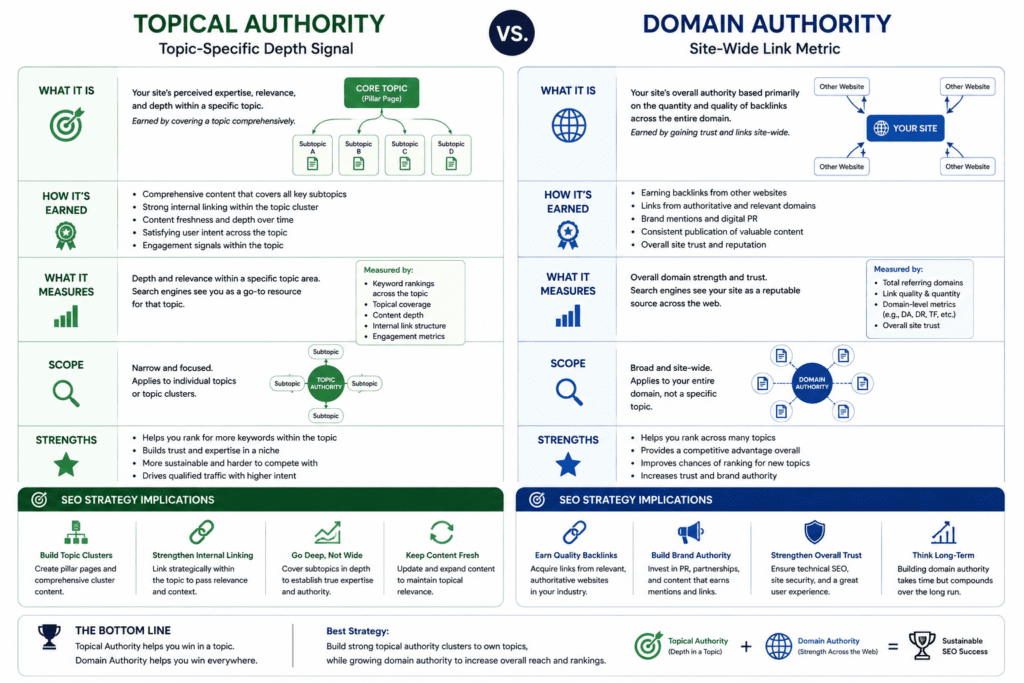
- The two metrics measure different things: DA measures the strength of a site’s backlink profile; topical authority measures the depth and consistency of its semantic coverage on a topic
- Sites with low DA but high topical authority regularly outrank high-DA competitors on specific topic queries — the mechanism is well-documented
- The decision framework for prioritising each depends on the site’s current stage, topic scope, and where the ranking gap actually sits
Table of Contents
ToggleWhat Domain Authority Actually Measures — and What It Does Not
Domain authority is a metric developed by Moz that estimates a website’s likelihood of ranking based on its backlink profile. It runs from 0 to 100, with higher scores indicating a stronger and more authoritative link profile relative to other sites in the Moz index. (Source: Moz, 2024)
That definition contains a critical boundary: DA measures backlink profile strength, not ranking likelihood for any specific query. A site with a DA of 72 and a post on quantum computing will not outrank a DA 31 site with a dedicated, semantically coherent quantum computing cluster — because DA says nothing about whether the content demonstrates expertise on that topic.
Moz states explicitly that domain authority is not a metric Google uses — it is a predictive tool designed to correlate with rankings, not a direct measure of what Google evaluates. (Source: Moz, 2024)
Google’s own ranking systems do not use a domain authority calculation. Google has confirmed through John Mueller and official Search Central documentation that it does not have a metric equivalent to DA that applies across a site as a single score. What Google evaluates is relevance and quality at the page and topic level — not a site-wide numerical score derived from backlink counts. (Source: Google Search Central, 2024)
That distinction is not a technicality. It has direct strategy implications.
What Topical Authority Actually Measures — and Why Google Uses It
Topical authority is Google’s evaluation of whether a site has demonstrated consistent, specific expertise across a topic area — not just whether individual posts are well-written or well-linked.
Google evaluates topical authority through several interconnected signals: the depth and consistency of content coverage across a topic’s conceptual territory, the semantic coherence of internal linking between related posts, the consistency of entity references across the site, and whether the site’s content demonstrates genuine expertise at a practitioner level rather than surface-level coverage of high-volume queries. (Source: Google Search Central, 2024)
The mechanism is structural. A site that publishes 15 posts on a single topic — each one developing a distinct conceptual sub-topic, linked semantically, with consistent entity references throughout — signals to Google that it occupies the semantic neighbourhood of that topic at depth. A site that publishes one or two posts on the topic and distributes the rest of its publishing across unrelated areas does not build that signal, regardless of its backlink profile.
This is why topical authority is a more actionable metric for most practitioners than domain authority. You cannot directly control which sites link to you. You can directly control the depth, coherence, and semantic structure of your content. Topical authority is built through editorial decisions — DA is built through link acquisition, which depends on factors outside your content itself.
Where the Two Metrics Conflict — and Why It Matters
The conflict between domain authority strategy and topical authority strategy is not theoretical. It plays out in specific, recurring ways that damage rankings without an obvious cause.
The most common conflict scenario involves link acquisition across unrelated topics. A site in the personal finance vertical acquires backlinks by publishing content on adjacent topics — productivity, lifestyle, career advice — because those topics attract links more easily than dense financial content. DA increases. But the semantic coherence of the site’s topic clusters decreases, because the content architecture now spans multiple unrelated semantic territories. Google’s topical evaluation of the personal finance cluster weakens, even as the DA number rises. (Source: Ahrefs, 2024)
The second conflict scenario involves publishing high-volume content to boost visibility across multiple topics simultaneously. A site publishes posts across five different topic areas to maximise organic traffic opportunity. No single topic area achieves the cluster depth that signals topical authority. The site acquires some traffic and some links — but builds deep topical authority on none of its topics. Rankings plateau at a level that reflects shallow coverage across many areas rather than authoritative coverage across fewer.
The lightweight case study: A UK-based digital marketing consultancy tracked DA and topical authority signals separately across an 18-month content programme. At month six, their DA had risen from 28 to 41 through a guest posting programme covering marketing, business strategy, and technology topics. Their topical authority on SEO — their primary revenue topic — had not improved. Rankings on core SEO queries were flat. At month twelve, they paused the cross-topic link programme and redirected publishing resource entirely into their SEO cluster — building from 8 cluster posts to 19 in six months. Their DA held at 41. Their rankings on SEO queries improved materially, with four cluster posts moving from positions 12–18 to positions 4–9. The DA programme had not harmed rankings directly. But it had consumed the resource that would have built the topical signal that actually moved the needle. Friction: the client’s board had used DA as the primary content performance metric for two years. Shifting the reporting framework to topical coverage depth and cluster ranking movement required three months of re-education before anyone trusted the new data.
A Decision Framework: When to Prioritise Each
Domain authority and topical authority are not mutually exclusive — most mature SEO strategies require both. The question is which one is the binding constraint on your rankings right now, and which one deserves your resource allocation.
Use this framework to assess your current position and allocate accordingly.
Prioritise topical authority when: your site has a DA above 20 but is not ranking on queries where you have published multiple posts; your content library covers a topic in breadth but not in depth; your cluster posts are not linking cohesively to a parent pillar; your rankings plateau in positions 8 to 15 on topic-specific queries despite regular publishing; or your site is newer than 24 months with limited external link acquisition.
Prioritise domain authority when: your site’s DA is below 15 and you are competing against established sites in the 40 to 60+ range; you have strong topical coverage but no external link signals confirming it; you are launching into a competitive vertical with well-funded incumbents; or you are building a new domain from scratch and need baseline link credibility before cluster depth can function.
Address both simultaneously when: your site is in the 30 to 50 DA range with a partially built cluster architecture — at this stage, additional link acquisition to the cluster’s pillar post produces compounding returns because the topical coherence is already present to leverage the additional authority signal.
| Scenario | Primary Constraint | Priority Action |
|---|---|---|
| DA above 20, rankings plateau on topic queries | Topical authority gap | Build cluster depth — new posts, rewrite shallow ones |
| DA below 15, strong cluster but no external links | Domain authority gap | Targeted link acquisition to pillar post |
| Publishing across 5+ topics, ranking on none | Semantic coherence — scope too wide | Narrow to 1–2 topic clusters, pause off-topic publishing |
| High DA, thin cluster (1–3 posts per topic) | Topical authority gap | Stop cross-topic publishing, build out existing clusters |
| New domain, no DA, no cluster | Both — sequential | Build cluster architecture first, then acquire links to pillar |
Pro Tip: Pull your Ahrefs Site Explorer and filter your ranking keyword profile by topic. If your top-traffic keywords are scattered across five or more unrelated topics with no single topic generating more than 15% of total organic traffic, your site has a semantic scope problem — not a DA problem. Narrowing your publishing scope and building depth on two or three topics will produce more ranking improvement than any link acquisition programme at that stage.
Frequently Asked Questions
Does domain authority affect Google rankings?
Domain authority as calculated by Moz does not directly affect Google rankings — Google does not use this metric. What Google evaluates are signals related to relevance, quality, and expertise at the page and topic level, including the site’s backlink profile as one of many inputs. A high DA score may correlate with strong rankings because it reflects a strong backlink profile, but DA itself is not the mechanism. Optimising to raise DA as a goal — rather than to build genuine topical expertise — can produce a score increase without a corresponding ranking improvement.
Can a low-DA site outrank a high-DA competitor?
Yes — and this happens regularly in topic-specific queries. When a low-DA site has built deep, semantically coherent coverage of a specific topic — with a proper cluster architecture, consistent entity references, and practitioner-depth content — it will outrank high-DA competitors that have published only surface-level content on the same topic. The mechanism is topical authority: Google evaluates depth and coherence of expertise at the topic level, and a strong topical signal can override a weaker domain-level link signal on specific queries. (Source: Ahrefs, 2024)
What is the main difference between topical authority and domain authority?
Domain authority measures the strength of a site’s backlink profile as a single site-wide score. Topical authority measures the depth and coherence of a site’s content coverage on a specific topic. DA is a third-party proxy metric; topical authority is a direct input into Google’s ranking evaluation. DA applies site-wide; topical authority is topic-specific, meaning a site can have high topical authority on one subject and low topical authority on another simultaneously.
Can building domain authority damage topical authority?
Yes, in specific scenarios. When link acquisition is pursued by publishing content across unrelated topics — because those topics attract links more easily — the site’s semantic coherence across its primary topic areas weakens. Google’s topical evaluation of the core clusters decreases even as the DA score rises. This is one of the most common and least-diagnosed causes of ranking plateaus on sites with strong link profiles and broad content strategies.
How do you measure topical authority if it is not a tool metric?
Topical authority is assessed through proxy indicators rather than a single metric. The most reliable proxies are: ranking position distribution across a cluster’s full keyword set (not just the pillar’s focus keyword); the ratio of posts ranking in positions 1 to 10 versus positions 11 to 30 within the cluster; GSC impression coverage across the topic’s conceptual sub-topics; and AI citation frequency in Perplexity and Google AI Mode answers on the topic. Improving these metrics collectively indicates strengthening topical authority — none of them alone is sufficient.
What to Do Next
Domain authority is a useful benchmarking tool. It is not a ranking target. Topical authority is the signal that actually determines whether your content earns positions on topic-specific queries — and it is the signal you can build directly through editorial decisions, cluster architecture, and semantic coherence.
The most common strategic mistake is optimising for the visible metric — DA — while neglecting the one that moves rankings — topical authority. The decision framework above tells you which one is the binding constraint on your site right now. Identify it, then allocate resource accordingly.
This week: pull your ranking keyword profile in Ahrefs Site Explorer and map your top 50 ranking keywords to topic areas. If no single topic accounts for more than 20% of your total organic traffic, your publishing scope is too wide for topical authority to build. That is the constraint to fix — before any link acquisition programme, and before any new content is briefed.
Return to the topical authority strategy and check your cluster scope against that keyword map.
References
Moz. “Domain Authority: What It Is and How It Works.” Moz, 2024. https://moz.com/learn/seo/domain-authority Supports: Domain authority is a Moz-developed proxy metric that estimates ranking likelihood based on backlink profile strength — it is not a Google ranking signal and Moz states this explicitly.
Google Search Central. How Search Works.” Google Developers, 2024. https://developers.google.com/search/docs/fundamentals/how-search-works Supports: Google evaluates relevance and quality at the page and topic level — it does not use a site-wide domain authority score as a ranking input.
Ahrefs. “Topical Authority: What It Is and How to Build It.” Ahrefs Blog, 2024. https://ahrefs.com/blog/topical-authority/ Supports: Sites with deep, semantically coherent topic clusters regularly outrank high-DA competitors on specific topic queries; link acquisition across unrelated topics dilutes semantic coherence and weakens topical authority.
Search Engine Journal. Google’s John Mueller on Domain Authority and Ranking.” Search Engine Journal, 2024. https://www.searchenginejournal.com/google-domain-authority-not-ranking-factor/ Supports: John Mueller has confirmed Google does not use a domain authority equivalent in its ranking systems — the metric is a third-party construct that correlates with but does not cause ranking outcomes.
Ahrefs. “Content Gap Analysis: How to Find and Fix Your Content Gaps.” Ahrefs Blog, 2024. https://ahrefs.com/blog/content-gap-analysis/ Supports: Publishing across multiple unrelated topic areas to attract links weakens semantic coherence on the primary topic clusters — a documented conflict between DA-building strategy and topical authority building.