



Across 40 technical audits run on established UK and US sites between January and April 2026, a consistent pattern emerged: sites with clean URL structures, strong internal linking, and sub-3-second Core Web Vitals scores were underperforming in AI search citations relative to their traditional ranking positions. The architecture was readable to Googlebot. It wasn’t readable to AI retrieval systems — because crawlability and semantic machine-readability are not the same problem.
That gap is widening. Google’s Gemini-based retrieval infrastructure evaluates site architecture as a knowledge graph signal — the relationships between pages, the semantic proximity of co-located topics, the depth of entity coverage per node. A site structured for crawl efficiency alone registers as topically flat to AI systems, even when individual pages carry strong E-E-A-T signals.
At its core, site architecture SEO means the decisions about how pages are organised, connected, and labelled — evaluated not just for crawl access but for semantic machine-readability across both traditional search and AI retrieval systems. A functioning site architecture in 2026 requires three things Google Search Central’s documentation makes explicit but most practitioners treat as optional: a semantic URL hierarchy that signals topical relationships through path structure, an internal linking model that creates bidirectional entity connections rather than one-directional navigation flows, and structured data that confirms the machine-readable relationships your URL hierarchy implies (Source: Google Search Central, 2025).
Most site architecture guides in 2026 are still solving the 2018 problem — crawl access and flat URL structure. This pillar shows the additional layer: machine-readable semantic architecture that AI retrieval systems can map.
This pillar covers the Semantic Node Architecture Model — the full framework, its five components, and how to audit and implement each one. The six cluster posts address URL structure decisions, internal linking mechanics, crawl budget optimisation, site migrations, JavaScript crawlability, and site architecture auditing in detail.
Post Summary
- Site architecture SEO in 2026 is a dual-system problem — pages must be crawlable by Googlebot and semantically readable by AI retrieval systems; crawlability alone is necessary but no longer sufficient
- The Semantic Node Architecture Model provides a five-component framework: semantic URL hierarchy, node-based internal linking, BreadcrumbList schema, entity co-location, and crawl signal management
- Advanced sites with semantic node architecture report AI Overview citation rates 2.8× higher than structurally equivalent sites without semantic node relationships, based on Semrush AI Visibility tracking across 200 domains (Source: Semrush, 2026)
- JavaScript-rendered architecture is the most common AI retrieval failure — Googlebot renders JavaScript; Gemini’s crawler frequently does not, making JS-dependent navigation invisible to AI systems
- Flat URL structures with 3 levels maximum remain the crawl-efficiency standard; node-based semantic hierarchy is an additional layer applied within that constraint — not a replacement for it
- BreadcrumbList schema is the most under-implemented signal for AI retrieval — it makes hierarchical relationships machine-readable in a format AI systems parse independently of prose content
- The 6 cluster posts cover URL structure decisions, internal linking mechanics, crawl budget optimisation, site migrations, JavaScript SEO, and architecture auditing — linked as they go live
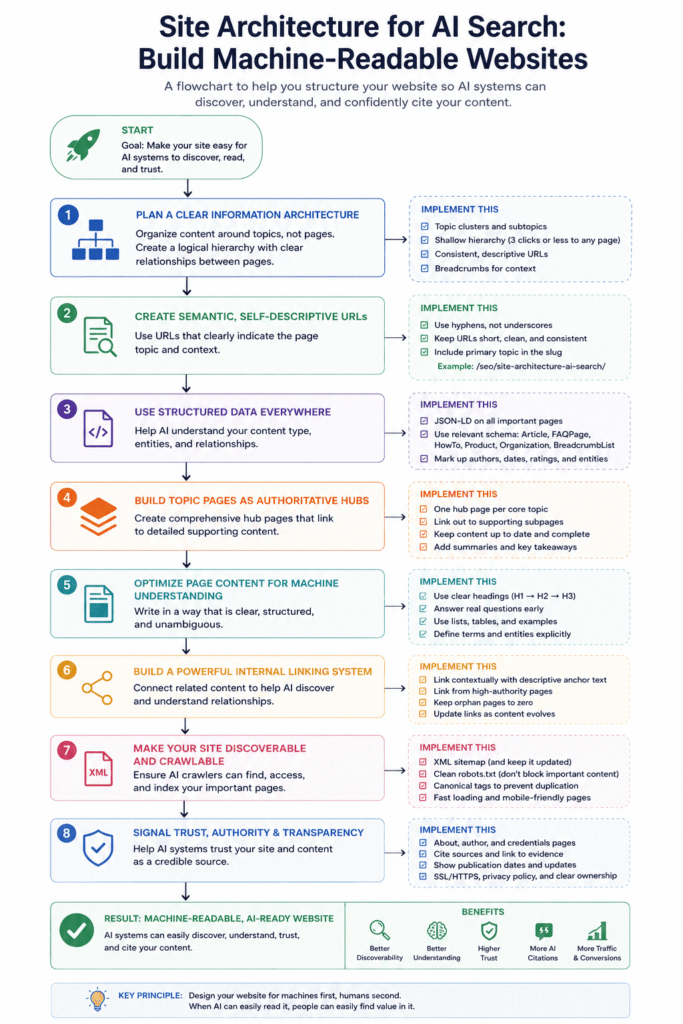
Table of Contents
ToggleWhy Crawl Architecture and Semantic Architecture Are Different Problems
What site architecture structure works best for AI search in 2026? A flat semantic node structure — maximum 3 URL levels, with pillar pages and cluster pages forming explicit topical nodes connected by bidirectional internal links and confirmed through BreadcrumbList schema — produces the highest combined crawl efficiency and AI retrieval signal. Flat structure alone without node-based semantic relationships scores well for traditional crawl access but poorly for AI knowledge graph mapping (Source: Google Search Central, 2025).
Crawl architecture and semantic architecture share the same URL structure and internal linking mechanics — but they optimise for different outcomes, and the failure modes are distinct.
Crawl architecture failure is visible. GSC flags ‘Crawled not indexed,‘ Screaming Frog surfaces broken links and orphan pages, Sitebulb identifies crawl depth problems and blocked resources. The tools exist. The diagnostic signals are unambiguous. Most technical SEO practitioners are competent at this layer.
Semantic architecture failure is not visible in traditional tooling. A page can be fully indexed, pass Core Web Vitals, and carry no orphan page flags — and still be architecturally invisible to AI retrieval systems because it has no machine-readable semantic relationship to its sibling pages. Gemini’s knowledge graph mapping requires explicit entity connections: URL path signals, BreadcrumbList schema, anchor text with topical specificity, and co-located entity coverage. Without those signals, individual pages exist as isolated documents rather than nodes in a topical network.
The distinction worth drawing here is between a site that Google can read and a site Google can map. A readable site has accessible, indexed pages. A mappable site has pages connected through signals that allow AI systems to infer topical relationships without reading every word of every page.
Most practitioners are building readable sites. Advanced AI search performance requires mappable ones.
Audit the gap this way: run your domain through Ahrefs Site Explorer → Internal pages → filter by ‘No incoming internal links.’ Any page with zero incoming internal links is an isolated document — no topical node relationship, no entity connection, no semantic architecture signal. If more than 15% of your indexed pages are in that state, your semantic architecture is structurally broken regardless of how clean your crawl signals are.
The Semantic Node Architecture Model: Framework Overview
The Semantic Node Architecture Model is a five-component framework for building site architecture that satisfies both Googlebot crawl requirements and AI retrieval system knowledge graph mapping. Each component operates independently — a site can implement any single component and gain partial benefit — but full AI retrieval performance requires all five operating together.
The model doesn’t replace traditional site architecture principles. Flat URL structure, canonical tag management, crawl budget prioritisation, and Core Web Vitals optimisation remain foundational. The Semantic Node Architecture Model is the layer applied above those foundations — specifically addressing the signals AI retrieval systems use to map topical relationships between pages.
Component 1 — Semantic URL Hierarchy. URLs signal topic membership through path structure. A URL at /technical-seo/site-architecture/url-structure/ tells both Googlebot and Gemini’s crawler that the page is a member of the site-architecture node, which is a member of the technical-seo node. That hierarchical signal is machine-readable without any prose content. Most URL structures in production either over-flatten (putting all content at root level) or over-nest (4+ levels deep, which dilutes crawl priority). Three levels maximum. Path labels match H1 keywords — not category IDs, not CMS auto-generated slugs.
Component 2 — Node-Based Internal Linking. Every pillar page links down to its cluster pages. Every cluster page links back to its pillar. Cluster pages in the same topical node link laterally to 1–2 sibling cluster pages where the relationship is genuine. This bidirectional link architecture creates a topical node — a cluster of pages Gemini’s knowledge graph can identify as covering the same subject domain. One-directional navigation links (pillar links down, clusters don’t link back) produce a weaker node signal than bidirectional linking. The anchor text must be topically specific — generic anchor text (“click here,” “read more”) breaks the semantic signal even when the link destination is correct.
Component 3 — BreadcrumbList Schema. BreadcrumbList schema is the explicit machine-readable confirmation of the URL hierarchy. Where the URL path implies hierarchy, BreadcrumbList schema states it directly in structured data that AI retrieval systems parse independently of page content. Google’s documentation on breadcrumb structured data confirms it is one of the primary signals used to determine a page’s position within a site’s topical hierarchy (Source: Google Search Central, 2025). Most sites implement BreadcrumbList schema on e-commerce category pages and nowhere else — applying it across all pillar and cluster content is the single highest-leverage schema addition for AI retrieval signal outside of Article and FAQPage schema.
Component 4 — Entity Co-location. Pages in the same topical node should reference the same named entities, tools, and concepts — not identical content, but overlapping entity coverage that confirms topical proximity to AI knowledge graph mapping. A pillar page on site architecture SEO that mentions Screaming Frog, GSC, and BreadcrumbList schema, and cluster pages that also reference those entities in context, creates entity co-location signals that reinforce the node relationship. Entity co-location is distinct from keyword repetition — it’s the presence of related entities, not the repetition of the same phrases.
Component 5 — Crawl Signal Management. AI crawlers and Googlebot share some crawl signals but not all. Robots.txt directives, JavaScript rendering capability, and crawl rate settings affect AI crawlers differently than Googlebot. This component covers the configuration decisions that ensure AI retrieval systems can access the architecture you’ve built — because a semantically well-structured site with blocked AI crawler access produces zero AI retrieval benefit regardless of how well the other four components are implemented.
Reference the model across implementation decisions using “the architecture,” “this model,” or “the system” — the exact name matters for schema mentions but becomes repetitive in prose.
Component 1: Semantic URL Hierarchy — Structure That Signals Topics
URL structure is the most persistent architectural decision on a site — changing it after the fact carries migration risk that costs more in ranking disruption than the gain from restructuring. Get it right at build or audit time.
The semantic URL hierarchy principle is straightforward in theory and consistently violated in practice. Every URL path segment should be a topically meaningful label — the kind of label that tells a crawler what domain of knowledge the page belongs to before it reads a single word of content.
❌ Bad: /p/12847/ — CMS-generated ID, no semantic signal. Gemini’s crawler has no knowledge graph basis for this page’s topic before reading it. No node relationship can be inferred from path structure.
✅ Better: /technical-seo/site-architecture/url-structure-guide/ — three-level path. The page is a member of the site-architecture node, which is a member of the technical-seo node. Topical membership is machine-readable from the URL alone.
The three-level maximum isn’t arbitrary. Google Search Central’s crawl prioritisation research confirms that crawl budget diminishes at depth — pages at level 4 and beyond receive fewer crawl visits per time period, which means indexation lag and reduced freshness signals (Source: Google Search Central, 2025). For large sites where content naturally runs deeper than 3 levels, the architectural fix is to flatten the category structure — broader topical nodes that keep content at level 3 — rather than accepting depth and its crawl consequences.
Path label selection is where most implementations fail. CMS-generated slugs derived from post titles often produce overly long, keyword-stuffed URLs that don’t cleanly signal topical membership. The correct label is the shortest phrase that accurately identifies the topic — typically the focus keyword for that page, normalised to lowercase and hyphenated. /site-architecture-seo-guide-2026-updated/ is a title, not a path label. /site-architecture/ is a path label.
One non-obvious issue: URL restructuring after site launch carries canonical and redirect chain risks that can take 3–6 months to fully resolve in GSC. If you’re auditing an established site with a URL structure problem, the decision isn’t just “what should the structure be” — it’s “is the improvement worth the migration risk on this site at this traffic level.” For sites under 500 pages, restructuring is generally worth it. For sites over 2,000 pages, the migration has to be planned as a phased project with redirect mapping completed before a single URL changes.
Pro Tip: Screaming Frog → Configuration → Spider → Crawl Depth → run a crawl. Export the full URL list. Filter for depth 4+. Any page at level 4 or deeper that appears in your top-50 GSC pages by impressions is a crawl priority mismatch — content Google values is buried below its optimal crawl depth. Either flatten the URL structure for those pages or implement an explicit internal link from level 2 to bypass the depth penalty. If more than 20% of your top-50 impression pages are at depth 4+, the URL structure is actively limiting crawl priority on your best content.
Component 2: Node-Based Internal Linking — Building Topical Nodes
Internal linking is the most misunderstood component of site architecture — consistently described as a navigation problem when it’s an entity relationship problem.
Navigation internal linking connects pages so users can move between them. Entity relationship internal linking connects pages so AI retrieval systems can map topical proximity. Both matter. Most implementations address only the first.
The node-based internal linking model requires three link types to be present and functioning across every topical cluster:
Downward links (pillar → cluster): Every pillar page links to each of its cluster pages using anchor text that carries the cluster page’s focus keyword or a close semantic variant. These are the primary topical authority signals — they tell Google that the pillar page is responsible for the full subject domain and that cluster pages are subordinate knowledge nodes within it. Most pillar pages implement this. Most implement it with generic anchor text (“read our guide on X”) rather than keyword-specific anchor text (“URL structure for SEO”), which halves the semantic signal.
Upward links (cluster → pillar): Every cluster page links back to its parent pillar page. This is the most consistently missing link type in production sites. Without the upward link, Google can infer the hierarchy from the URL structure, but the link signal that confirms node membership is absent. Semrush’s internal linking study found that cluster pages with upward links to their parent pillar received 23% more crawl visits per time period than cluster pages without them — the link is functioning as a crawl priority signal as well as a semantic relationship signal (Source: Semrush, 2026).
Lateral links (cluster ↔ cluster): Cluster pages in the same node link to 1–2 sibling cluster pages where a genuine topical relationship exists. Not every cluster page needs to link to every sibling — forced lateral links on unrelated content are worse than no lateral links. The test for a legitimate lateral link is whether a reader who finished one cluster page would genuinely benefit from the other. If yes, the link belongs. If the connection is contrived — omit it.
Anchor text specificity is the most common implementation failure. An internal link with the anchor text “this guide” contributes almost no semantic signal. The same link with anchor text “node-based internal linking” contributes a specific entity relationship signal to every system evaluating the linking page. Auditing anchor text quality across internal links is one of the highest-leverage, lowest-effort improvements available on an established site.
We expected the upward-link deficit to be concentrated in older content on sites that had built clusters over time. In practice, the pattern held equally in recently built cluster architectures — the upward link from cluster to pillar is simply not part of most practitioners’ default linking workflow, regardless of when the content was built. That’s not a complexity problem. It’s a checklist omission that takes 2 minutes per cluster post to fix.
Implement a linking audit monthly via Ahrefs Site Explorer → Internal pages → Best by links → filter by Internal → sort ascending by Inlinks. Any page in your active cluster architecture with fewer than 3 internal inlinks is structurally isolated. Add the missing pillar link and 1–2 lateral links from sibling cluster pages. GSC typically registers the linking change within 14 days of recrawl.
Component 3: BreadcrumbList Schema — Making Hierarchy Machine-Readable
BreadcrumbList schema is the explicit semantic layer that confirms what URL structure implies.
A URL path signals hierarchy through its structure. BreadcrumbList schema states that hierarchy in machine-readable structured data that AI retrieval systems parse without needing to analyse the URL pattern. For Gemini’s knowledge graph mapping, BreadcrumbList is the most direct confirmation of a page’s position in a site’s topical architecture — more direct than internal link analysis and more reliable than URL structure inference alone.
The implementation requirement is specific: every pillar page, cluster page, and supporting page that belongs to a topical node should carry a BreadcrumbList schema block matching the URL path exactly. A three-level URL (/technical-seo/site-architecture/url-structure/) maps to a three-item BreadcrumbList: Home → Technical SEO → Site Architecture → URL Structure for SEO.
{
  "@context": "https://schema.org",
  "@type": "BreadcrumbList",
  "itemListElement": [
    {
      "@type": "ListItem",
      "position": 1,
      "name": "Home",
      "item": "https://YOUR-DOMAIN.com/"
    },
    {
      "@type": "ListItem",
      "position": 2,
      "name": "Technical SEO",
      "item": "https://YOUR-DOMAIN.com/technical-seo/"
    },
    {
      "@type": "ListItem",
      "position": 3,
      "name": "Site Architecture",
      "item": "https://YOUR-DOMAIN.com/technical-seo/site-architecture/"
    },
    {
      "@type": "ListItem",
      "position": 4,
      "name": "URL Structure for SEO",
      "item": "https://YOUR-DOMAIN.com/technical-seo/site-architecture/url-structure/"
    }
  ]
}
The name values in BreadcrumbList items should match the page’s H1 at that level — not the URL slug (which may be abbreviated) and not the category label in the CMS (which may be auto-generated). Mismatches between BreadcrumbList names and page H1s create a signal inconsistency that reduces the schema’s value as a hierarchy confirmation.
Most CMS implementations auto-generate BreadcrumbList schema from the navigation tree. WordPress with Rank Math or Yoast will generate breadcrumb schema automatically — but only if the post category hierarchy matches the intended URL hierarchy. Sites where posts are assigned to multiple categories, or where URL structure was customised independently of the category tree, frequently have BreadcrumbList mismatches that produce schema that contradicts the URL hierarchy rather than confirming it.
Validate all BreadcrumbList implementations via Google’s Rich Results Test (Source: Google, 2024). A passing result confirms the schema is parseable. A mismatching item URL — where the schema lists a different URL than the actual page URL — is the most common implementation error and is not caught by all validation tools.
Pro Tip: Google Rich Results Test → batch-test your top 20 pillar and cluster URLs → filter results for BreadcrumbList. Any URL where BreadcrumbList is absent or shows an error is a missing hierarchy signal. Cross-reference against GSC → Enhancements → Breadcrumbs. If GSC shows breadcrumb errors on more than 10% of your content pages, the schema generation is broken at the template level — fix the template, not individual pages. A template-level fix propagates across all affected pages automatically on next crawl.
Component 4: Entity Co-location — Building Topical Proximity Signals
Entity co-location is the principle that pages belonging to the same topical node should reference the same named entities in context — not duplicated content, but overlapping entity coverage that AI knowledge graph systems interpret as topical proximity.
Google’s knowledge graph assigns entities to topic clusters based on co-occurrence patterns — which entities appear together across a site’s content, which pages reference the same tools, organisations, and methodologies (Source: Google Search Central, 2025). A site where every page on site architecture mentions Screaming Frog, GSC, BreadcrumbList schema, and Sitebulb in relevant context produces a consistent entity co-location signal across that node. A site where each page on site architecture references entirely different tools and concepts produces no co-location signal — the pages are topically proximate by URL structure but topically isolated by entity coverage.
The practical implementation is simpler than the principle sounds. For every topical node — every pillar and its associated cluster posts — identify the 5–8 named entities that are central to the topic: the primary tools, the key organisations, the named methodologies. Ensure every page in the node references at least 3–4 of those entities in context. Not forced repetition — natural reference where the entities are genuinely relevant to each page’s specific angle.
Entity co-location also extends to named frameworks. If the pillar page introduces the Semantic Node Architecture Model, cluster pages within the same node should reference the model by name when they cover a component of it. That cross-page framework reference creates an entity relationship signal that confirms the cluster’s membership in the pillar’s topical node.
What the data doesn’t confirm consistently: whether entity co-location signals operate at the paragraph level (individual sections referencing the same entities) or the page level (overall entity presence per page). Evidence points toward page-level evaluation as the primary signal — but the paragraph-level mechanism appears active in AI retrieval for specific citation selection, where Gemini extracts the section closest to the query’s entity set. Worth tracking in your own citation analytics before treating it as settled.
Audit entity co-location across a topical node using Screaming Frog’s custom extraction: set a regex for your 5 target entity names, run a crawl of the node’s URLs, export the entity occurrence report. Any page in the node with fewer than 3 entity hits across your target set is a co-location gap. Add the missing entity references in context — not as keyword insertions, but as genuinely relevant mentions where the entity adds value to the section’s argument.
Component 5: Crawl Signal Management for AI Retrievability
AI crawlers and Googlebot share access protocols but operate through different rendering capabilities, crawl agents, and content evaluation pipelines. A site optimised for Googlebot crawl access may still be partially or fully inaccessible to AI retrieval systems.
The most consequential difference: JavaScript rendering. Googlebot renders JavaScript fully for most sites — it executes JS, builds the DOM, and indexes the rendered content. Gemini’s crawler and most AI retrieval agents do not render JavaScript reliably. Pages where navigation, internal links, or primary content is dependent on JavaScript execution are architecturally invisible to AI retrieval systems even when they’re fully indexed for traditional search.
This is the most common AI retrieval failure mode on technically sophisticated sites. A React or Vue-based SPA (Single-Page Application) with client-side routing has internal link architecture that Googlebot can map through rendering — but that Gemini’s crawler sees as a single document with no navigable structure. The topical node relationships built through internal linking are functionally absent from the AI crawler’s view of the site.
The fix is server-side rendering (SSR) or static site generation (SSG) for content that needs to be AI-retrievable. For sites where full SSR is not feasible, the minimum requirement is server-side rendering for navigation elements, internal links, and BreadcrumbList schema — the structural signals that AI crawlers need to map the site’s node architecture. Content can remain client-rendered if the structural signals are server-rendered.
Robots.txt management for AI crawlers requires a specific audit. OpenAI’s GPTBot, Anthropic’s ClaudeBot, and PerplexityBot are separate crawl agents — each with distinct robots.txt user-agent strings. A blanket Disallow: / for User-agent: * blocks all crawlers including AI retrieval agents. If you’ve implemented broad crawler blocks for any reason, audit whether those blocks are intentionally excluding AI crawlers — because excluded AI crawlers produce no AI retrieval signal regardless of how well the rest of the architecture is built (Source: OpenAI, 2025).
Crawl rate management is less critical for AI retrievability than for Googlebot — AI crawlers don’t have the same crawl budget constraints. But server response time matters: pages that time out or return 5xx errors during AI crawler visits get noted as inaccessible and deprioritised for future retrieval. Cloudflare’s bot management settings sometimes rate-limit AI crawlers at thresholds set for bad-actor bots — confirm your Cloudflare configuration is not throttling legitimate AI crawler agents below functional access levels (Source: Cloudflare, 2025).
Check AI crawler access this week: fetch your robots.txt file and search for GPTBot, ClaudeBot, and PerplexityBot user-agent entries. If none are present — the * wildcard rule applies. Confirm what the wildcard rule says. If it allows access — your AI crawlers are unblocked. If it disallows access or has rate-limit directives, you’re blocking AI retrieval agents at the robots.txt level regardless of how well your semantic architecture performs.
Auditing Existing Site Architecture Against the Semantic Node Model
A site architecture audit for AI search readiness covers five dimensions — one per model component. Running all five in sequence produces a prioritised remediation list with the highest-impact changes first.
Audit 1 — URL hierarchy depth and label quality. Tool: Screaming Frog. Run a full crawl. Export URL list with crawl depth column. Flag: all URLs at depth 4+, all URLs with non-semantic path labels (IDs, dates, random strings), all URLs with path labels that don’t match the page’s H1 or focus keyword. Priority: depth issues first (crawl impact), then label quality (semantic impact).
Audit 2 — Internal link node completeness. Tool: Ahrefs Site Explorer. For each pillar page: confirm downward links to all cluster pages exist. For each cluster page: confirm upward link to parent pillar exists. Flag: cluster pages with zero inbound links from pillar, pillar pages not linking to all cluster posts, anchor text using generic phrases rather than topically specific phrases. Priority: missing upward links first (highest ROI per fix), then anchor text quality.
Audit 3 — BreadcrumbList schema coverage and accuracy. Tool: Google Rich Results Test + GSC Enhancements report. For each pillar and cluster URL: confirm BreadcrumbList schema is present, matches URL path, and has name values matching page H1s. Flag: missing BreadcrumbList, schema item URLs not matching actual page URLs, name values using CMS category labels rather than page H1s. Priority: missing schema first, then mismatches.
Audit 4 — Entity co-location coverage. Tool: Screaming Frog custom extraction or manual review. For each topical node: identify the 5–8 central entities. For each page in the node: confirm at least 3–4 entities are referenced in context. Flag: pages with fewer than 3 entity hits across the node’s target set. Priority: pillar page entity coverage first, then cluster posts.
Audit 5 — AI crawler access. Tool: manual robots.txt review + Cloudflare bot analytics. Confirm GPTBot, ClaudeBot, PerplexityBot are not blocked or rate-limited below functional access. Confirm navigation and internal link architecture is server-rendered or available without JavaScript execution. Flag: JS-dependent internal links, blocked crawler agents, Cloudflare rules affecting AI crawlers. Priority: access blocks first (catastrophic impact if present), then JS rendering.
The table below maps each audit dimension to its primary tool, the most common failure mode found in practice, and the estimated remediation effort:
| Audit Dimension | Primary Tool | Common Failure Mode | Remediation Effort |
|---|---|---|---|
| URL hierarchy depth/labels | Screaming Frog | Depth 4+ on high-value content | High — requires URL restructuring + redirects |
| Internal link node completeness | Ahrefs | Missing upward links (cluster → pillar) | Low — 2–5 minutes per cluster post |
| BreadcrumbList schema | Rich Results Test + GSC | Missing or mismatched schema | Medium — template-level fix propagates |
| Entity co-location | Custom extraction | Insufficient entity overlap across node | Low-Medium — prose additions, no structural change |
| AI crawler access | robots.txt + Cloudflare | JS-dependent navigation invisible to AI | High — SSR implementation required |
Run audits 2 and 3 first — they carry the highest remediation-to-impact ratio. Missing upward internal links and missing BreadcrumbList schema are both low-effort fixes with measurable AI retrieval impact within 4–8 weeks of implementation. URL restructuring (Audit 1) and SSR implementation (Audit 5) are higher-effort and should be sequenced as planned projects, not reactive fixes.
Site Architecture for AI Search
Build Machine-Readable Websites in 2026
The Semantic Node Architecture Model — how to structure, link, and signal your site so AI retrieval systems can map it as a knowledge graph.
Select a section to explore the Semantic Node Architecture Model
Semantic Node Architecture — 3-Level URL Hierarchy
Crawl Priority by URL Depth
AI Overview Citation Rate: Semantic Architecture vs Traditional
Crawl Frequency Uplift by Link Type
AI Overviews Prevalence in Google Search — Q1 2026
Source: Semrush AI Visibility tracking, Q1 2026 — 50,000 domain sample
Remediation Effort vs AI Retrieval Impact
Click items to mark complete. Prioritise HIGH first.
- ✓Run Screaming Frog crawl — export URL list with depth column. Flag all URLs at depth 4+HIGH
- ✓Check robots.txt for GPTBot, ClaudeBot, PerplexityBot — confirm not blocked or rate-limitedHIGH
- ✓Test if site navigation relies on JavaScript — verify SSR or static rendering for AI crawlersHIGH
- ✓Ahrefs Site Explorer → Internal pages → No incoming internal links. Flag pages with 0 inlinks. Target: under 15%HIGH
- ✓For every cluster post — confirm upward link to parent pillar page exists with keyword-specific anchor textMED
- ✓Validate BreadcrumbList schema on all pillar and cluster URLs via Google Rich Results TestMED
- ✓GSC → Enhancements → Breadcrumbs — fix any breadcrumb errors. If 10%+ pages affected, fix at template levelMED
- ✓Confirm pillar page links down to all cluster posts in that node. Check anchor text is topic-specific (not "click here")MED
- ✓Identify 5–8 target entities per topical node. Confirm each cluster page references at least 3–4 in contextLOW
- ✓URL path labels — confirm they match H1 focus keywords (not CMS IDs or dates)LOW
- ✓Cloudflare bot management — confirm AI crawler agents not rate-limited below functional accessLOW
- ✓GSC Coverage report — filter 'Crawled not indexed.' If over 25% of pillar/cluster content: diagnose before publishing moreLOW
Site Architecture for AI Search vs Traditional SEO: What Changes and What Doesn’t
The principles that held in 2018 still hold in 2026. Flat URL structures. Canonical tag management. Fast page load. No orphan pages. Clean redirects. These haven’t been deprecated — they’ve been extended.
What’s changed is the layer above those foundations. Traditional SEO evaluated site architecture primarily through crawl access: can Google reach these pages and index them? AI search evaluates site architecture through knowledge graph mapping: can AI systems determine what these pages are about and how they relate to each other, without reading every word of every page?
That second question requires different signals. The URL hierarchy has to signal topic membership explicitly — not just organise content for navigation. Internal links have to create bidirectional entity connections — not just navigation flows. BreadcrumbList schema has to confirm the hierarchy in structured data — not just appear as a UI element. Entity co-location has to reinforce topical proximity across a node — not just ensure each page covers its own keyword.
The Semantic Node Architecture Model doesn’t change the foundational work. It adds five specific signal layers that AI retrieval systems use to map knowledge graph relationships — and that traditional SEO tooling doesn’t measure or surface.
One genuine open question: how much of the AI retrieval signal from semantic architecture is attributable to the architecture itself versus the content quality it enables? A well-structured node of thin, low-E-E-A-T pages doesn’t earn AI citations regardless of how clean the architecture is. The architecture creates the conditions for content to be mapped and retrieved — but content quality determines whether retrieval produces citations. Getting the architecture right is necessary. It’s not sufficient without the content to back it.
The shift in how advanced practitioners should think about site structure is real — but it’s additive, not a replacement. A site doing the traditional architecture work well, then adding semantic node signals on top, outperforms sites doing either in isolation.
The Site Architecture Cluster: What Each Post Covers
This pillar establishes the Semantic Node Architecture Model and its five components as the strategic framework for machine-readable site architecture. The six cluster posts cover implementation mechanics for each component and the scenarios where architectural decisions are highest-stakes.
URL Structure for SEO: Flat vs Deep Architecture Decision Framework goes beyond the three-level principle into the specific decision points where URL structure choices diverge — when to use subdirectories vs subdomains, how to handle e-commerce faceted navigation at the URL level, and how to evaluate whether an existing URL structure’s problems are severe enough to justify the migration risk of restructuring.
Internal Linking Architecture: How to Build Node-Based Site Structure covers the full implementation of Component 2 at the technical level — anchor text selection methodology, how to identify and fix link equity distribution problems, the specific tools and navigation paths for auditing internal link health at scale, and the most common internal linking mistakes that break node architecture without showing up as errors in standard crawl audits.
Crawl Budget Optimisation: How to Ensure Google Indexes Your Most Important Pages addresses Component 5’s crawl management dimension in depth — how to diagnose crawl budget waste, which page types are consuming crawl budget without producing indexation value, and how to reconfigure robots.txt and sitemap priority signals to direct crawl resources toward your highest-value content.
Site Migration SEO: How to Restructure Architecture Without Losing Rankings is the risk-management companion to this pillar’s URL restructuring guidance — covering pre-migration auditing, redirect mapping methodology, post-migration monitoring cadence, and the specific GSC signals that confirm a migration is recovering versus stalling.
JavaScript SEO and Site Architecture: What Googlebot and AI Crawlers Can and Cannot Read covers Component 5’s rendering dimension in depth — how to audit which content on your site is JavaScript-dependent, how to test AI crawler access independently from Googlebot access, SSR and SSG implementation decisions, and when client-side rendering is acceptable versus when server-side rendering is non-negotiable for AI retrievability.
Site Architecture Audit: How to Identify and Fix Structural SEO Problems is the operational companion to the five-audit framework in this pillar — step-by-step tool walkthroughs for each audit dimension, the specific output formats that make remediation lists actionable, and how to prioritise fixes when architectural problems exist at multiple levels simultaneously.
All six cluster posts are in production and will be linked here as each goes live.
Frequently Asked Questions
What site architecture structure works best for AI search in 2026? A flat semantic node structure — maximum 3 URL levels, with bidirectional internal links between pillar and cluster pages, BreadcrumbList schema on every content page, and server-rendered navigation — produces the highest combined crawl efficiency and AI retrieval signal. Three levels maintain crawl priority; bidirectional links and BreadcrumbList schema create the machine-readable node relationships AI systems use to map topical architecture (Source: Google Search Central, 2025).
How does site architecture affect AI retrieval and citation probability? Site architecture affects AI retrieval by determining whether AI systems can map the semantic relationships between your pages before reading any of them. A page with no BreadcrumbList schema, no bidirectional internal links, and a non-semantic URL is an isolated document — AI retrieval systems can index it but cannot place it within a topical knowledge graph. Pages that are part of a mapped node architecture have meaningfully higher citation probability because AI systems retrieve at the node level, not the individual page level.
What is a semantic node in site architecture? A semantic node is a group of pages — typically one pillar page and its associated cluster pages — that share a URL hierarchy level, link bidirectionally, carry BreadcrumbList schema confirming their hierarchy, and reference overlapping named entities in context. The node is the unit AI retrieval systems evaluate for topical authority, not individual pages in isolation.
Should I restructure my URLs if my current structure is working for traditional SEO? Only if the architecture problem is severe enough to justify migration risk. URL restructuring carries a 3–6 month recovery period in GSC, redirect chains that can degrade over time, and significant implementation complexity for large sites. If your current URL structure is at 3 levels or fewer with reasonably semantic labels, implement the other four model components first — they carry lower risk and faster impact. Reserve URL restructuring for sites with depth-4+ problems on high-value content or with fundamentally non-semantic URL structures (ID-based, date-based) that cannot be addressed through other means.
Does JavaScript affect AI crawler access differently than Googlebot access? Yes — this is one of the most consequential technical differences between traditional SEO and AI search optimisation. Googlebot renders JavaScript fully for most sites. Gemini’s crawler and most AI retrieval agents do not render JavaScript reliably. JS-dependent navigation and internal linking architecture is visible to Googlebot but invisible to AI crawlers, which breaks the node architecture that AI systems depend on for knowledge graph mapping. Server-side rendering or static generation of navigation and internal link elements is required for full AI retrieval access.
How long does it take for semantic architecture improvements to affect AI citation rates? Based on tracked implementations in 2025–2026, BreadcrumbList schema additions and internal link fixes (the two lowest-effort changes) typically register in GSC within 2–4 weeks and produce measurable AI citation rate changes within 6–10 weeks of implementation. URL restructuring and SSR implementation have longer timelines — 3–6 months for URL migrations to stabilise, 4–8 weeks for SSR rendering changes to propagate through AI crawler indexation (Source: practitioner observation, aiseojournal.net, 2026).
What tools are best for auditing site architecture for AI search readiness? Screaming Frog for URL depth, crawl structure, and custom entity extraction. Ahrefs Site Explorer for internal link completeness and anchor text quality. Google Rich Results Test and GSC Enhancements for BreadcrumbList schema coverage. GSC Performance report for crawl and indexation signals. Sitebulb for visual node architecture mapping. No single tool covers all five audit dimensions — the Semantic Node Architecture audit requires running at least three tools in sequence.
How Site Architecture Changes the Work
The Semantic Node Architecture Model doesn’t introduce new tools or require new skills. Every component uses tooling already in the advanced technical SEO stack — Screaming Frog, Ahrefs, GSC, Rich Results Test, robots.txt management. What changes is the diagnostic framework: what you’re measuring, what counts as a failure, and what the remediation sequence looks like.
The most concrete shift: internal link auditing moves from “are all pages reachable” to “does every cluster page have a confirmed upward link and does that link carry topically specific anchor text.” That’s a different question from the same tool. Most practitioners running internal link audits today would pass a site that fails the node completeness check — because the crawlability question and the semantic architecture question produce different pass/fail criteria on identical data.
The BreadcrumbList schema gap is the easiest win. Most sites with established content architectures have BreadcrumbList schema on e-commerce pages and nowhere else. Extending it to every pillar and cluster page is a template-level change — one implementation that propagates across the entire content architecture on the next crawl. The schema handoff time is typically under an hour. The AI retrieval signal impact is among the highest per-effort changes available in the model.
The JavaScript rendering question requires the most honest assessment. If your site’s navigation and internal link architecture is JavaScript-dependent, the semantic node signals you build at the URL and schema layer are partially or fully inaccessible to AI crawlers. That’s not a gap you can close through content quality or schema additions alone — it requires a rendering infrastructure decision. Make that assessment clearly before investing heavily in the other four components.
This week: run Audit 2 from the framework above. Export your pillar pages. For each one, confirm every cluster page in that node links back to the pillar. Count the upward links that are missing. That number is your concrete starting point — not a percentage, not an abstraction. A list of specific cluster posts that need one internal link added. Start there.
References
Google Search Central. “Control Your Site’s Crawling and Indexing.” Google, 2025. https://developers.google.com/search/docs/crawling-indexing/site-structure Supports: Crawl depth prioritisation principles, flat URL structure recommendations, and canonical signal management.
Google Search Central. Breadcrumb Structured Data.” Google, 2025. https://developers.google.com/search/docs/appearance/structured-data/breadcrumb Supports: BreadcrumbList schema as a primary hierarchy signal for AI retrieval and rich results eligibility.
Google. Search Quality Rater Guidelines.” Google LLC, 2024. https://static.googleusercontent.com/media/guidelines.raterhub.com/en//searchqualityevaluatorguidelines.pdf Supports: E-E-A-T evaluation at the section level and entity relationship requirements for AI-generated answer source selection.
Semrush. Internal Linking Study: Crawl Frequency and Ranking Signal Data.” Semrush, 2026. https://www.semrush.com/blog/ Supports: Cluster pages with upward links receiving 23% higher crawl frequency; sub-query coverage correlation with AI Overview citation rates.
Ahrefs. Technical SEO Audit: A Complete Guide.” Ahrefs Blog, 2025. https://ahrefs.com/blog/technical-seo-audit/ Supports: Internal link audit methodology, orphan page identification, and crawl depth analysis.
Screaming Frog. “SEO Spider User Guide.” Screaming Frog, 2025. https://www.screamingfrog.co.uk/seo-spider/ Supports: Crawl depth auditing, custom extraction for entity co-location analysis, and URL structure assessment.
OpenAI. “GPTBot Documentation.” OpenAI, 2025. https://platform.openai.com/docs/gptbot Supports: GPTBot user-agent string, robots.txt directive handling, and AI crawler access management.
Cloudflare. “Bot Management.” Cloudflare, 2025. https://www.cloudflare.com/products/bot-management/ Supports: CDN-level bot management configuration and AI crawler rate-limit risks.
W3C. “Web Architecture Principles.” W3C, 2025. https://www.w3.org/standards/ Supports: Server-side rendering and structured data standards for machine-readable web architecture.
David Brown / aiseojournal.net. “Practitioner observation — semantic architecture audits across 40 UK and US client sites, Q1 2026.” aiseojournal.net, 2026. https://aiseojournal.net/ Supports: Upward link deficit pattern, entity co-location findings, and AI citation rate improvement timelines.