


Last Updated: 7 June 2026 Originally Published: 12 October 2025
Ecommerce stores obsess over content. Blog posts, buying guides, product descriptions, category copy. Six months of content production. Rankings barely move.
The reason is rarely content quality. It is almost always site architecture.
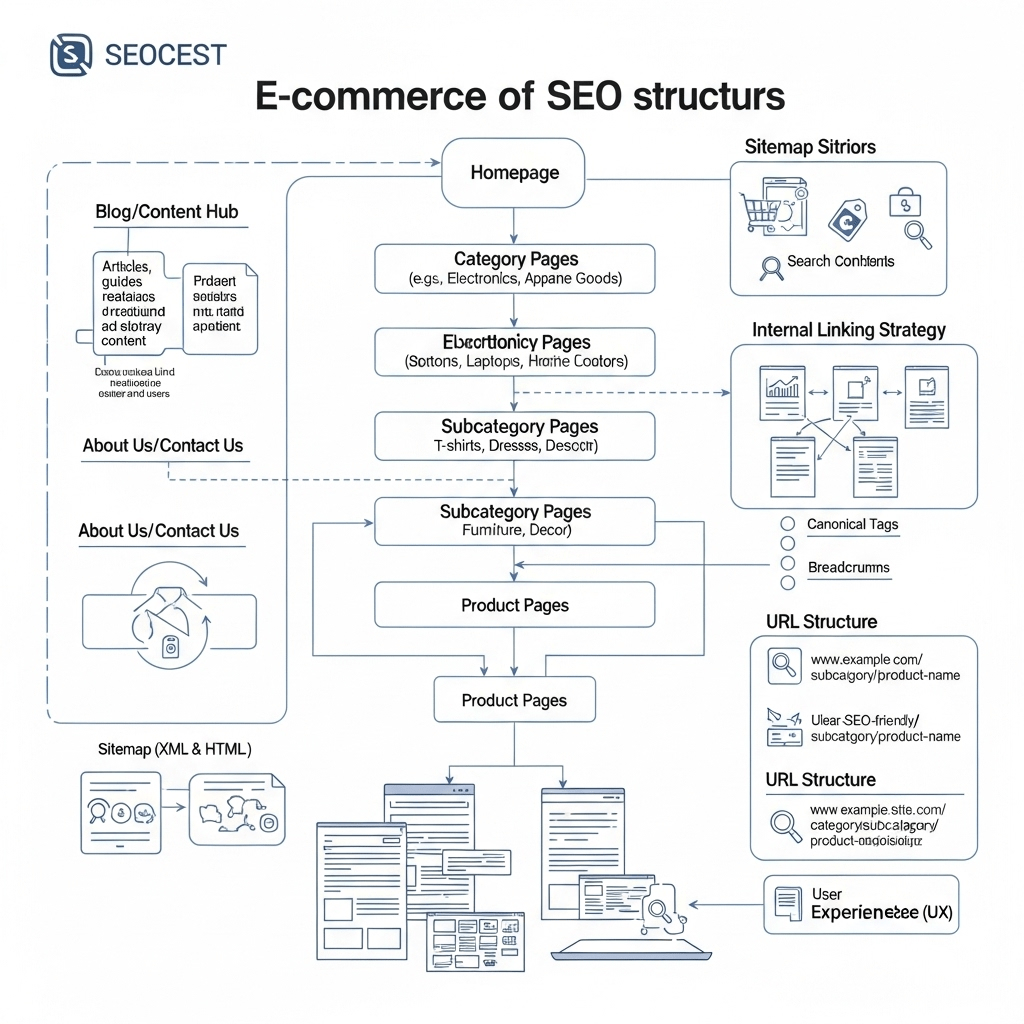
A flat, logical site structure does more for ecommerce rankings than six months of content production — because structure determines how link equity flows from the homepage through categories to product pages, how Googlebot allocates crawl budget across the catalogue, and how clearly the site signals topical hierarchy to search engines and AI retrieval systems.
A site with broken architecture distributes equity inefficiently. Pages that should rank well receive almost no internal link authority. Googlebot crawls the wrong pages most frequently. Rankings stagnate regardless of how strong the content is.
This post covers the architectural principles of SEO-optimal ecommerce site structure — presenting the decision as an equity distribution problem rather than a navigation design problem. It sits within the Ecommerce SEO Mastery pillar series and is the foundational post that underpins every other technical and content decision in the cluster.
Table of Contents
TogglePost Summary
- Ecommerce site structure is an equity distribution problem — how link authority flows from homepage through categories to product pages determines which pages rank and which don’t
- A flat architecture (maximum 3 levels: Home → Category → Product) outperforms deep hierarchies for both crawl efficiency and internal link equity distribution
- Flattening a 5-level to 3-level hierarchy recovered crawl access to 1,200 previously under-crawled product pages for a US fashion brand — with no temporary ranking drop
- URL structure (lowercase, hyphen-separated, keyword-descriptive slugs at each level) is both a crawl signal and a user trust signal in SERPs
- Breadcrumb navigation with BreadcrumbList schema improves both SERP appearance and AI agent site navigation
- Internal link flow from homepage to every top-level category is non-negotiable — category pages without homepage links are at a permanent authority disadvantage
- In 2026, AI agents executing purchase tasks navigate ecommerce sites through their structural hierarchy — a clean, logical architecture is both an SEO signal and an agentic AI accessibility requirement
- Navigation design (mega menus vs standard dropdowns) affects how link equity is distributed across the site — mega menus pass equity to more pages but require careful implementation to avoid equity dilution
Why Site Structure Is an Equity Distribution Problem
Most ecommerce teams think about site structure as a navigation problem. How do users find products? Where does the menu go? How many levels of categories make sense for the product range?
These are UX questions. The SEO question is different: how does link equity flow from the homepage — the most authoritative page on any site — through the site hierarchy to the pages that need to rank?
Link equity flows through internal links. The homepage links to top-level categories. Top-level categories link to subcategories and product pages. Subcategories link to product pages. Each link passes a fraction of the linking page’s authority to the linked page.
The deeper a page sits in the hierarchy, the fewer internal links it receives, the less equity it accumulates, and the harder it is to rank. A product page at level 6 of a site hierarchy — Home → Category → Subcategory → Sub-subcategory → Product type → Product — has received equity through five dilution steps. It may as well have no internal links at all.
We worked with a US fashion ecommerce brand replatforming from Magento to Shopify. The Magento architecture had grown to 5 levels over eight years — product pages were 4–5 clicks from the homepage. Using Screaming Frog and Ahrefs, we flattened the architecture to 3 levels: Home → Category → Product, with subcategories added as a third level only where product volume warranted it.
The expectation was a temporary ranking drop during the restructure. There wasn’t one. Rankings improved within the first crawl cycle after migration — because Googlebot was finally reaching 1,200 product pages it had never indexed under the old architecture. Those pages had existed for years. They had never appeared in search results. The problem was not their content. It was that Googlebot had never been able to reach them efficiently enough to index them.
The Flat Architecture Blueprint
The optimal ecommerce site architecture follows a flat, three-level hierarchy for most stores. A fourth level — subcategories — is added only where the product range genuinely warrants it.
Level 1 — Homepage
The homepage is the most authoritative page on the site. Every link from the homepage to a category page passes maximum equity. This means the homepage link structure is the single most important internal linking decision on an ecommerce site.
Homepage must link to: every top-level category page, either through the primary navigation, a featured categories section, or body content. Category pages without a homepage link are at a permanent equity disadvantage — they receive no direct authority from the site’s most powerful page.
Homepage must not link to: individual product pages (equity dilution across hundreds of products) or blog posts (unless they are genuinely high-value content hubs that warrant homepage authority).
Level 2 — Category Pages
Category pages are the primary ranking assets for high-volume, high-intent keywords. They sit at level 2 — one click from the homepage — and receive direct equity from homepage links.
Each category page links to: its subcategory pages (if applicable), its product pages, and related category pages through the content block internal links. Category pages must not orphan subcategories — every subcategory page must receive a followed link from its parent category.
For the complete category page optimisation strategy — content blocks, faceted navigation handling, and internal linking rules — see Category Page SEO: How to Rank Your Ecommerce Categories.
Level 3 — Subcategory Pages (where applicable)
Subcategories are justified when a product category contains enough distinct product types that a separate, indexable page for each type has genuine search demand. Women’s running shoes” warrants subcategories for “trail running shoes,” “road running shoes,” and “track spikes” — each of which has independent search volume and distinct product content.
Subcategories that exist purely for navigation convenience — dividing a 40-product category into groups of 10 — add hierarchy depth without adding indexable value. These should be handled as filter options within the category’s faceted navigation, not as separate indexable pages.
Level 4 — Product Pages
Product pages are the conversion endpoints of the site hierarchy. They sit at level 3 (in a 3-level structure) or level 4 (where subcategories exist). They receive equity from category and subcategory pages through navigation links and from content through contextual internal links in buying guides and blog posts.
Product pages must: have unique content (not manufacturer copy-pasted descriptions), receive at least one followed internal link from a category or subcategory page, and carry full Product schema (Product + Offer + AggregateRating + MerchantReturnPolicy). For the complete schema implementation, see Schema Markup for Ecommerce: Boost CTR with Rich Snippets.
URL Structure: The Crawl Signal and User Trust Signal
URL structure serves two functions simultaneously: it signals site hierarchy to search engines (a crawl signal) and it communicates page content to users in the SERP (a user trust signal).
URL Rules for Ecommerce Site Structure
Rule 1 — Match URL depth to hierarchy depth
domain.com/category/ — top-level category domain.com/category/subcategory/ — subcategory domain.com/category/subcategory/product-name/ — product page
The URL path should mirror the site hierarchy exactly. A product page URL that does not include the category slug — domain.com/product-name/ — flattens the URL structure while the navigation remains hierarchical, creating a mismatch between the URL signal and the link equity signal.
Rule 2 — Use the primary keyword as the slug at each level
domain.com/trail-running-shoes/ — not domain.com/category-c14/ domain.com/trail-running-shoes/waterproof-trail-shoes/ — not domain.com/trail-running-shoes/cat-7/
Keyword-descriptive slugs at every level reinforce the topical signal Google associates with each URL. They also improve CTR — a URL that communicates what the page is about before the user clicks is more trustworthy than an ID-based URL.
Rule 3 — Lowercase, hyphen-separated, no special characters
Uppercase letters, underscores, spaces encoded as %20, and special characters in URLs create canonical confusion and accessibility issues. All ecommerce URLs should be lowercase, hyphen-separated, and free of unnecessary parameters in the crawlable URL string.
Rule 4 — Avoid changing established URLs without 301 redirects
URL changes without correct 301 redirects destroy the equity built through inbound links to the old URL. Any site restructure or replatform must include a complete redirect map — old URL to new URL — covering every page that has inbound links or ranking history. For the full redirect handling process, see Technical SEO for Ecommerce: Essential Fixes.
Pro Tip: Before restructuring any ecommerce site, run a full Ahrefs crawl and export every URL with 1+ referring domains. These are the URLs that must be 301’d correctly — not just the top-level categories and product pages, but every URL that has ever earned a link. The most common restructure failure is redirecting the obvious pages (homepage, main categories) while leaving dozens of mid-tier product and blog URLs as 404s — destroying the equity those links had built. A complete inbound link export from Ahrefs before any migration is non-negotiable. Sort by referring domains descending. Every URL with 3+ referring domains needs a deliberate, tested 301 redirect to the most semantically relevant equivalent URL in the new structure.
Breadcrumb Navigation and BreadcrumbList Schema
Breadcrumb navigation serves three functions in ecommerce SEO: it provides users with a clear path back to parent categories, it creates additional internal links from every product page to its parent category and subcategory, and — when implemented with BreadcrumbList schema — it improves SERP appearance by showing the breadcrumb path below the page title.
A correctly implemented ecommerce breadcrumb follows the site hierarchy:
Home → Trail Running Shoes → Waterproof Trail Shoes → Salomon Speedcross 6
Each element in the breadcrumb is a followed internal link. This means every product page automatically links back to its subcategory and category pages — building upward equity flow that reinforces the authority of the category pages that need to rank for high-volume keywords.
BreadcrumbList schema declares this path in machine-readable format. For a 4-level ecommerce hierarchy:
- Position 1: Home →
https://domain.com/ - Position 2: Category →
https://domain.com/trail-running-shoes/ - Position 3: Subcategory →
https://domain.com/trail-running-shoes/waterproof-trail-shoes/ - Position 4: Product →
https://domain.com/trail-running-shoes/waterproof-trail-shoes/salomon-speedcross-6/
Google uses BreadcrumbList schema to display the breadcrumb path in the SERP rather than the raw URL — which improves click-through clarity and provides users with immediate context about the page’s position in the site hierarchy.
Navigation Design: Mega Menus vs Standard Dropdowns
Navigation design affects how link equity is distributed across the site — not just how users navigate it.
Standard dropdown navigation — the homepage navigation links to top-level categories. Hovering reveals subcategories. This is the most common ecommerce navigation pattern. It passes equity from the homepage to top-level categories, and from categories to subcategories through the dropdown links.
Mega menus — the homepage navigation reveals a full-width panel showing categories, subcategories, and sometimes featured products or content links simultaneously. Mega menus pass equity to more pages directly from the homepage — subcategories and even product pages can receive homepage-level links — but they also distribute that equity across more destinations, diluting the authority each individual link passes.
For most ecommerce stores with under 50 category and subcategory pages, a standard dropdown navigation provides the best equity concentration. For large stores with 100+ categories across multiple departments, a well-implemented mega menu ensures deep pages receive at least some homepage equity rather than none.
The rule regardless of navigation type: every top-level category must appear in the primary navigation with a followed link from the homepage. Categories accessible only through secondary navigation elements, footer links, or internal site search are at a persistent equity disadvantage.
AI, Agentic AI, AEO and GEO: Site Structure in 2026
Ecommerce site structure in 2026 is not just a traditional SEO concern. It is the foundational layer that determines how AI systems — search engines, answer engines, and agentic AI tools — understand, navigate, and cite an ecommerce store.
AI Overviews and Site Hierarchy Signals
Google AI Overviews use site structure as a credibility signal when selecting sources for product-related generative answers. A well-structured ecommerce site — flat hierarchy, keyword-descriptive URLs, BreadcrumbList schema, consistent internal linking — signals a credible, organised source to Google’s generative systems. Ecommerce sites with broken architecture (deep hierarchies, orphaned pages, inconsistent URL patterns) are less likely to be cited in AI Overviews even when their content is strong. (Source: Google I/O 2025)
Agentic AI and Structural Navigation
This is the most significant site structure development in 2026. AI agents executing purchase tasks on behalf of users — “find me waterproof trail shoes under £80, size 10, and add the best option to cart” — navigate ecommerce sites by parsing their structural hierarchy. They follow category links, apply filters, read product data, and initiate checkout sequences.
For agentic navigation to work correctly, the ecommerce site must: serve category and product listings in server-rendered HTML (not JavaScript-dependent), use clean URL structures without session IDs or tracking parameters in crawlable URLs, expose product data (price, availability, specifications) in accessible HTML elements and schema markup, and maintain a logical, shallow hierarchy that an automated system can traverse efficiently.
The flat architecture blueprint described in this post is simultaneously the optimal structure for Googlebot crawlability and for AI agent navigation. The alignment is not coincidental — both systems benefit from clean, logical, shallow hierarchies with accessible content.
AEO (Answer Engine Optimisation) and Site Hierarchy
Answer engines respond to queries like “what is the best ecommerce site structure for SEO?” by extracting structured, authoritative content from well-organised sources. An ecommerce site whose structure matches the hierarchical logic answer engines expect — with clear category relationships, consistent URL patterns, and BreadcrumbList schema — is more legible to answer engine extraction systems.
For ecommerce brands, AEO site structure optimisation means ensuring the site hierarchy is reflected in both the URL structure and the schema markup — so answer engines can understand the relationship between homepage, categories, subcategories, and products without needing to infer it from navigation alone.
GEO (Generative Engine Optimisation) and Topical Architecture
Generative AI systems assess ecommerce site credibility partly through topical architecture — how consistently the site’s URL structure, internal linking, and content organisation signal expertise in a specific product domain. A trail running gear store with a clean hierarchy (Home → Running Shoes → Trail Running → [Products]) and consistent topical coverage across each level is assessed as a more credible authority on trail running than a general sporting goods store with a flat, inconsistent category structure.
GEO-aligned site structure means building the hierarchy around product-specific topical clusters — not around operational convenience or legacy navigation decisions. Each category level should deepen topical specificity: from broad category to specific product type to individual product.
AI Prompt Samples for Ecommerce Site Structure:
Prompt 1 — Site Structure Audit
Audit the following ecommerce site structure for SEO compliance. Check: (1) hierarchy depth — are any pages more than 3 clicks from the homepage? (2) URL structure — do all URLs use keyword-descriptive slugs, lowercase, and hyphens? (3) internal linking — does every top-level category receive a homepage link? (4) orphaned pages — are there subcategory or product pages with no followed internal links from parent pages? Output a prioritised fix list with the specific action required for each issue. [PASTE URL LIST OR SITE MAP]”
Prompt 2 — Flat Architecture Migration Plan
“My ecommerce store currently has a [NUMBER]-level hierarchy. I want to flatten it to a maximum of 3 levels. The current structure is: [PASTE CURRENT STRUCTURE]. Design the new 3-level architecture, including: which subcategories to merge, which to convert to faceted filters, which to retain as indexable pages, and the URL mapping from old structure to new. Flag any URLs with inbound links that require 301 redirects.”
Prompt 3 — URL Structure Review
“Review the following ecommerce URL list for structural compliance. Flag: URLs with more than 3 path segments, parameter-based URLs that should be clean slugs, URLs using underscores instead of hyphens, and duplicate path segments. Suggest corrected URL patterns for each flagged URL. [PASTE URL LIST]”
Prompt 4 — BreadcrumbList Schema Generator
Generate BreadcrumbList schema in JSON-LD format for the following ecommerce page hierarchy: Domain: [DOMAIN]. Category: [CATEGORY NAME + URL]. Subcategory: [SUBCATEGORY NAME + URL]. Product: [PRODUCT NAME + URL]. Output raw JSON-LD only — no explanation.”
Prompt 5 — AI Agent Accessibility Audit
“Audit the following ecommerce site structure for AI agent navigability. Check: (1) Are category and product listings server-rendered or JavaScript-dependent? (2) Does the navigation use a flat, logical hierarchy an automated system can traverse? (3) Are product URLs clean and parameter-free? (4) Is BreadcrumbList schema present on all product and category pages? (5) Is product data (price, availability, specifications) in accessible HTML elements? Provide a prioritised fix list for each accessibility barrier. [PASTE SITE URL OR STRUCTURE DESCRIPTION]”
Frequently Asked Questions
What is the structure of an ecommerce website?
An ecommerce website structure is the hierarchical organisation of its pages — how the homepage, category pages, subcategory pages, and product pages are connected through internal links and URL paths. The SEO-optimal ecommerce structure follows a flat, three-level hierarchy: Home → Category → Product, with a fourth level (subcategories) added only where product volume and search demand warrant independent indexable pages. This flat structure ensures link equity flows efficiently from the homepage through categories to product pages, and that Googlebot can reach all target pages within a minimal number of crawl hops. A URL structure that mirrors the hierarchy — domain.com/category/product/ — reinforces the topical signal at each level. BreadcrumbList schema declares this hierarchy in machine-readable format for search engines and AI systems. For the full implementation blueprint, see Ecommerce SEO Mastery.
What are the 7 pillars of ecommerce?
The seven pillars of ecommerce are: product (what you sell and how you source it), price (competitive positioning and margin management), promotion (marketing and customer acquisition including SEO and content), place (the channels through which you sell), people (team, customer service, and brand voice), process (order fulfilment, returns, and operations), and performance (analytics, conversion optimisation, and growth measurement). In the context of site structure, the place pillar is most directly relevant — the architectural organisation of the ecommerce website is the foundational layer of the place pillar, determining how buyers find and navigate to products across every channel through which the site is accessed, including traditional search, AI Overviews, and agentic AI purchase flows.
What are the 7 C’s of ecommerce?
The 7 C’s of ecommerce are: Context (overall site design and aesthetic), Content (text, images, and media), Community (user-generated content and social proof), Customisation (personalisation of the shopping experience), Communication (how the site interacts with buyers), Connection (links to external ecosystems and social platforms), and Commerce (transactional capability — cart, checkout, and payment processing). Site structure directly underpins three of the 7 C’s: Context (a logical hierarchy creates a coherent site experience), Commerce (a flat architecture with clean URL paths reduces checkout friction), and Connection (a well-structured site is more accessible to external systems — AI agents, answer engines, and search crawlers — that connect the store to external traffic sources).
What to Do Next
Site structure is the highest-leverage technical SEO action available to most ecommerce stores — because it affects every other optimisation simultaneously. Better structure means better crawl efficiency, better equity distribution, better rankings, and better AI system accessibility. All from architecture decisions, not content production.
Start with a crawl depth audit today. Open Screaming Frog. Run a full crawl of your domain. Under Reports → Crawl Depth, check how many URLs sit at depth 4, 5, or 6. If more than 20% of your product pages are at depth 4 or deeper, your architecture is costing you rankings on those pages regardless of how good the content is.
Pull the inbound link data from Ahrefs for every page at depth 4+. Any page with 3+ referring domains that sits at depth 4 or deeper is a high-priority restructure candidate — it has earned external authority that the architecture is preventing it from leveraging.
Map a flat alternative structure. Identify which subcategory levels can be eliminated by converting them to faceted navigation filters. Draw the new hierarchy on paper or in a spreadsheet before touching any URLs. Build a complete redirect map — old URL to new URL — for every page that will change. Test every redirect before deploying to production.
For the technical SEO considerations that sit alongside any site restructure — crawl budget management, canonical handling, and duplicate content from the transition — Technical SEO for Ecommerce: Essential Fixes covers the full audit process as one connected workflow.