

Your URL says /product-category/item-12847-blue-widget-v2-updated-final and you wonder why it’s not ranking. Meanwhile, your competitor’s /blue-widgets sits at position #3, mocking your eight-tier hierarchical nightmare.
URLs aren’t just addresses—they’re SEO signals, user experience elements, and readability tests all crammed into one string of characters. Mess them up and Google gets confused. Users get confused. You get confused looking at your own site structure six months later.
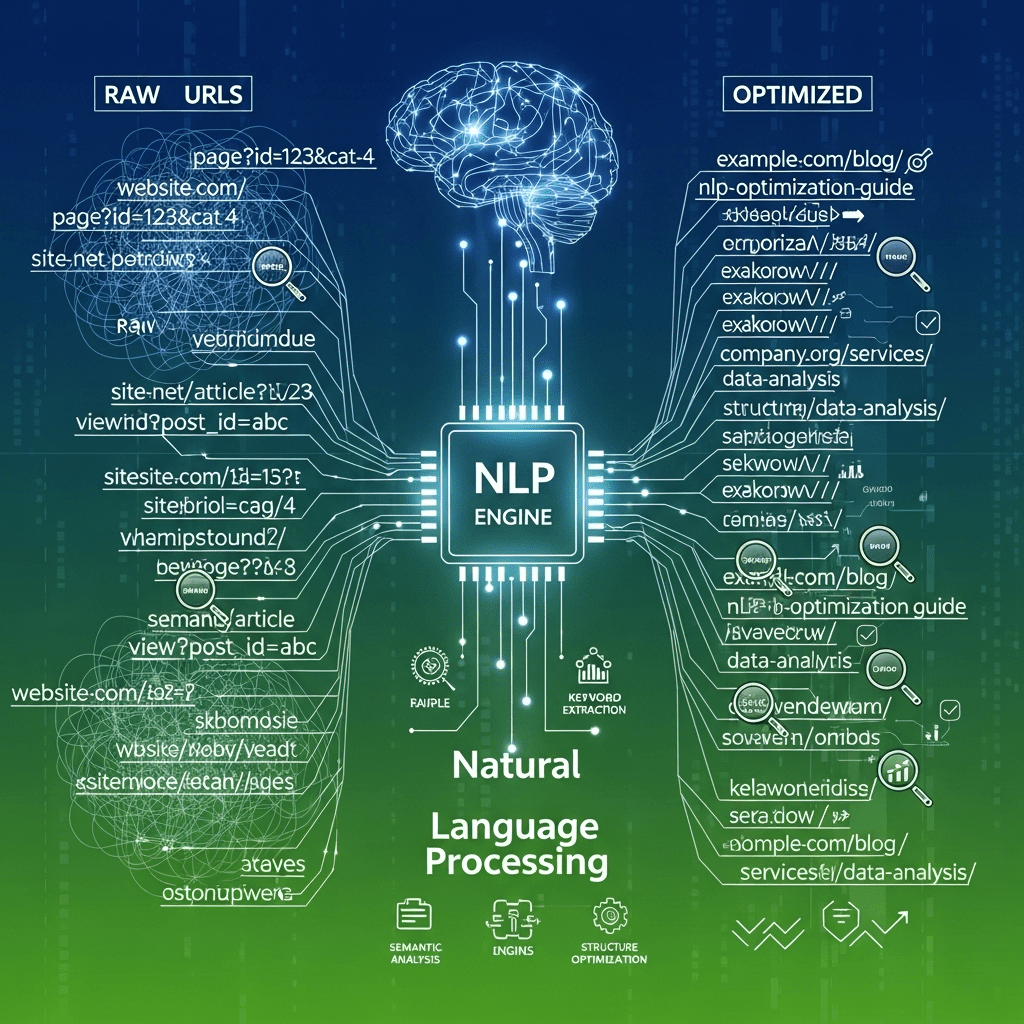
AI URL optimization fixes this chaos using natural language processing to analyze content, understand intent, and generate clean, semantic URLs that both humans and search engines love.
Let’s explore how machine learning turns URL structure from afterthought into competitive advantage.
Table of Contents
ToggleWhat Is AI URL Optimization and Why Does It Matter?
Traditional URL creation relies on whatever your CMS defaults to—usually slugified versions of your page title, complete with stop words, duplicate keywords, and zero strategic thinking.
NLP for SEO analyzes your page content, extracts the most semantically relevant keywords, and structures URLs that accurately represent topic and hierarchy while maximizing ranking potential.
The difference? Manual URLs might use /best-coffee-makers-for-home-use-in-2025-review-guide. AI-optimized URLs strip unnecessary fluff to /coffee-makers-home-use—cleaner, more clickable, and keyword-focused without over-optimization.
According to Backlinko’s 2024 ranking factors analysis, URLs containing target keywords correlate with 45% higher click-through rates in search results, and shorter URLs (under 60 characters) outperform longer ones in user engagement metrics.
How Natural Language Processing Analyzes Content for URLs
NLP doesn’t just extract keywords—it understands context, semantic relationships, and user intent to create URLs that match how people actually search.
Semantic Keyword Extraction
Machine learning models analyze your entire page content to identify the most semantically important terms. Not just high-frequency words, but concepts that define what the page is actually about.
AI slug generation tools use term frequency-inverse document frequency (TF-IDF) and semantic analysis to determine which keywords deserve URL placement. The algorithm ignores common words like “the,” “and,” “best” (unless “best” is crucial to the content’s value proposition) and focuses on core topic terms.
For a page about “wireless noise-canceling headphones under $200,” NLP identifies the critical elements: product type (headphones), key feature (noise-canceling, wireless), and price point. The optimized URL becomes /wireless-noise-canceling-headphones-200 instead of the title-based /best-affordable-wireless-headphones-with-active-noise-canceling-2025.
A consumer electronics site used semantic URL structure optimization across 8,400 product pages. Average URL length dropped from 87 characters to 41 characters, and organic CTR improved 23% over 12 weeks as cleaner URLs appeared more trustworthy in search results.
Intent Classification for URL Patterns
Different search intents require different URL structures. NLP determines whether content is informational, commercial, transactional, or navigational—then optimizes URLs accordingly.
Informational content (guides, tutorials): URLs focus on the topic and question type
/how-to-change-motorcycle-oil/wordpress-security-checklist
Commercial content (reviews, comparisons): URLs include product categories and comparison indicators
/crm-software-comparison/best-standing-desks-2025
Transactional content (product pages, services): URLs emphasize the specific product/service without unnecessary descriptors
/macbook-pro-14-inch/seo-audit-services
Navigational content (about, contact): URLs use simple, expected patterns
/about/contact
AI classifies content intent automatically by analyzing page structure, calls-to-action, and content patterns. A page with pricing tables and “buy now” buttons gets transactional URL treatment. A page with step-by-step instructions gets how-to URL patterns.
Hierarchical Structure Optimization
NLP doesn’t just optimize individual slugs—it analyzes your entire site architecture and recommends hierarchical URL patterns that make logical sense.
Machine learning identifies:
- Topic clusters and subtopic relationships
- Parent-child content hierarchies
- Logical category groupings
- Unnecessary nesting creating overly deep URLs
A B2B SaaS company had URLs like /resources/blog/category/marketing/content/how-to-write-case-studies. AI URL optimization restructured this to /blog/write-case-studies—eliminating unnecessary hierarchy while maintaining clear categorization.
The system recognized that /resources/blog/category/ added zero semantic value and created URLs that were 3-4 segments longer than necessary.
Top AI URL Optimization Tools
Several platforms now use machine learning to generate and optimize URL structures automatically.
Clearscope: Content + URL Optimization
Clearscope’s AI analyzes top-ranking content for target keywords and recommends URL structures matching successful competitors. The platform identifies which URL elements correlate with rankings and suggests patterns accordingly.
Best for: Content teams optimizing individual articles and pages for specific keywords.
Pricing from $170/month. The tool integrates URL recommendations with overall content optimization, showing how URL changes affect predicted ranking potential.
MarketMuse: Topic Modeling for URLs
MarketMuse uses topic modeling and semantic analysis to recommend URL structures that reflect comprehensive topic coverage. The AI identifies core topics, subtopics, and related concepts—then structures URLs to mirror this semantic hierarchy.
Best for: Enterprise content operations building topical authority through clustered content.
Custom pricing (typically $1,500+/month). The platform maps content inventories to topic clusters and recommends URL restructuring for better semantic organization.
Surfer SEO: Data-Driven URL Analysis
Surfer SEO analyzes URLs of top-ranking pages for target queries and identifies patterns in URL length, keyword placement, and structure. The tool provides specific recommendations for optimizing URLs based on competitive analysis.
Best for: SEOs wanting data-backed URL decisions based on what actually ranks.
Plans from $89/month. The URL analyzer is part of Surfer’s content editor, showing real-time optimization scores as you modify URLs.
INK Editor: AI Writing + URL Generation
INK uses NLP to analyze content as you write and automatically suggests optimized URL slugs based on extracted key topics and search intent classification.
Best for: Writers and content creators wanting automated URL suggestions during content creation.
Plans from $39/month. The AI generates URLs in real-time as content develops, updating suggestions as you add or modify content.
Custom NLP Scripts and APIs
Technical SEOs can build custom URL optimization using NLP libraries and APIs:
OpenAI API: Use GPT-4 to analyze content and generate URL suggestions spaCy: Open-source NLP library for entity extraction and keyword analysis Google Cloud Natural Language API: Entity recognition and semantic analysis for URL generation
Best for: Developers and technical SEO teams wanting full control and customization.
Costs vary based on usage. Custom solutions offer maximum flexibility but require development resources.
Implementing AI-Powered URL Optimization Step-by-Step
Getting automated URL optimization right requires strategy, not just running AI tools and accepting all suggestions.
Step 1: Audit Current URL Structure
Before optimizing, understand your baseline. Export all URLs from your sitemap or crawl your site with Screaming Frog or Sitebulb.
Analyze current patterns:
- Average URL length
- URL depth (how many segments)
- Keyword usage in URLs
- Stop words and unnecessary parameters
- URL structure consistency across sections
A financial services site discovered their blog URLs averaged 94 characters with 5-7 segments, while their highest-performing pages had URLs under 50 characters with 2-3 segments. This baseline informed their optimization priorities.
Step 2: Define URL Structure Rules by Content Type
Establish URL patterns for different page templates. Consistency matters more than perfection on individual URLs.
Blog posts: /blog/topic-keywords or /topic-keywords (if blog is primary content) Product pages: /product-category/product-name or /product-name for simple catalogs Service pages: /services/service-name or /service-name Location pages: /locations/city-state or /city-service-name
Feed these rules into your AI URL optimization tool as constraints. The AI generates URLs following your structural patterns while optimizing keyword selection within those patterns.
Step 3: Use NLP to Analyze and Generate URLs
Run your content through NLP analysis to extract semantically relevant keywords for URLs. Most tools provide confidence scores showing how relevant each term is to the overall content.
For a page about “cloud-based project management software for remote teams,” NLP might extract:
- Primary concepts: project management, software, cloud, remote teams
- Secondary concepts: collaboration, task tracking, team communication
- Modifiers: cloud-based, remote, online
The AI weighs relevance and search volume to recommend /cloud-project-management-software or /remote-team-project-management depending on target keyword focus.
Pro Tip: Use AI for technical SEO analysis to identify which keyword combinations in URLs correlate with better rankings in your industry. Different niches show different patterns—what works for e-commerce may not work for B2B services.
Step 4: Test URL Readability and Click Likelihood
AI-generated URLs should pass the “say it out loud” test. If you can’t easily communicate the URL verbally or remember it after seeing it once, it’s too complex.
URL readability factors NLP tools can analyze:
- Character count (shorter usually better, under 60 characters ideal)
- Word count (2-5 words optimal for most content)
- Memorable keywords vs. generic terms
- Hyphen usage (readable separation without excessive dashes)
A/B test URLs in ads or social media posts to measure actual click-through rates. A SaaS company testing /crm-small-business versus /small-business-crm-software found the shorter version achieved 18% higher CTR despite both being semantically similar.
Step 5: Implement URL Changes Strategically
Never mass-update thousands of URLs simultaneously. Google interprets this as a site migration and may temporarily suppress rankings during reassessment.
Implement URL optimizations in phases:
Phase 1: New content launches with optimized URLs (zero risk) Phase 2: Underperforming pages with minimal traffic (low risk, test impact) Phase 3: Moderate traffic pages with ranking opportunity (measured risk) Phase 4: High-traffic pages only if data proves optimization value (high risk requires strong justification)
A publishing site optimized URLs on 200 new articles over 8 weeks, measuring performance against control group with default CMS-generated URLs. Optimized URLs showed 31% better ranking performance, providing data to justify optimizing existing content URLs.
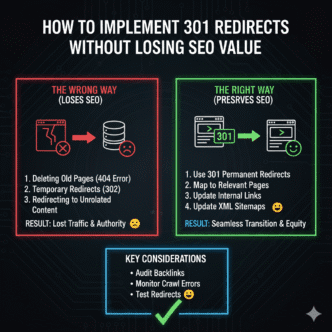
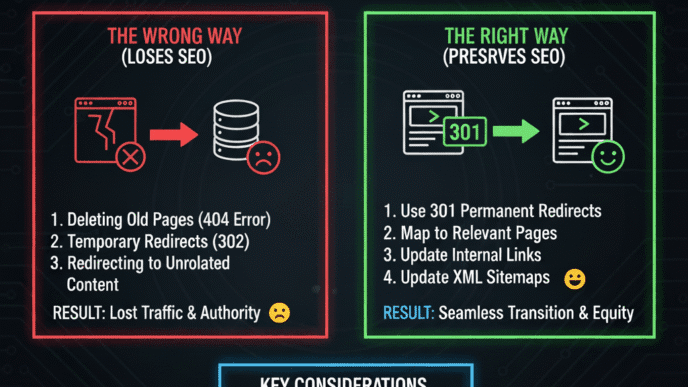
Step 6: Set Up Proper 301 Redirects
When changing existing URLs, implement 301 redirects from old to new URLs to preserve link equity and prevent 404 errors.
Use redirect mapping tools or custom scripts to:
- Map old URL to optimized new URL
- Verify redirects return proper 301 status codes
- Check for redirect chains (old→temp→new should be old→new directly)
- Update internal links to point directly to new URLs
Monitor Google Search Console for 404 errors after implementation. Any sudden spike indicates broken redirects or missing mappings.
According to Moz’s 2024 technical SEO guide, properly implemented 301 redirects pass 90-99% of link equity to the new URL, while redirect chains or 302 temporary redirects pass significantly less value.
Advanced NLP URL Optimization Strategies
Basic AI slug generation handles individual page URLs. Advanced strategies optimize entire site architecture using semantic relationships.
Topic Cluster URL Architecture
NLP identifies related content pieces that should cluster around pillar topics, then structures URLs to reflect these relationships.
Pillar content: /email-marketing Cluster content: /email-marketing/subject-lines, /email-marketing/automation, /email-marketing/deliverability
This semantic URL structure signals to Google that these pages cover related subtopics within a broader subject area, building topical authority.
A marketing blog used NLP to restructure 400 articles into 12 topic clusters with consistent URL patterns. Organic traffic to pillar pages increased 47% over 16 weeks as Google recognized comprehensive topic coverage.
Multilingual URL Optimization
International sites need URLs optimized for each language while maintaining semantic consistency. NLP translates concepts, not just words, to create natural URLs in each language.
English: /running-shoes Spanish: /zapatillas-correr (not literal translation /zapatos-corriendo) German: /laufschuhe French: /chaussures-course
AI ensures translated URLs use natural search terms native speakers actually use, not awkward direct translations. The system analyzes search volume and usage patterns in each language.
Dynamic URL Generation for User-Generated Content
Sites with user-generated content (forums, reviews, Q&A platforms) struggle with URL optimization since content creators don’t think about SEO.
AI slug generation analyzes user-submitted titles and generates clean URLs automatically:
User title: “What’s the best way to remove coffee stains from white shirts???” AI-generated URL: /remove-coffee-stains-white-shirts
The NLP removes unnecessary words, fixes punctuation issues, handles special characters, and creates readable URLs from messy input.
A community forum with 50,000+ user-generated threads implemented automated URL generation and saw 34% improvement in organic discovery of older threads as clean URLs made content more accessible to search engines.
URL Optimization for Voice Search
Voice queries use natural language patterns different from typed searches. NLP optimizes URLs to match conversational query structures.
Typed search: “best affordable gaming laptop” Voice search: “what is the best affordable laptop for gaming”
URLs optimized for voice queries include question-format keywords when appropriate:
/what-is-keyword/how-to-keyword/why-keyword-matters
A healthcare information site restructured URLs to match common health questions and saw 52% increase in featured snippet wins—critical for voice search results that read single answers.
Common URL Optimization Mistakes AI Helps Avoid
Even with AI assistance, certain URL pitfalls require human oversight to prevent.
Over-Optimization and Keyword Stuffing
Cramming every possible keyword variation into URLs creates spammy-looking addresses that hurt more than help.
Bad: /best-cheap-affordable-budget-running-shoes-sneakers Good: /affordable-running-shoes
AI URL optimization tools typically include over-optimization detection, warning when keyword density in URLs exceeds natural patterns. However, some tools maximize keyword inclusion without considering user perception.
Set maximum URL length limits (40-60 characters) to force AI toward concise keyword selection.
Changing URLs Too Frequently
Every URL change requires redirects, risks broken links, and forces Google to reassess rankings. Constant URL modifications signal instability.
Establish URL structures early and commit to consistency. Use AI to optimize URLs during content creation, not after publication unless absolutely necessary.
A SaaS company changed product page URLs three times in 18 months chasing different optimization theories. Rankings declined 40% as Google struggled to maintain consistent signals across constantly changing URLs.
Ignoring URL Hierarchy Logic
NLP might suggest optimal keywords for individual URLs without considering overall site hierarchy. Human oversight ensures URLs make logical sense in context.
A product page URL /wireless-keyboards works fine individually, but creates confusion if the category URL is /computer-accessories/keyboards/wireless. The product URL should be /keyboards/wireless-keyboards to maintain logical hierarchy.
Review AI-suggested URLs in context of parent categories and related pages, not just as isolated optimization tasks.
Using Parameters Instead of Clean URLs
Dynamic sites often generate URLs with parameters: /product?id=12847&category=electronics&color=blue
Search engines can index these, but clean URLs perform better: /electronics/blue-smartphone
Automated URL optimization should convert dynamic parameters into clean, readable URL structures. Configure your CMS or use URL rewrite rules to transform parameters into semantic paths.
Pro Tip: According to Google’s URL structure best practices, while Google can handle parameters, users and search engines prefer simple, readable URLs. Sites with clean URL structures show 28% higher organic CTR than parameter-heavy URLs.
Creating URL Orphans Through Restructuring
When optimizing URLs, ensure internal links update to match new structures. Orphaned URLs (no internal links pointing to them) lose crawl priority and ranking potential.
AI URL optimization should trigger:
- Internal link updates pointing to changed URLs
- Sitemap regeneration with new URLs
- Breadcrumb and navigation updates
- Canonical tag verification
Measuring Impact of AI URL Optimization
URL changes affect multiple metrics. Track these to prove optimization value:
Organic Click-Through Rate
Compare CTR for pages with optimized URLs versus control pages with default URLs. Use Google Search Console’s Performance report to measure:
Average CTR before optimization Average CTR 30, 60, 90 days after optimization
CTR by position (eliminating ranking changes as variable)
Most sites see 15-35% CTR improvements from URL optimization alone when rankings remain constant—cleaner URLs appear more relevant and trustworthy in search results.
Keyword Rankings
Monitor whether URL changes affect rankings. Properly optimized URLs including target keywords typically see ranking improvements within 4-8 weeks.
Track:
- Target keyword rankings before and after URL optimization
- Long-tail keyword rankings (often improve as URLs become more specific)
- Branded vs. non-branded keyword performance
A travel blog optimized 300 destination guide URLs using NLP for SEO analysis. Average ranking for target keywords improved 7.3 positions over 12 weeks, with long-tail variations showing even stronger gains.
User Engagement Metrics
URLs affect user perception and behavior. Better URLs create trust, leading to:
Lower bounce rates (users confident they clicked the right result) Higher time on page (engaged visitors, not accidental clicks) Better internal link click-through (readable URLs in navigation and content)
Crawl Efficiency
Shorter, cleaner URLs reduce crawl budget waste. Monitor:
Pages crawled per day (should remain stable or increase) Crawl errors (should decrease with cleaner URL structures) Average crawl depth (shorter URLs often indicate flatter architecture)
Use server log analysis to verify Googlebot’s crawling patterns improve after URL optimization.
The Future of AI URL Optimization
NLP capabilities for URL generation continue evolving. Emerging trends include:
Real-time URL optimization: AI will suggest URL optimizations as you write content, updating recommendations based on content changes and keyword focus shifts.
Predictive URL performance modeling: Before publishing, AI will predict how proposed URLs will perform based on competitive analysis and historical patterns, letting you choose between URL variations with data-backed confidence.
Automated A/B URL testing: Advanced systems will test multiple URL variations for new content, measure performance, then automatically implement winning URL patterns across similar content.
Voice-first URL structures: As voice search grows, AI will optimize URLs specifically for conversational queries and featured snippet eligibility, not just traditional keyword matching.
Visual URL optimization: Tools will show how your URLs appear in search results, social media shares, and browser address bars, optimizing for visual appeal and click likelihood across contexts.
Sites mastering AI-powered technical SEO don’t just use NLP for content—they apply machine learning to every technical element including URL architecture, creating comprehensive optimization that compounds over time.
FAQ: AI URL Optimization
How does AI determine which keywords to include in URLs?
AI URL optimization uses natural language processing to analyze page content and extract semantically relevant keywords through TF-IDF scoring, entity recognition, and topic modeling. The algorithms identify core concepts (primary topics), supporting concepts (subtopics and modifiers), and search intent patterns. Machine learning then weighs these factors against search volume data, competitive analysis, and URL length constraints to recommend 2-5 keywords that best represent content while maintaining readability. Unlike simple keyword extraction that picks high-frequency words, semantic URL structure optimization focuses on terms that define what the page is fundamentally about—even if those exact words don’t appear frequently in the content.
Should I change existing URLs that are already ranking well?
Generally no—if URLs are ranking well and driving traffic, the risk of URL changes outweighs potential benefits. Every URL change requires 301 redirects, forces Google to reassess rankings, and risks temporary traffic fluctuations during the transition period. The exceptions: URLs containing parameters instead of clean paths, URLs violating current Google guidelines (excessive length, keyword stuffing), or URLs creating significant user experience problems. For well-ranking pages, focus AI optimization on internal linking, content quality, and new content creation rather than risky URL changes. According to Search Engine Journal’s 2024 migration analysis, even perfectly executed URL changes cause 5-15% temporary traffic dips averaging 4-8 weeks recovery time.
Can AI URL optimization handle e-commerce sites with thousands of products?
Yes, AI slug generation excels at scale—analyzing and optimizing thousands of product URLs far faster than manual processes. The AI identifies product attributes (brand, category, model, color, size) and structures URLs consistently across the entire catalog. For example, electronics might use /brand/category/model pattern, while fashion uses /category/gender/product-type. The key is defining URL templates for different product categories, then letting AI handle attribute extraction and slug generation within those templates. E-commerce sites report 60-80% time savings using AI for product URL optimization, with higher consistency than manual creation where different team members create URLs with varying patterns.
Does URL optimization work differently for different languages and countries?
Absolutely. NLP for SEO must account for language-specific search patterns, character sets, and cultural factors. For example, German compound words create longer URLs, Asian languages may require romanization decisions, and some languages use different word orders affecting keyword placement. AI tools trained on multilingual data recognize these patterns and generate natural URLs for each language—not literal translations but culturally appropriate semantic equivalents. International sites should use hreflang tags to signal language/region variations and structure URLs with clear language indicators (/en/, /es/, /de/) or use country-code domains with localized URL structures. The AI optimizes within each language’s patterns rather than forcing a one-size-fits-all approach across all regions.
How do I handle URL optimization for pages targeting multiple keywords?
Focus URLs on the primary keyword or concept while ensuring content thoroughly covers related topics. Including multiple keyword variations in a single URL creates unwieldy, over-optimized URLs that perform poorly. Instead, optimize the URL for the main target keyword, then use heading tags, content, and internal linking to capture related terms. For a page targeting “email marketing automation” and “automated email campaigns,” optimize the URL around the primary focus (likely /email-marketing-automation) rather than trying to stuff both variations. Automated URL optimization tools help identify which of your target keywords represents the core concept deserving URL placement versus supporting keywords better served through content optimization.
What’s the ideal URL length for SEO in 2025?
While Google has no strict character limit, URLs under 60 characters consistently outperform longer URLs in click-through rates and user engagement. Research from Ahrefs’ 2024 URL study analyzing 100,000 top-ranking pages found optimal URL length between 40-60 characters (3-5 words), with URLs over 80 characters showing measurably lower CTR even at identical rankings. However, URL length should never compromise clarity—a 70-character URL that clearly communicates content beats a cryptic 40-character URL using abbreviations or removing necessary context. AI URL optimization balances brevity with semantic clarity, using NLP to identify which words can be removed without losing meaning.
Final Thoughts
URLs started as simple file paths and evolved into sophisticated SEO signals that affect rankings, click-through rates, and user trust. Getting them right requires balancing keyword optimization, readability, hierarchy logic, and technical constraints—decisions that become impossible to manage consistently across hundreds or thousands of pages.
AI URL optimization using natural language processing transforms URL creation from gut-feel decisions into data-driven strategy. Machine learning analyzes what works, understands semantic relationships, and generates URLs that match both search engine algorithms and human expectations.
The data clearly shows impact. Sites implementing AI-driven URL optimization report 15-35% CTR improvements, better keyword rankings, and stronger topical authority through semantic URL hierarchies. Time savings run 60-90% compared to manual URL creation and optimization.
Start with new content—implement AI-generated URLs from publication rather than retrofitting existing URLs. Measure performance against control groups using default CMS-generated URLs. When data proves optimization value, carefully apply AI recommendations to existing content with proper redirects and monitoring.
The sites dominating search results aren’t manually crafting URLs based on instinct—they’re using NLP for SEO to analyze content, extract semantic keywords, and structure URLs that work for algorithms and humans simultaneously.
Your URL structure either supports your SEO strategy or fights against it. Choose to optimize with intelligence, not guesswork.