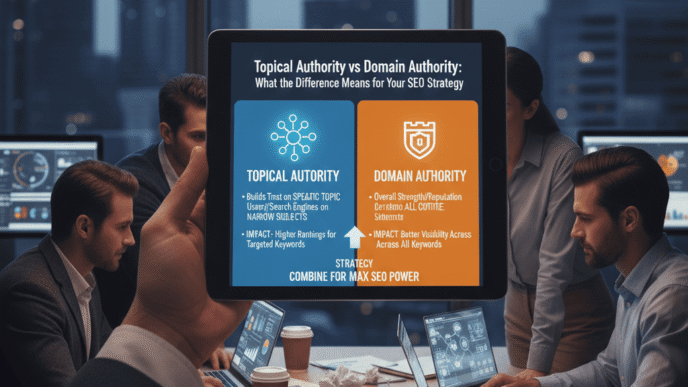




Most topical coverage audits start in the wrong place.
The default workflow — pull a keyword gap report, compare against competitors, build a list of missing terms — produces a content plan built on demand data, not semantic structure. Keyword gaps show you what people search for. They do not show you whether adding that content would strengthen your topical authority or dilute it.
A topical coverage audit that actually shifts rankings starts from the concept map of the topic, not from a competitor’s keyword profile. The gap you need to find is not “which keywords am I missing” — it is “which conceptual territory does my content fail to cover, and does that absence break the semantic coherence of my cluster?”
This cluster walks through the exact process to run that audit on an existing content library, prioritise what needs fixing first, and produce a gap list that builds topical authority rather than just adding content volume.
Post Summary
- A topical coverage audit starts from the concept map of the topic — not from competitor keyword lists
- The audit has five stages: concept mapping, content inventory, gap classification, query alignment, and prioritisation
- Google Search Console query data reveals which conceptual sub-topics your content reaches and which it does not
- Not every gap needs new content — some gaps are better fixed through rewriting or consolidating existing posts
- Topical gaps that sit between your pillar and its clusters are the highest-priority fix: they break the semantic chain Google needs to evaluate your authority
- A coverage audit takes two to four hours on a standard cluster; skipping it means any new content you add may be solving the wrong problem
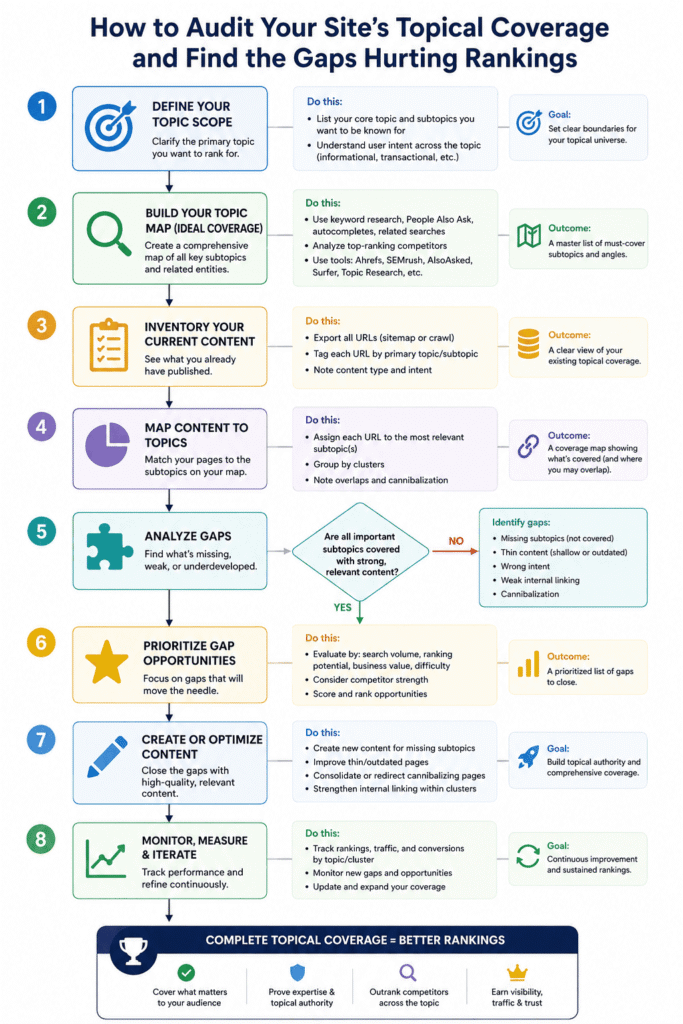
Table of Contents
ToggleWhy Keyword Gap Tools Give You the Wrong Starting Point
Running a keyword gap report is not a topical coverage audit. The distinction matters more than most practitioners acknowledge.
Keyword gap tools — Ahrefs Content Gap, Semrush Keyword Gap, and similar features — compare your ranking keyword profile against competitors and surface terms you are not ranking for. That data is genuinely useful for demand analysis. It tells you nothing about whether those missing terms represent gaps in your topic’s conceptual structure.
A competitor might rank for a keyword because they published a thin, high-volume post three years ago on a topic adjacent to yours. Adding that content to your site does not fill a topical gap — it adds an isolated post that weakens cluster coherence. (Source: Ahrefs, 2024)
Most practitioners audit from competitor data because it is the path of least resistance. That’s the wrong order entirely. Build your concept map first, then cross-reference keyword demand against the gaps the concept map identifies. Demand data filters which gaps to prioritise — it does not identify which gaps exist.
Start with a blank document, not a tool. Map every conceptual sub-topic the parent topic contains before you open a single gap report.
Stage 1 — Build the Concept Map Before You Open Any Tool
A concept map is a structured list of every sub-topic, question, and conceptual territory that belongs to the parent topic — built from what the topic is, not from what competitors have covered.
The fastest way to build one is to write the parent topic at the top of a document, then branch into three tiers: core concepts (the foundational ideas the topic cannot be understood without), operational questions (what a practitioner actually needs to do), and edge cases or advanced considerations (what experienced practitioners need that beginners do not).
For a topic like topical authority SEO, core concepts include: what topical authority is, how Google evaluates it, and how it differs from domain authority. Operational questions include: how to build a cluster, how to audit existing coverage, how to measure authority signals. Advanced considerations include: entity consistency across clusters, AI search evaluation criteria, and topical authority for new domains.
That map — built before any tool is opened — gives you the semantic skeleton of the topic. Everything in your content library either covers a node on that map, partially covers it, or misses it entirely. (Source: Search Engine Journal, 2025)
Spend 30 to 45 minutes building this map before moving to Stage 2. Any time saved by skipping it costs you twice as much in the prioritisation stage.
Stage 2 — Inventory Your Existing Content Against the Map
With the concept map built, pull a full list of your existing content on this topic: pillar posts, cluster posts, supporting articles, and any news or case study content that touches the subject.
Map each piece of content to a node on the concept map. One post can cover multiple nodes — that is expected. The goal is to identify which nodes have coverage and which do not.
Flag three content states as you go. Full coverage means the node has a dedicated post or a substantive section in a pillar that goes to practitioner depth. Partial coverage means the node is mentioned or briefly addressed but not developed. No coverage means the node appears on the concept map but nowhere in the content library.
Partial coverage is the most common finding — and the most under-diagnosed gap type. A node that is mentioned in several posts but developed in none looks like coverage in a keyword audit, because the term appears in the index. Semantically, it is a gap: Google can see the term but cannot find a post that owns the concept. (Source: Google Search Central, 2024)
Build a simple spreadsheet: concept map node in column one, matching post URL in column two, coverage state in column three. That inventory is the working document for the rest of the audit.
Stage 3 — Classify Each Gap by Type and Fix Route
Not every gap gets the same fix. Treating all missing coverage as “write a new post” is one of the most common mistakes in content gap remediation.
Gap classification determines the fix route before any writing begins.
A structural gap is a node that sits between your pillar and its clusters — a concept the pillar delegates but no cluster develops. These are the highest-priority gaps: they break the semantic chain Google uses to evaluate topical authority across the cluster. The fix is always a new cluster post. (Source: Ahrefs, 2024)
A depth gap is a node that has a post but the post does not go to practitioner depth — it covers the topic at introductory level while your audience needs operational detail. The fix is a rewrite, not a new post. Adding another thin post on the same node increases content volume without filling the gap.
A consolidation gap appears when two or three posts partially cover the same node without any of them owning it fully. The fix is to consolidate into one stronger post and redirect the others, not to add a fourth.
An adjacency gap is a node on the concept map that is genuinely outside your cluster’s scope — it belongs to a different topic that you have not yet built out. These gaps are not a current-cluster problem. Log them for a future cluster build rather than adding off-scope content to the existing architecture.
Run every flagged gap through this classification before writing a single brief.
Stage 4 — Cross-Reference the Concept Map Against GSC Query Data
The concept map tells you what gaps exist semantically. Google Search Console tells you which of those gaps are already generating impressions — and which are invisible to search entirely.
Pull your GSC Performance report filtered to queries containing your focus topic terms. Export at least 90 days of data. Map each query cluster to a node on your concept map.
Nodes that appear in GSC impressions but have no dedicated coverage are your highest-combined-priority gaps: semantic gap plus confirmed demand in the same location.
The lightweight case study: An e-commerce SEO agency ran this audit on a client’s content library in the home improvement vertical. The concept map identified 14 gaps across a 22-post cluster. The keyword gap tool had flagged only 6 of them — and 3 of the tool’s flagged gaps turned out to be adjacency gaps that sat outside the cluster’s scope entirely. The GSC cross-reference revealed 4 nodes generating between 200 and 800 monthly impressions with no dedicated coverage — nodes the tool had missed because the client’s domain was not ranking for the terms, so they did not appear in a competitor comparison. The agency prioritised those 4 nodes first. Within 8 weeks of publishing two new cluster posts and rewriting two existing ones, the cluster’s total impressions increased by 34%. We expected the keyword tool to surface the most urgent gaps. It did not — and the GSC step was what made the priority order clear.
Export your GSC queries, map them to your concept map nodes, and flag any node generating over 100 monthly impressions with no dedicated post. Those are your first-priority fixes.
Stage 5 — Prioritise the Fix List
With gaps classified and GSC data cross-referenced, you now have enough information to build a prioritised fix list.
Order by three criteria, applied in sequence. First: fix type. Structural gaps (broken semantic chain) come before depth gaps, which come before consolidations. Adjacency gaps go to a separate backlog. Second: demand signal. Within each fix type, prioritise nodes with confirmed GSC impressions over nodes with no current impression data. Third: effort. Within the same priority tier, a rewrite takes less time than a new post — sequence rewrites before new builds where the gap classification supports it.
A standard 10 to 15 post cluster typically produces 3 to 5 structural gaps, 4 to 6 depth gaps, 2 to 3 consolidation candidates, and 2 to 4 adjacency gaps. Fixing the structural and depth gaps — without touching the adjacency items — is usually sufficient to produce a measurable authority signal improvement. (Source: Search Engine Journal, 2025)
| Gap Type | Fix Route | Priority Order | Typical Fix Time |
|---|---|---|---|
| Structural | New cluster post | 1 — highest | 4–6 hours |
| Depth | Rewrite existing post | 2 | 2–3 hours |
| Consolidation | Merge + redirect | 3 | 3–4 hours |
| Adjacency | Log for future cluster | 4 — backlog | — |
Produce the prioritised list before briefing any content. The brief should follow the gap classification — not precede it.
Pro Tip: In Ahrefs Site Explorer, filter your content library by the parent topic’s focus keyword and sort by Organic Traffic. Posts generating zero traffic on a topic you have published 10+ pieces about are your consolidation candidates — open each one, check its concept map node, and assess whether it is genuinely developing that node or just mentioning the term. If the latter, it is a consolidation gap, not a separate content asset.
Frequently Asked Questions
What is a topical coverage audit?
A topical coverage audit is a structured review of an existing content library to identify which conceptual sub-topics within a topic are covered, which are partially addressed, and which are missing entirely. Unlike a keyword gap analysis, it starts from the semantic structure of the topic — not from competitor keyword data — and produces a gap list organised by fix type rather than by search volume.
How is a topical coverage audit different from a keyword gap analysis?
A keyword gap analysis compares your ranking keywords against competitors and flags terms you are not ranking for. A topical coverage audit maps the full conceptual territory of a topic and assesses whether your content library covers that territory at the depth your audience needs. Keyword gap tools surface demand data — they do not identify whether a missing piece of content would strengthen or weaken your cluster’s semantic coherence.
How often should you run a topical coverage audit?
Run a full audit when building a new cluster, and a lighter review every six months on established clusters. The lighter review involves checking your concept map against any new posts published since the last audit and pulling a fresh 90-day GSC query export to identify emerging gap nodes — queries that are generating impressions on sub-topics your content does not yet address at depth.
What does Google Search Console reveal in a topical coverage audit?
GSC query data shows which conceptual sub-topics your existing content is reaching — in the form of impressions — and which are generating search activity with no corresponding content. Nodes appearing in GSC impressions without dedicated coverage are your highest-priority combined gaps: confirmed demand with no content to capture it. Export 90 days of data and map query clusters to your concept map nodes to identify them.
What should you do with adjacency gaps found during a topical coverage audit?
Log them to a separate backlog rather than adding them to the current cluster. Adjacency gaps are conceptual territories that belong to a different, future topic cluster — adding them to your existing cluster dilutes its semantic focus and can weaken topical authority rather than build it. Address them when you build the relevant topic cluster, not before.
What to Do Next
A topical coverage audit run from keyword gap data alone produces a content plan that adds volume without fixing the underlying semantic gaps suppressing your rankings. The concept-map-first approach surfaces the gaps that actually matter — the structural breaks, the depth failures, the consolidation opportunities — and gives you a fix order that builds topical authority rather than just adding posts.
The audit takes two to four hours on a standard cluster. The output is a prioritised fix list with a clear route for each gap — new post, rewrite, or consolidate.
Run it before briefing any new content. Open a blank document now — write your parent topic at the top, build the concept map for 30 minutes, then pull your content inventory and map each post to a node. That first stage alone will show you whether your cluster has the gaps you suspected or different ones entirely.
References
Ahrefs. “Content Gap Analysis: How to Find and Fix Your Content Gaps.” Ahrefs Blog, 2024. https://ahrefs.com/blog/content-gap-analysis/ Supports: Keyword gap tools surface demand data but do not identify whether missing content would strengthen or dilute topical authority — concept mapping must precede gap tool use.
Google Search Central. How Search Works.” Google Developers, 2024. https://developers.google.com/search/docs/fundamentals/how-search-works Supports: Partial coverage — a term mentioned across posts but not developed in any — registers as a semantic gap to Google’s evaluation even when it appears in the index.
Search Engine Journal. Topical Authority: A Complete Guide for SEO.” Search Engine Journal, 2025. https://www.searchenginejournal.com/topical-authority/ Supports: Structural gaps — nodes the pillar delegates but no cluster develops — break the semantic chain Google uses to evaluate topical authority and are the highest-priority fix in any coverage audit.
Google Search Console. “Search Console Help.” Google, 2024. https://search.google.com/search-console/about Supports: GSC query data cross-referenced against a concept map reveals which gap nodes are already generating impressions — identifying highest-priority combined gaps with confirmed demand and no dedicated coverage.
Ahrefs. “Topical Authority: What It Is and How to Build It.” Ahrefs Blog, 2024. https://ahrefs.com/blog/topical-authority/ Supports: Gap classification by fix type — structural, depth, consolidation, adjacency — determines the correct remediation route before any writing begins.