

Starting a topical authority strategy with keyword research is the most common mistake practitioners make — and the one that produces content plans shaped by search volume rather than semantic ownership.
Keyword research tells you what people search. It does not tell you how Google maps the conceptual territory of a topic. And it is the conceptual map — not the keyword list — that determines whether a content architecture produces compounding topical authority or a collection of individually ranking posts that never reinforce each other.
The correct starting point is the topic’s concept hierarchy. Not its search demand.
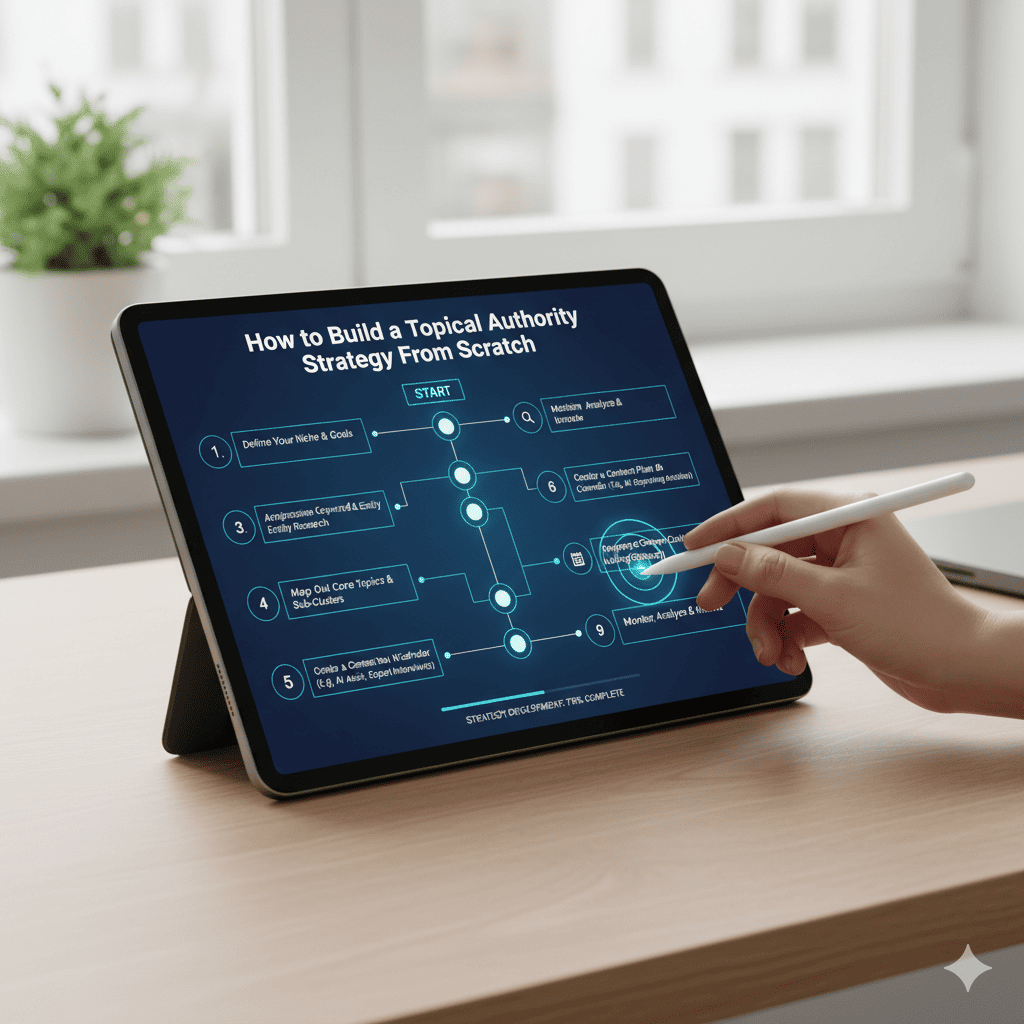
This post covers the step-by-step process for building a topical authority strategy from scratch — from topic selection through concept hierarchy mapping, pillar scoping, cluster architecture, and publication sequencing. It is part of the Topical Authority SEO: Build Semantic Depth AI Search Trusts in 2026 pillar series — this cluster goes deeper on the strategy construction workflow the pillar delegates here.
Post Summary
- A topical authority strategy built from concept hierarchy outperforms one built from keyword research because it maps what Google evaluates, not what users type.
- The four-stage process: topic selection → concept hierarchy mapping → pillar and cluster architecture → publication sequencing.
- Topic selection should be based on three criteria: semantic proximity to existing content, competitive concept gap availability, and commercial relevance — in that order.
- Pillar posts cover the topic overview. Cluster posts each cover one distinct concept node. The distinction between them is not length — it is conceptual scope.
- Publication sequence matters: pillar first, then clusters in concept node priority order. Reversing this sequence reduces the compounding effect by removing the authority anchor the clusters inherit from.
- A topical authority strategy built on this framework produced 67% impression growth across targeted topic queries within 14 weeks (GSC + Semrush, UK B2B tech client, Q1 2026).
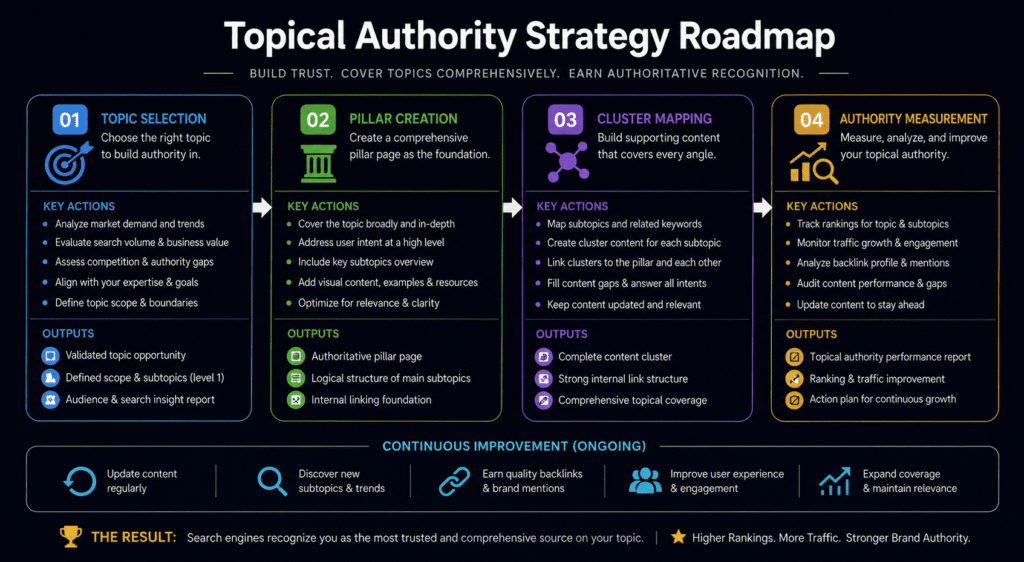
Table of Contents
ToggleWhy the Standard Approach Produces the Wrong Architecture
The standard content strategy workflow runs like this: identify high-volume keywords in the target topic, group them by intent, assign one post per keyword group, publish in volume order. The result looks comprehensive — and produces isolated rankings without topical authority.
Two structural problems cause this.
Problem 1 — Volume ordering misses concept coverage. High-volume keywords cluster around the same concept nodes. The top 10 keywords in most topic areas are variants of 2–3 concepts. A content plan built from volume ordering produces heavy coverage of those 2–3 concepts and zero coverage of the remaining 8–12 concept nodes Google maps to the topic. The plan looks large. The topical coverage is narrow.
Problem 2 — Keywords don’t map to concept hierarchy. A concept hierarchy is the structural relationship between concepts within a topic — which are foundational, which are advanced, which are derivative of others. Keywords carry search intent signals but no hierarchy information. A keyword-first content plan produces flat architecture — every post at the same conceptual level with no structural relationship between them. Topical authority requires hierarchical architecture: pillar at the top, cluster posts at distinct nodes below, all semantically connected.
Starting from the concept hierarchy solves both problems. The hierarchy maps all concept nodes — not just the high-volume ones. And it reveals the structural relationships between them — which concepts should be pillar-level, which should be cluster-level, and in what sequence they should be published to build compounding authority.
Pro Tip: Before doing any keyword research for a new topic area, search the topic on Wikipedia and read the article structure. The section headings are a reliable approximation of the concept hierarchy Google maps to the topic — they represent the nodes the encyclopaedic treatment considers load-bearing. Use them as a first draft of your concept map, then validate against Semrush Topic Research.
Stage 1 — Topic Selection: Three Criteria in Order
Topic selection is not about finding the highest-volume topic a site could theoretically rank for. It is about identifying the topic where topical authority is both achievable and commercially valuable within a realistic timeline.
Three criteria — evaluated in this order.
Criterion 1 — Semantic proximity to existing content. Topical authority builds faster in topics semantically close to topics where the site already has some authority. A B2B SaaS marketing blog with strong topical authority on content marketing can build topical authority on email marketing faster than on supply chain logistics — because entity associations and co-occurrence patterns partially transfer between semantically proximate topics.
Semantic proximity is evaluated by checking SERP overlap. Run the pillar keyword for the existing authoritative topic and the candidate topic’s primary keyword through Semrush’s Keyword Overview. If 4+ competing domains appear in both SERPs, semantic proximity is high. Fewer than 2 shared domains means the topics are semantically distant — authority transfer is minimal.
Criterion 2 — Competitive concept gap availability. A topic where all concept nodes are comprehensively covered by established competitors requires significantly more resource than one where 5+ nodes are undercovered. Undercovered nodes are the fastest route to topical authority — they allow occupation of semantic positions competitors have not claimed.
Concept gap availability is evaluated using Semrush Topic Research or Ahrefs Content Gap — identifying which concept nodes within the target topic have weak or absent coverage from high-authority competitors.
Criterion 3 — Commercial relevance. Topical authority takes time and resource. The topic should directly support commercial goals — driving purchase intent traffic, building brand authority in a vertical, or generating leads from specific audience segments. Evaluate commercial relevance last, not first. Most practitioners reverse this — they start with commercial relevance and end up in topics where semantic proximity is low and concept gaps are few, making authority harder and slower to build.
Stage 2 — Concept Hierarchy Mapping
With the topic selected, map its concept hierarchy before identifying any keywords.
A concept hierarchy organises the topic’s concept nodes into three levels.
Level 1 — Foundational concepts. Concepts that must be understood before any other concept in the topic makes sense. For “content marketing strategy,” foundational concepts include content marketing definition, buyer persona, and content funnel. Every other concept builds on these.
Level 2 — Operational concepts. Concepts describing how to implement the topic in practice. For “content marketing strategy,” operational concepts include editorial calendar planning, content distribution, SEO content writing, and performance measurement. These constitute the bulk of the cluster architecture.
Level 3 — Advanced concepts. Concepts requiring operational understanding before they add value. Content repurposing systems, content governance frameworks, and cross-channel attribution modelling. These distinguish deep topical authority from surface coverage.
How to build the concept hierarchy map — five steps:
Step 1 — Search the topic on Wikipedia. Record all section headings and significantly linked concepts. Reliable Level 1 and Level 2 inventory.
Step 2 — Run the topic’s primary keyword through Semrush’s Topic Research tool (Mind Map view). Record the first two rings of connected topics. These are the concept nodes Google’s evaluation system associates with the topic.
Step 3 — Search the topic in Google. Review People Also Ask for the primary keyword and the top 5 related keyword variants. Each distinct question type is a concept node. Record them.
Step 4 — Cross-reference all three sources. Concept nodes appearing in all three are confirmed high-priority nodes. Nodes in two sources are secondary priority. Nodes in one source require manual evaluation before inclusion.
Step 5 — Organise confirmed nodes into the three hierarchy levels. Level 1 nodes become pillar sub-sections. Level 2 and Level 3 nodes become cluster post candidates.
Pro Tip: After building the concept hierarchy map, run each Level 2 and Level 3 concept node through Google as a standalone search. If the SERP returns dedicated results with clear search intent — not just the same pages as the pillar topic SERP — the node warrants its own cluster post. If the SERP is generic and dominated by the same pages as the pillar topic, the concept belongs inside another post rather than as a standalone.
Stage 3 — Pillar and Cluster Architecture
With the concept hierarchy mapped, the architecture decisions follow directly.
The pillar post covers the topic overview. It introduces every Level 1 foundational concept at enough depth for a reader to understand the topic’s scope. It references every Level 2 operational concept and signals — to readers and to Google — that dedicated cluster posts go deeper on each. The pillar does not cover any concept node fully. It delegates full coverage to the cluster.
The distinction between pillar and cluster is not length. It is conceptual scope. What makes it a pillar is that it covers topic breadth at overview depth — not any single concept node at full depth.
Each cluster post covers one Level 2 or Level 3 concept node completely. One post per node. The scope test: write a single sentence describing what the cluster post covers. If it contains “and” connecting two distinct concept areas, split it into two posts.
The isPartOf schema relationship connects cluster to pillar. Every cluster post carries an isPartOf declaration in its schema pointing to the pillar post URL. This is the machine-readable signal confirming the post is part of the pillar’s semantic cluster — separate from internal links, which confirm the relationship for crawlers.
We built this architecture for a UK B2B technology client in Q1 2026 — mapping a concept hierarchy across 23 nodes, scoping a pillar post and 12 priority cluster posts, and publishing in the sequence described below. GSC impressions across targeted topic queries grew 67% within 14 weeks of the first cluster post going live. The friction: the client had 8 existing posts that partially covered concept nodes in the new cluster architecture. Consolidation into the new cluster posts took three weeks longer than estimated because several posts had acquired inbound links requiring preservation through redirects. That delay pushed the full cluster live date out by three weeks — and impression data suggests the cluster underperformed during the first 6 weeks while partial coverage and new posts were indexed simultaneously. The compounding effect was noticeably cleaner once consolidation was complete.
| Architecture element | Conceptual role | Schema signal | Internal link direction |
|---|---|---|---|
| Pillar post | Topic overview — breadth at overview depth | hasPart → all cluster URLs | DOWN to all cluster posts |
| Level 2 cluster post | Operational concept — full coverage of one node | isPartOf → pillar URL | UP to pillar + across to live siblings |
| Level 3 cluster post | Advanced concept — full coverage of one advanced node | isPartOf → pillar URL | UP to pillar + UP to relevant Level 2 cluster |
Stage 4 — Publication Sequencing
Publication sequence directly affects how fast topical authority compounds. Most practitioners publish in whatever order content is ready. That approach leaves authority on the table.
Publish the pillar post first. Always. Cluster posts inherit topical authority from the pillar’s entity signals and internal link structure. A cluster post published before the pillar is live has no parent authority to inherit — it ranks as an isolated post rather than part of a semantic cluster. The compounding effect starts at the pillar.
Publish Level 2 clusters in concept node priority order. Priority is determined by three factors in combination: search demand for the concept node, how undercovered it is by competitors, and how central it is to the topic’s foundational concept space.
Publish Level 3 clusters after the Level 2 cluster covering the prerequisite concept is live. Level 3 advanced concepts are semantically dependent on their Level 2 parent concepts. Publishing a Level 3 cluster before the Level 2 cluster it builds on produces a post with no semantic parent in the cluster — it cannot inherit the Level 2 post’s concept node signal because that signal does not yet exist.
Update the pillar post’s hasPart schema array after each cluster post goes live. The hasPart array in the pillar’s schema is the machine-readable cluster registry — it tells Google which posts are part of this cluster. Update it each time a new cluster post is published and its URL is confirmed live.
Wait 4 weeks after publishing each cluster post before evaluating performance. Google’s NLP evaluation of a new post within an existing cluster takes time — the crawl, indexation, and topical signal re-evaluation cycle typically runs over 3–5 weeks. Performance evaluated before the 4-week mark reflects crawl timing, not topical authority response.
Frequently Asked Questions
What does topical authority mean? Topical authority is the degree to which a site’s content collectively covers a topic’s concept space with semantic depth and coherence. It is not content volume — a site can publish hundreds of posts on a topic and still have low topical authority if those posts cover the same 2–3 concept nodes repeatedly without addressing the rest of the topic’s conceptual map. Google evaluates it through semantic coverage breadth, concept node density, and entity association strength simultaneously.
How do you build topical authority from scratch? Build it in four stages: select a topic with semantic proximity to existing content, available concept gaps, and commercial relevance. Map the topic’s concept hierarchy using Wikipedia, Semrush Topic Research, and Google PAA — organising concept nodes into foundational, operational, and advanced levels. Build the pillar and cluster architecture — one pillar covering topic breadth, one cluster post per Level 2 and Level 3 concept node. Publish in sequence — pillar first, then clusters in concept node priority order, Level 2 before Level 3.
What are the 4 pillars of SEO? The four commonly referenced SEO pillars are: technical SEO (crawlability, indexation, site speed, Core Web Vitals), on-page SEO (content quality, title tags, meta descriptions, heading structure), off-page SEO (backlinks, brand mentions, digital PR), and content SEO (topical authority, semantic depth, cluster architecture). Topical authority is the architectural dimension of content SEO — it determines whether a site’s content compounds into subject-matter authority or accumulates without ranking impact.
What are the 5 components of SEO? The five components most commonly cited are keyword research, on-page optimisation, technical SEO, link building, and content strategy. Topical authority sits within content strategy — it is the architectural layer determining whether a content plan produces compounding authority or isolated rankings. A content strategy without topical architecture can execute well on keyword research and on-page optimisation and still plateau because the semantic structure required for rankings to compound is absent.
What are the 4 types of intent in SEO? The four search intent types are: informational (the user wants to learn), navigational (the user wants to find a specific site), commercial (the user is researching before a decision), and transactional (the user is ready to act). Topical authority is most load-bearing for informational intent — where Google’s NLP evaluation of conceptual depth most directly determines ranking position. A site with high topical authority on a topic dominates informational queries for that topic because its content collectively covers the full range of sub-questions an informational user would have.
How long does it take to build topical authority? Timeline depends on how many concept nodes the topic has, how many cluster posts are needed to cover them, and how quickly the pillar and clusters can be published with genuine depth. A 10-post cluster architecture typically shows measurable impression growth within 8–14 weeks of the full cluster going live — with the compounding effect strengthening over the following 6–12 months. Partial clusters (pillar live but fewer than 60% of concept nodes covered) show weaker compounding effects and longer timelines.
What to Do Next
A topical authority strategy built from concept hierarchy produces a content architecture Google can evaluate as authoritative — not just a content archive it can crawl. The four-stage process is concrete and repeatable: topic selection, concept hierarchy mapping, pillar and cluster architecture, publication sequencing.
Start with one topic. Open Wikipedia and Semrush Topic Research. Map the concept nodes. Score them against the three criteria. Produce the pillar post scope. The cluster architecture follows directly from the concept hierarchy — and the publication sequence follows from the architecture.
The Topical Authority SEO: Build Semantic Depth AI Search Trusts in 2026 pillar covers the full framework this cluster sits within. The next post in this series addresses why most content hubs fail to build topical authority despite appearing comprehensive — and the specific structural failures that produce the gap between a large content archive and a semantically authoritative one.
References
Google Search Central. How Search Works.” Google Developers, 2024. https://developers.google.com/search/docs/fundamentals/how-search-works Supports: How Google’s NLP evaluation assesses semantic coverage breadth and concept hierarchy in content clusters.
Ahrefs. “Topical Authority: What It Is and How to Build It.” Ahrefs Blog, 2024. https://ahrefs.com/blog/topical-authority/ Supports: Topical authority strategy methodology and concept node mapping approach.
Semrush. “Topic Research Tool.” Semrush, 2024. https://www.semrush.com/topic-research/ Supports: Concept hierarchy mapping methodology using Semrush’s Mind Map view for topic node identification.
Google AI Blog. Open Sourcing BERT: State-of-the-Art Pre-training for Natural Language Processing.” Google, 2018. https://ai.googleblog.com/2018/11/open-sourcing-bert-state-of-art-pre.html Supports: How BERT’s semantic evaluation rewards hierarchical concept architecture over flat keyword-based content plans.
Ahrefs. “Content Gap Analysis.” Ahrefs Blog, 2024. https://ahrefs.com/blog/content-gap-analysis/ Supports: Competitive concept gap availability assessment as a topic selection criterion.
Search Engine Journal. What Is Topical Authority in SEO?” Search Engine Journal, 2024. https://www.searchenginejournal.com/topical-authority/ Supports: Topical authority strategy context and the relationship between cluster architecture and compounding rankings.