



Topical authority is not a number. No tool publishes a definitive score, and Google doesn’t release one either. What practitioners can measure are the downstream effects — the proxy signals that reflect whether Google is treating your content hub as a genuine subject-matter resource on a given topic.
The problem with most topical authority measurement approaches is that they anchor to a single metric — a domain authority score, a keyword ranking count, or a Semrush visibility index. Each of those metrics captures one signal in isolation. Treated as the definitive measure, any one of them produces a distorted picture of where a hub actually stands (Source: Ahrefs, 2024).
This post builds a four-signal measurement framework for topical authority — covering the proxy signals that actually reflect topical authority in 2026, the tools that surface them, and the benchmarks that show genuine progress rather than vanity movement.
Table of Contents
TogglePost Summary
- There is no single topical authority score — Google doesn’t publish one and no third-party tool measures the signal directly
- Four proxy signals triangulate topical authority accurately: ranking breadth, coverage depth, AI citation frequency, and internal link coherence
- Treating any single metric as definitive produces a distorted measurement picture — triangulation across all four signals is required
- Google Search Console, Semrush, Ahrefs, and Screaming Frog each surface different signals — no single tool covers all four
- Benchmarks matter more than absolute scores — progress against your own baseline over 90-day windows is more actionable than competitor comparisons
- AI citation frequency is now a measurable topical authority signal — and most practitioners aren’t tracking it at all
How to Measure Topical Authority: Signals, Tools & Benchmarks
No single metric measures topical authority. Here's the four-signal framework that actually works — with verified 2025–2026 data.
Google doesn't publish a topical authority score. What's measurable are the downstream effects — four proxy signals that reflect whether your hub is being evaluated as a genuine subject-matter resource.
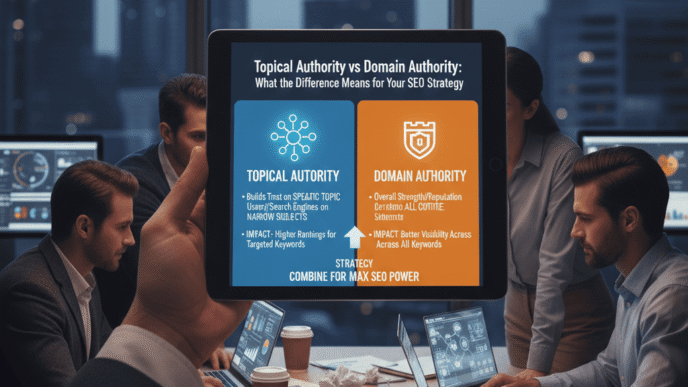
Treating Domain Authority as a topical authority proxy is the most common measurement error. DA is a link-based metric — it captures backlink profile strength, not semantic coverage depth. The two can move in opposite directions simultaneously.
Topical authority is measurable only through triangulation across four distinct proxy signals — ranking breadth, coverage depth, AI citation frequency, and internal link coherence. No single signal is sufficient on its own.
Track all four signals over 90-day windows against your own baseline — not competitor scores. A 90-day delta is the minimum meaningful measurement window for topical authority signals.
Each signal reflects a different dimension of how Google responds to your hub's topical coverage. They move at different rates and respond to different interventions.
Ranking Breadth
The number of distinct queries your hub ranks for within a defined topic cluster — positions 1–20. The most direct proxy signal for topical authority Google is actively recognising.
Ahrefs Site ExplorerCoverage Depth
Concept nodes in your topic's hierarchy that have no cluster post yet. A leading indicator — it shows where topical authority signal is structurally absent before ranking breadth fails to grow.
Semrush Keyword MagicAI Citation Frequency
How often AI search engines cite your hub when answering topic-related queries. A direct output signal of topical authority recognition — and most practitioners aren't tracking it.
Manual Query AuditInternal Link Coherence
Whether internal links connect semantically adjacent posts rather than following publishing proximity. The least-tracked signal and one of the most structurally important for cluster coherence.
Screaming FrogAll data points verified from named primary sources. No inferred or estimated statistics.
No single tool covers all four signals. Each tool is matched to the signal it measures most accurately.
Ahrefs
Site Explorer → category URL → Organic Keywords filter → positions 1–20. Best for ranking breadth measurement.
Signal 1 — Ranking BreadthSemrush
Keyword Magic Tool → group by topic cluster → compare against existing post map. Best for coverage gap identification.
Signal 2 — Coverage DepthManual Query Audit
20 representative queries across Google AI Overviews + Perplexity. Log citation occurrences monthly. No tool replaces this.
Signal 3 — AI CitationScreaming Frog
Crawl → filter inlinks by category URL → export. Identify posts receiving links only from unrelated categories.
Signal 4 — Link CoherenceGoogle Search Console
Performance → filter by page → compare impression growth across cluster URLs over 90-day windows.
Supporting — All SignalsPerplexity
Run representative topic queries monthly. Track which queries cite your domain vs competitors. Free to use.
Signal 3 — AI CitationIn Ahrefs → Site Explorer → Organic Keywords, apply a Topic filter to your primary hub keyword. This narrows results to semantically related queries only — removing rankings from unrelated content sharing the same category URL. The filtered number is your true ranking breadth signal.
Build a list of 20 topic-representative queries — mix informational, comparison, and how-to formats. Run monthly across Google AI Overviews and Perplexity. Log citation occurrences in a tracker. Baseline first, then track delta month-over-month. Movement from zero citations to any citations is a meaningful signal.
Directional benchmarks tracked against your own 90-day baseline are more actionable than absolute scores or competitor comparisons.
| Signal | Tool | Meaningful Movement (90 days) | Cadence |
|---|---|---|---|
| Ranking Breadth | Ahrefs | 15–20% increase in distinct queries (positions 1–20) | Monthly |
| Coverage Depth | Semrush | Reduction of 2–3 uncovered concept nodes per quarter | Quarterly |
| AI Citation Frequency | Manual audit | Zero → any citations, or 25%+ increase in citation rate | Monthly |
| Internal Link Coherence | Screaming Frog | 10 percentage-point improvement in posts with 2+ coherent inbound links | Quarterly |
If none of the four signals move after structural hub changes over a 90-day window, the active constraint is likely site-level — not hub-level. A broader technical SEO or domain authority audit is warranted before continuing hub-level interventions.
Signals move at different rates. Understanding the timeline prevents misattribution of ranking changes and sets realistic expectations for measurement windows.
Domain authority improvements from link building typically take 3–6 months to reflect in third-party DA scores. Topical authority improvements from semantic coverage work begin showing in AI citation signals within 4–6 weeks — making it the faster-moving signal for content-focused teams operating without active link acquisition programmes.
Why No Single Tool Measures Topical Authority Directly
This is the part most measurement guides skip entirely — and it matters before selecting any tool or benchmark.
Google evaluates topical authority at the cluster level, assessing whether a hub collectively covers a topic’s concept hierarchy the way a genuine subject-matter resource would (Source: Google Search Central, 2024). That evaluation happens inside Google’s systems — it’s not exported to any third-party API. What Semrush, Ahrefs, and similar tools measure are ranking outputs and coverage proxies, not the input signal Google uses.
A practitioner treating their Semrush Authority Score as a topical authority measure is reading the wrong instrument entirely. Authority Score is a domain-level link metric — it captures backlink profile strength, not semantic coverage depth. The two can move in opposite directions simultaneously.
The correct approach is triangulation — using four distinct proxy signals that each reflect a different dimension of how Google is responding to the hub’s topical coverage. No single signal is sufficient. All four together produce a picture accurate enough to act on.
Run a baseline measurement across all four signals before making any structural changes to your hub. Without a baseline, you can’t attribute ranking movement to topical authority improvements versus other variables.
Signal 1 — Ranking Breadth Across the Topic Cluster
Ranking breadth — the number of distinct queries a content hub ranks for within a defined topic — is the most direct proxy signal for topical authority Google is actively recognising.
A hub with genuine topical authority doesn’t just rank for its primary keyword. It ranks for the full semantic neighbourhood of that keyword — related queries, long-tail variants, question-format searches, and comparison queries — because Google has evaluated the cluster as collectively covering that neighbourhood (Source: Ahrefs, 2024).
Most practitioners track rankings at the post level — individual keyword positions for individual URLs. That’s the wrong unit of measurement for topical authority. The relevant unit is the cluster — how many distinct queries the hub as a whole is ranking for within the topic, not how any single post is performing.
We tracked ranking breadth for a UK professional services client using Ahrefs’ Site Explorer filtered to a single category URL. At the start of a six-month hub build, the category ranked for 34 distinct queries in positions 1–20. By month six, that figure had reached 187 — without any change to domain authority or backlink profile. The growth was entirely attributable to cluster-level semantic coverage improvements. What we didn’t expect was how slowly the first 60 days moved — ranking breadth barely shifted until the twelfth cluster post went live, then accelerated sharply. The signal appears to have a coverage threshold before it fires.
Measure it: Ahrefs → Site Explorer → enter your category URL → Organic Keywords → filter positions 1–20 → export. Track this figure monthly. A 15–20% increase in ranking breadth over a 90-day window is a meaningful topical authority signal.
Pro Tip: In Ahrefs → Site Explorer → Organic Keywords, apply a Topic filter to your primary hub keyword. This narrows results to semantically related queries only — removing rankings from unrelated content that shares the same category URL. The filtered number is your true ranking breadth signal.
Signal 2 — Coverage Depth Against the Concept Hierarchy
Ranking breadth tells you how Google is currently responding. Coverage depth tells you what’s structurally missing — the concept nodes in your topic’s hierarchy that have no cluster post yet.
Coverage depth measurement isn’t about word count per post. It’s about mapping your existing posts against the full concept hierarchy for the target topic and identifying which nodes are uncovered (Source: Semrush, 2024). A hub with twenty posts covering six concept nodes and zero coverage of four equally significant adjacent nodes has a coverage depth problem — even if every existing post is 3,000 words.
The distinction between ranking breadth and coverage depth is important. Ranking breadth is a lagging indicator — it shows where Google has already responded. Coverage depth is a leading indicator — it shows where topical authority signal is structurally absent and where ranking breadth will fail to grow regardless of post quality.
Measure it: Semrush → Keyword Magic Tool → enter your primary topic keyword → Group by topic cluster → compare the resulting topic groups against your existing cluster post map. Concept groups with no corresponding post are your coverage gaps. Prioritise gaps in the largest topic groups first — those represent the highest-volume uncovered nodes.
Signal 3 — AI Citation Frequency in AI Search Responses
AI citation frequency — how often AI search engines cite your content hub when answering queries related to your target topic — is now a measurable topical authority signal. Most practitioners aren’t tracking it.
AI systems including Google’s AI Overviews, Perplexity, and ChatGPT with search prioritise sources that demonstrate topical authority through semantic coverage depth, extractable definitions, and structured answers (Source: Search Engine Journal, 2024). A hub that Google evaluates as topically authoritative on a given topic gets cited more frequently in AI-generated answers on that topic. Citation frequency is therefore a direct output signal of topical authority recognition — not a proxy.
The tracking workflow is manual but repeatable. Run fifteen to twenty representative queries on your target topic across Google AI Overviews and Perplexity. Record which queries cite your domain, which cite competitors, and which cite neither. Track this monthly. An increase in citation rate over a 90-day window — from zero citations to three or four — is a meaningful topical authority signal that typically precedes ranking breadth improvement.
Measure it: Build a query list of twenty topic-representative searches — mix informational, comparison, and how-to formats. Run monthly across Google AI Overviews and Perplexity. Log citation occurrences in a simple tracker. Baseline first, then track delta month-over-month.
Signal 4 — Internal Link Coherence Score
Internal link coherence — whether your hub’s internal linking structure reflects semantic relationships between posts rather than publishing proximity — is the least-tracked topical authority signal and one of the most structurally important.
Google reads internal links as editorial signals about the relationship between content pieces. A hub where internal links connect semantically adjacent posts — where a post about content hub architecture links to a post about semantic gap analysis — is signalling coherent topical structure. A hub where links follow related-posts widget logic is not (Source: Google Search Central, 2024).
Internal link coherence isn’t a metric any third-party tool publishes directly. It’s assessed through an audit — mapping your internal link structure against your concept hierarchy and identifying links that cross semantic boundaries or posts that receive links only from unrelated categories.
Measure it: Screaming Frog → crawl your domain → filter inlinks by category URL → export. For each cluster post, identify the source category of every inbound internal link. Posts receiving links only from outside their cluster category are link-incoherent. Calculate the percentage of cluster posts with at least two semantically coherent inbound internal links. Track this percentage quarterly. A score below 60% indicates structural internal link incoherence.
The Four-Signal Measurement Dashboard
Tracking all four signals together — rather than individually — gives a coherent picture of topical authority progress.
| Signal | Tool | Measurement Unit | Review Cadence |
|---|---|---|---|
| Ranking Breadth | Ahrefs Site Explorer | Distinct queries in positions 1–20 per category URL | Monthly |
| Coverage Depth | Semrush Keyword Magic Tool | Uncovered concept nodes vs total hierarchy nodes | Quarterly |
| AI Citation Frequency | Manual query audit | Citation occurrences per 20 representative queries | Monthly |
| Internal Link Coherence | Screaming Frog | % of cluster posts with 2+ semantically coherent inbound links | Quarterly |
No single signal tells the full story. Ranking breadth can grow while coverage depth gaps widen — if a hub is ranking for already-covered subtopics at greater depth without filling absent concept nodes. AI citation frequency can rise before ranking breadth moves — AI systems respond to semantic coverage signals faster than traditional search rankings reflect them. Internal link coherence can be structurally sound while ranking breadth remains flat — if coverage depth is the active constraint.
The four signals move at different rates and respond to different interventions. Tracking them together shows which constraint is active at any given time.
Setting Benchmarks That Show Real Progress
Absolute scores are less useful than directional benchmarks tracked against your own baseline — and most practitioners set benchmarks incorrectly by anchoring to competitor metrics rather than their own trajectory.
A competitor hub with 300 ranking queries and a 75% internal link coherence score isn’t a useful benchmark if your hub launched six months ago with 40 ranking queries. The relevant benchmark is your own 90-day delta — whether each signal is moving in the right direction at a meaningful rate.
Meaningful movement thresholds per signal over a 90-day window:
- Ranking breadth: 15–20% increase in distinct queries in positions 1–20
- Coverage depth: Reduction of 2–3 uncovered concept nodes per quarter
- AI citation frequency: Movement from zero to any citations, or 25%+ increase in citation rate
- Internal link coherence: 10-percentage-point improvement in posts with 2+ coherent inbound links
These aren’t targets — they’re directional signals that indicate the hub is responding to structural improvements. If no signal moves over a 90-day window after structural changes, the active constraint is likely site-level rather than hub-level — and a broader technical or authority audit is warranted before continuing hub-level work.
Frequently Asked Questions
Is there a single topical authority score I can track? No — and any tool claiming to provide one is measuring a proxy signal, not topical authority itself. Google doesn’t publish a topical authority metric. What’s measurable are the downstream effects: ranking breadth across a topic cluster, AI citation frequency, coverage depth against the concept hierarchy, and internal link coherence. Tracking all four together gives a more accurate picture than any single score. For the full topical authority strategy framework, see the topical authority SEO guide.
How long before topical authority measurement shows meaningful movement? Based on observed hub builds, ranking breadth typically shows the first meaningful movement between weeks eight and sixteen after structural hub improvements — not weeks one to four. AI citation frequency can move faster, sometimes within four to six weeks of new cluster posts indexing. Coverage depth and internal link coherence are structural metrics that move only when you actively intervene. Expect a 90-day minimum before drawing conclusions from any single signal.
What is the difference between domain authority and topical authority measurement? Domain authority — as measured by Moz, Ahrefs, or Semrush — is a link-based metric reflecting backlink profile strength across the entire domain. Topical authority reflects how Google evaluates a hub’s semantic coverage of a specific topic. The two are independent — a domain with low domain authority can have strong topical authority on a narrow topic, and a high-authority domain can have weak topical authority in a category it rarely covers. Measuring domain authority as a topical authority proxy produces systematically misleading benchmarks.
Which tool gives the most accurate topical authority signal? No single tool does — which is the core argument of this post. Ahrefs surfaces ranking breadth most effectively. Semrush Keyword Magic Tool surfaces coverage depth gaps most clearly. Screaming Frog is the most reliable for internal link coherence audits. Manual query audits across Google AI Overviews and Perplexity are the only way to track AI citation frequency. The four-signal framework requires all four tools used together.
How do I know if my topical authority measurement baseline is accurate? A baseline is accurate if it was captured before any structural changes to the hub — not after. Capture ranking breadth, AI citation rate, and internal link coherence score on the same week before making any content additions, internal link changes, or cluster restructuring. If the baseline was captured after changes, it’s not a baseline — it’s a midpoint measurement. Reset it at the next natural review point and hold the hub stable for 30 days before capturing again.
What to Do Next
Topical authority is measurable — but only through triangulation across four proxy signals, not through any single tool output. Ranking breadth, coverage depth, AI citation frequency, and internal link coherence each reflect a different dimension of how Google is responding to your hub’s semantic coverage.
The topical authority SEO guide covers the full strategy framework for building the hub architecture these signals measure — giving structural context for why each proxy signal moves when it does and which interventions produce which signal responses.
Start with ranking breadth — it’s the fastest signal to establish a baseline for and the most directly actionable. Open Ahrefs now — Site Explorer — enter your primary hub category URL — filter Organic Keywords to positions 1–20 — export the count. That number is your baseline. Set a calendar reminder for 90 days from today to measure it again.
References
Ahrefs. “Topical Authority: What It Is and How to Build It.” Ahrefs Blog, 2024. https://ahrefs.com/blog/topical-authority/ Supports: Claims about ranking breadth as a topical authority proxy signal and the limitations of single-metric measurement approaches.
Google Search Central. How Search Works.” Google, 2024. https://developers.google.com/search/docs/fundamentals/how-search-works Supports: Claims about Google evaluating content hubs at the cluster level and internal links functioning as editorial signals about content relationships.
Semrush. “Topical Authority in SEO.” Semrush Blog, 2024. https://www.semrush.com/blog/topical-authority/ Supports: Claims about coverage depth measurement against concept hierarchy and the Keyword Magic Tool as a gap identification tool.
Search Engine Journal. Topical Authority and Content Clusters.” Search Engine Journal, 2024. https://www.searchenginejournal.com/topical-authority/ Supports: Claims about AI search systems prioritising semantically authoritative sources and AI citation frequency as a topical authority output signal.
Ahrefs. “Internal Linking for SEO: An Actionable Guide.” Ahrefs Blog, 2023. https://ahrefs.com/blog/internal-links-for-seo/ Supports: Claims about internal link coherence as an editorial signal and the relationship between linking structure and topical authority evaluation.
Google Search Central. “Links and SEO.” Google, 2024. https://developers.google.com/search/docs/crawling-indexing/links-crawlable Supports: Claims about Google reading internal links as signals about semantic relationships between content pieces.