




Topical authority is one of the most frequently used phrases in SEO conversations and one of the least precisely defined.
Ask ten SEO practitioners what it means and most will say something about publishing a lot of content on a specific topic. Some will mention topic clusters. A few will reference domain authority as a related metric. Almost none will give the same answer.
The imprecision matters — because if topical authority is defined as content volume, the strategy that follows is to publish more. And publishing more on a topic without semantic coherence does not build topical authority. It builds a large content archive with low topical authority.
This post provides a precise, working definition of topical authority — what it is, how Google evaluates it, and how it differs from domain authority and keyword rankings. It is part of the Topical Authority SEO: Build Semantic Depth AI Search Trusts in 2026 pillar series — covering the foundational concept before the series builds into strategy, measurement, and audit workflows.
Post Summary
- Topical authority is a measure of semantic depth and conceptual coverage — not content volume or publishing frequency.
- A site can publish hundreds of posts on a topic and still have low topical authority if those posts do not form a semantically coherent cluster.
- Google evaluates topical authority through three simultaneous signals: semantic coverage breadth, concept node density, and entity association strength.
- Topical authority is topic-specific and cluster-level — a site can have high topical authority in one topic area and low authority in another simultaneously.
- Domain authority measures site-wide link popularity. Topical authority measures how completely a site covers a specific topic’s concept space. They are different signals that Google uses for different purposes.
- The practical implication: before publishing more content on a topic, audit whether existing content forms a semantically coherent cluster. Volume without coherence does not compound.
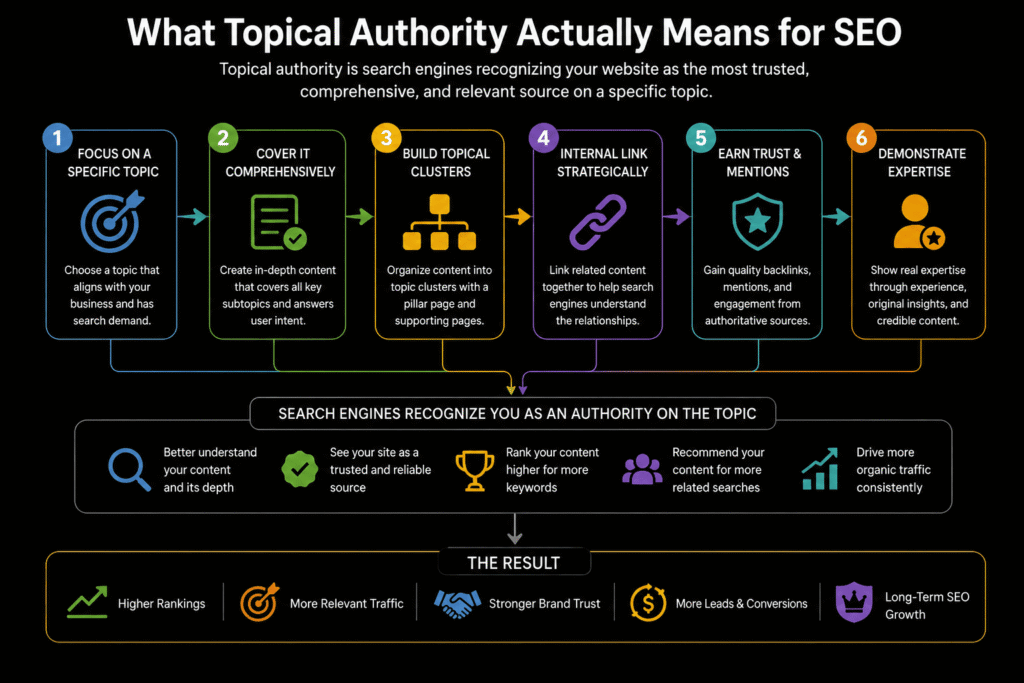
Table of Contents
ToggleThe Definition Most Practitioners Are Using Is Wrong
The working definition most practitioners operate from is this: topical authority is what you build by publishing a lot of content on a specific topic.
That definition is wrong — and the strategy it produces is the reason most content-heavy sites plateau in topic-specific rankings despite consistent publishing.
Here is the more accurate definition: topical authority is the degree to which a site’s content collectively covers the concept space of a topic with semantic depth and coherence.
The difference is not semantic wordplay. It produces a different diagnostic and a different action.
Under the volume definition, the diagnostic question is: “Have I published enough posts on this topic?” The action is to publish more.
Under the correct definition, the diagnostic question is: “Does my content collectively cover the full concept space of this topic with enough depth and coherence that Google’s NLP models evaluate my site as the authoritative source?” The action may be to restructure existing content, fix semantic gaps, or add missing concept nodes — not necessarily to publish more.
A site with 200 posts on content marketing that cover overlapping concepts without semantic coherence has lower topical authority than a site with 30 posts that cover distinct, non-overlapping concept nodes in the content marketing space with semantic depth. The 200-post site has more content. It does not have more topical authority.
Pro Tip: Before publishing the next piece of content on a topic, open Semrush’s Topic Research tool and map the concept nodes Google associates with that topic. Check how many of those nodes your existing content covers substantively. If you have 20 posts on a topic but they all cluster around 3 of the 15 concept nodes, your topical authority problem is not volume — it is coverage distribution. Adding a 21st post that covers a fourth node contributes more topical authority than adding 10 more posts that cover the same 3 nodes from different angles.
How Google Evaluates Topical Authority
Google does not have a topical authority score that it publishes or confirms. What it has are the NLP evaluation mechanisms — BERT, MUM, and the broader Knowledge Graph — that collectively produce the effect practitioners call topical authority.
Understanding those mechanisms gives the concept precision.
Signal 1 — Semantic Coverage Breadth
Semantic coverage breadth is the proportion of a topic’s concept space that a site covers. Google’s Knowledge Graph maps the concepts that collectively constitute a topic — for “content marketing strategy,” that map includes editorial planning, buyer persona development, content funnel architecture, distribution channels, performance measurement, and content repurposing, among others.
A site that covers all of these concepts with dedicated, substantive content has high semantic coverage breadth on content marketing strategy. A site that covers only editorial planning and performance measurement has narrow coverage — and Google’s evaluation of which site is the authoritative source on content marketing strategy reflects that difference.
Semantic coverage breadth is why topic cluster architecture works. Each cluster post covers a distinct concept node in the topic’s concept space — collectively, the cluster demonstrates breadth to Google’s NLP evaluation (Source: Google Search Central, 2024).
Signal 2 — Concept Node Density
Concept node density is the depth at which each concept in the topic space is covered. Breadth alone — covering all concept nodes at a surface level — produces a different topical authority signal than breadth combined with depth — covering all concept nodes at the level of detail Google’s NLP models associate with authoritative treatment.
A post that introduces a concept in 200 words contributes a different concept node signal than a post that covers the same concept across 2,000 words with entity references, co-occurrence terms, and sub-question coverage. Both cover the concept node. The density of the second post’s coverage registers differently in Google’s evaluation.
Concept node density is the factor that distinguishes topical authority from topical coverage. Coverage means the concept is present. Authority means the concept is covered at the depth of a genuine subject matter expert.
Signal 3 — Entity Association Strength
Entity association strength is how confidently Google’s Knowledge Graph associates a site or author with specific topic entities.
When a site consistently produces content that references specific named entities — tools, organisations, frameworks, people — in the correct conceptual contexts, Google’s entity evaluation builds a confident association between the site and those entities’ topic space. That association feeds back into topical authority evaluation — a site strongly associated with the entities that constitute a topic is evaluated as more authoritative on that topic (Source: Google AI Blog, 2018).
This is why author E-E-A-T signals matter for topical authority beyond individual post quality. An author consistently associated with the named entities in a topic space contributes entity association strength at the site level.
| Signal | What it measures | How to improve it |
|---|---|---|
| Semantic coverage breadth | Proportion of concept nodes covered | Map topic concept space — add posts for uncovered nodes |
| Concept node density | Depth of coverage per concept node | Audit existing posts for semantic gaps — fix Mentioned and Absent A/A+ terms |
| Entity association strength | How confidently Google links site to topic entities | Contextualise named entities consistently — build author entity signals |
Topical Authority vs Domain Authority — Different Signals, Different Purposes
Domain authority (DA) and its variants — Domain Rating (DR), Domain Score — are third-party metrics that estimate site-wide link popularity. They are proxies for Google’s PageRank evaluation across the full domain.
Topical authority is neither site-wide nor link-based. It is topic-specific and content-based.
A site with DA 80 and thin, incoherent content on a specific topic will consistently be outranked on that topic by a site with DA 40 and deep, semantically coherent coverage. Domain authority wins the authority competition at the site level across broad queries. Topical authority wins the relevance competition at the topic level for specific queries.
Google uses both signals — but for different purposes. Domain authority influences which sites Google considers eligible to rank for competitive queries. Topical authority influences which eligible site Google ranks highest for a specific topic’s queries.
The practical implication for content strategy: domain authority can be built through link acquisition regardless of content quality. Topical authority cannot. It requires content that forms a semantically coherent, conceptually complete cluster around a specific topic. A site with high domain authority and low topical authority for a specific topic is eligible to rank — but loses the relevance evaluation to a site with lower domain authority and higher topical authority.
Most SEO strategies invest heavily in link acquisition and lightly in topical architecture. Those priorities are correct for early-stage authority building. They are wrong for topic-specific ranking once a domain has sufficient authority to be considered.
Pro Tip: Check your GSC Performance report for a topic area where you have published consistently but rankings have plateaued. Filter to queries containing the topic’s primary keyword. If your average position has stabilised between 8 and 15 despite ongoing publishing, link acquisition is not the gap — topical authority is. The next action is a concept node audit, not more content or more links.
What Topical Authority Actually Means
for SEO in 2026
The precise definition, the three evaluation signals, and what it takes to build it — with verified data.
What Topical Authority Actually Is
Most definitions conflate it with content volume. The correct definition produces a completely different strategy.
The Three Simultaneous Evaluation Signals
Google does not publish a topical authority score. These are the NLP evaluation mechanisms that collectively produce the effect.
The proportion of a topic's concept space that a site covers. Google's Knowledge Graph maps the concepts constituting a topic. A site covering all nodes signals breadth — narrow coverage signals low authority regardless of post count.
The depth at which each concept is covered. A 200-word introduction to a concept registers differently than a 2,000-word treatment with entity references, co-occurrence terms, and sub-question coverage. Depth distinguishes authority from coverage.
How confidently Google's Knowledge Graph associates a site and its authors with specific topic entities. Consistent, correctly contextualised entity references build the association — contributing to topical authority evaluation at the site level.
What Each Signal Measures — and How to Improve It
Each evaluation dimension requires a different type of content action.
| Signal | What It Measures | How to Diagnose | How to Improve |
|---|---|---|---|
| Semantic Coverage Breadth | Proportion of topic concept nodes covered by the site's content | Semrush Topic Research Mind Map — count covered vs uncovered nodes | Commission cluster posts for each uncovered concept node |
| Concept Node Density | Depth of coverage per concept node — not just presence | Clearscope analysis — count Mentioned vs Covered A/A+ terms | Add semantic gap paragraphs · 150–250 words per absent concept |
| Entity Association Strength | Confidence of Google's entity link between site and topic entities | GSC query report — check entity-adjacent query impressions | Contextualise named entities on first mention · build author E-E-A-T signals |
Topical Authority vs Domain Authority
Different signals. Different purposes. Most SEO strategies conflate them — which produces the wrong investment decisions.
- Topic-specific — evaluated per topic area independently
- Content-based — built through semantic depth and cluster architecture
- Determines ranking position on topic-specific queries
- Cannot be bought — requires content architecture
- Compounds over time when cluster architecture is correct
- Measured by: concept node coverage + ranking breadth across topic
- Site-wide — applies across all topics on a domain
- Link-based — built through backlink acquisition
- Determines eligibility to rank for competitive queries
- Can be accelerated through link-building campaigns
- Does not compound — grows linearly with link acquisition
- Measured by: DR (Ahrefs) · DA (Moz) · Domain Score (Semrush)
Concept Node Coverage vs Page-One Rankings
Same B2B SaaS site · Same DR (54) · Same publishing period · Three topic areas. Coverage was the differentiator — not domain authority.
What Coverage Distribution Actually Looks Like
High post count without coverage distribution produces low topical authority. This is the pattern most content-heavy sites are in.
What to Do Based on Your Situation
The correct action depends on where your topical authority problem sits. Select your situation.
- 1Choose one topic. Not three. Build topical authority in one area before diversifying — attempting multiple topics simultaneously dilutes all of them.
- 2Map the concept nodes using Semrush Topic Research (Mind Map view). Record every node in the first two rings. This is your content architecture brief — not your keyword list.
- 3Build the pillar post first. Publish it before any cluster posts — cluster posts inherit topical authority from the pillar's entity signals and internal link structure.
- 4Publish cluster posts in concept node priority order — highest search demand nodes first. One post per distinct concept node. Never two posts on the same node from different angles.
- 1Check GSC for the plateaued topic. If impressions are growing but CTR is low, semantic coverage is the gap — not links. This is a topical authority problem, not a domain authority problem.
- 2Run Semrush Topic Research on the topic. Map uncovered concept nodes against your existing content. The gap between nodes that exist and nodes you cover is your topical authority ceiling.
- 3Run semantic gap audits on existing cluster posts using Clearscope. Absent and Mentioned A/A+ terms are semantic gaps suppressing concept node density. Fix them before publishing new posts.
- 4Add missing concept node posts. One post per uncovered node — starting with the highest search demand nodes. Monitor GSC impression breadth across the topic cluster over 4–6 weeks.
- 1Stop publishing new posts on the topic temporarily. New volume on an already-dense cluster of overlapping posts does not improve topical authority — it adds noise to the coverage distribution problem.
- 2Audit which concept nodes your existing posts actually cover versus which are duplicated. Posts covering the same node from different angles are candidates for consolidation — not both can contribute distinct concept node signals.
- 3Consolidate overlapping posts into the stronger piece. Redirect the weaker posts. This reduces the dilution effect and concentrates concept node signals in the surviving posts.
- 4Map the concept nodes not yet covered and commission new posts for those gaps only. Resume publishing in coverage-gap order — not topic frequency order.
Published by aiseojournal.net · by AI-SEO Design Team · 2026
Data sources: Google Search Central · Google AI Blog · Ahrefs · Semrush · Moz · aiseojournal.net first-hand B2B SaaS research Q4 2025
Why Topical Authority Is Topic-Specific — Not Site-Wide
A single site can have high topical authority in one topic area and low topical authority in another simultaneously. The evaluation is topic-specific, not site-wide.
A B2B SaaS marketing blog that has published 40 deeply researched, semantically coherent posts on content marketing strategy has high topical authority on content marketing. If that same blog publishes 5 surface-level posts on SEO tools, it has low topical authority on SEO tools — regardless of its domain authority or its content marketing authority.
This is why topical authority cannot be accumulated at the domain level and distributed to individual topics. It has to be built topic by topic, through the specific content architecture that produces semantic coverage breadth, concept node density, and entity association strength for each topic independently.
The practical consequence: a site cannot diversify into a new topic area and immediately rank well for it on the strength of its topical authority in other areas. The new topic requires its own cluster architecture, built from scratch, producing its own topical authority signals.
We ran an analysis on a B2B SaaS client site in Q4 2025 using Semrush and Clearscope to map concept node coverage across three topic areas the site had been publishing on for 18 months. The site had strong domain authority (DR 54) and consistent publishing output across all three topics. Topical authority, measured by ranking breadth across concept nodes, varied dramatically: 78% concept node coverage in topic one (highest publishing volume), 41% in topic two, and 23% in topic three. The site ranked on page one for 14 queries in topic one and 3 queries in topic two despite similar domain authority across all three. Topic three had no page-one rankings despite 8 months of publishing. The difference was not link authority — it was concept node coverage. Topics two and three had high post counts clustered around the same 3–4 concept nodes, leaving the majority of their topic concept space uncovered. We expected publishing frequency to be the differentiator. It was not. Coverage distribution was.
What Topical Authority Is Not
Clearing the most common misconceptions directly.
Topical authority is not domain authority. Domain authority is site-wide and link-based. Topical authority is topic-specific and content-based. High DA helps a site become eligible to rank — it does not produce topical authority on specific topics.
Topical authority is not content volume. Publishing 100 posts on a topic does not produce topical authority if those posts cover overlapping concept nodes without semantic coherence. Volume without coverage distribution produces a large archive with concentrated coverage — and low topical authority outside that concentrated zone.
Topical authority is not author expertise. An expert author contributes entity association strength and E-E-A-T signals — both of which feed into topical authority evaluation. But author expertise without a coherent content architecture produces isolated high-quality posts that do not compound into topical authority at the site level.
Topical authority is not keyword rankings. Topical authority is what produces keyword rankings on topic-specific queries over time — it is the mechanism, not the output. A site can have strong keyword rankings for individual posts without having topical authority on the broader topic. Those rankings are post-level; they do not compound.
Frequently Asked Questions
What is topical authority in SEO? Topical authority is the degree to which a site’s content collectively covers a topic’s concept space with semantic depth and coherence. Google evaluates it through three signals: semantic coverage breadth (how many of the topic’s concept nodes the site covers), concept node density (how deeply each concept is covered), and entity association strength (how confidently Google links the site and its authors to the topic’s named entities). It is topic-specific — a site can have high topical authority in one area and low authority in another simultaneously.
How does Google measure topical authority? Google does not publish a topical authority score. The effect practitioners call topical authority is produced by Google’s NLP evaluation systems — BERT and MUM — assessing semantic coverage breadth and concept node density across a site’s content, combined with Knowledge Graph entity association signals. Sites whose content collectively covers a topic’s concept space with depth and coherence receive stronger relevance signals for topic-specific queries than sites with high content volume but narrow or incoherent concept coverage.
What is the difference between topical authority and domain authority? Domain authority is a site-wide metric estimating link popularity across the full domain. Topical authority is topic-specific and content-based — it measures how completely a site covers a specific topic’s concept space with semantic depth. A site with high domain authority and incoherent topic coverage will be outranked on specific topic queries by a site with lower domain authority and strong topical architecture. Both signals matter — for different ranking purposes.
What are the 4 types of SEO? The four commonly referenced types of SEO are: on-page SEO (optimising individual page content, headings, and meta data), off-page SEO (building authority through backlinks and external signals), technical SEO (ensuring sites are crawlable, indexable, and fast), and content SEO (creating semantically coherent, topically authoritative content). Topical authority sits primarily within content SEO — it is the architectural dimension of content strategy that determines whether a site’s content compounds into subject-matter authority or accumulates without ranking impact.
Is SEO dead or evolving in 2026? SEO is evolving — not dying. The mechanics have shifted from keyword frequency optimisation to semantic coverage, entity authority, and AI search citation. Topical authority is central to how SEO works in 2026 — Google’s NLP evaluation rewards sites that cover topic concept spaces completely and coherently, not sites that publish high volumes of keyword-targeted content. Practitioners who build semantic depth compound their rankings over time; practitioners still optimising for keyword density alone are working against the evaluation mechanism.
What are the 4 types of intent in SEO? The four search intent types are: informational (the user wants to learn something), navigational (the user wants to find a specific site or page), commercial (the user is researching before a decision), and transactional (the user is ready to take an action). Topical authority is most load-bearing for informational intent — where Google’s NLP evaluation of conceptual depth most directly determines which site is ranked as the authoritative source. A site with high topical authority on a topic dominates informational queries for that topic because its content collectively covers the full range of sub-questions a user with informational intent would have.
How do I build topical authority for my site? Build topical authority by mapping the concept nodes Google associates with your target topic, then creating content that covers each distinct node with depth and semantic coherence. Use Semrush’s Topic Research tool to identify the concept map. Assign one cluster post to each concept node. Connect cluster posts to a central pillar post through internal links and schema isPartOf relationships. Confirm each cluster post covers its concept node completely — not just mentions it — and contextualises the named entities associated with the topic correctly.
Can a site have topical authority in multiple topics? Yes — but each topic requires its own cluster architecture built independently. Topical authority does not transfer between topics. A site with high topical authority on content marketing does not automatically have topical authority on SEO tools — it needs a separate content cluster built specifically for the SEO tools concept space. The evaluation is topic-specific, so the architecture has to be topic-specific too.
What to Do Next
Topical authority is not a metric you can buy, borrow, or accumulate through volume alone. It is built through a specific content architecture — one that covers a topic’s concept space completely, at depth, with semantic coherence.
The first action is diagnostic: map the concept nodes Google associates with one of your target topics using Semrush’s Topic Research tool. Count how many of those nodes your existing content covers substantively. The gap between the nodes that exist and the nodes you cover is your topical authority gap — and that gap is a more accurate predictor of your ranking ceiling than your domain authority score or your post count.
The Topical Authority SEO: Build Semantic Depth AI Search Trusts in 2026 pillar covers the full architecture this cluster introduces. The next post in this series builds on this foundation — covering the step-by-step process for building a topical authority strategy from scratch, from topic selection through cluster mapping.
References
Google Search Central. How Search Works.” Google Developers, 2024. https://developers.google.com/search/docs/fundamentals/how-search-works Supports: How Google’s NLP evaluation systems assess semantic coverage and conceptual depth across content clusters.
Google AI Blog. Open Sourcing BERT: State-of-the-Art Pre-training for Natural Language Processing.” Google, 2018. https://ai.googleblog.com/2018/11/open-sourcing-bert-state-of-art-pre.html Supports: BERT’s role in evaluating semantic coherence and entity association strength across topic-specific content.
Ahrefs. “Topical Authority: What It Is and How to Build It.” Ahrefs Blog, 2024. https://ahrefs.com/blog/topical-authority/ Supports: Topical authority definition, measurement methodology, and distinction from domain authority.
Semrush. “Topic Research Tool.” Semrush, 2024. https://www.semrush.com/topic-research/ Supports: Concept node mapping methodology for identifying semantic coverage gaps in topic cluster architecture.
Search Engine Journal. What Is Topical Authority in SEO?” Search Engine Journal, 2024. https://www.searchenginejournal.com/topical-authority/ Supports: Topical authority as a search ranking signal and how it differs from traditional authority metrics.
Clearscope. “Content Optimisation and Semantic Coverage.” Clearscope, 2024. https://www.clearscope.io/ Supports: Concept node density measurement and semantic gap analysis methodology for topical authority building.