



Entity SEO and semantic SEO are treated as separate disciplines in most SEO workflows. Entity work goes into the Knowledge Graph bucket — Wikidata entries, schema markup, brand disambiguation. Semantic work goes into the content bucket — co-occurrence terms, topic clusters, keyword research.
That separation is wrong. And it costs rankings.
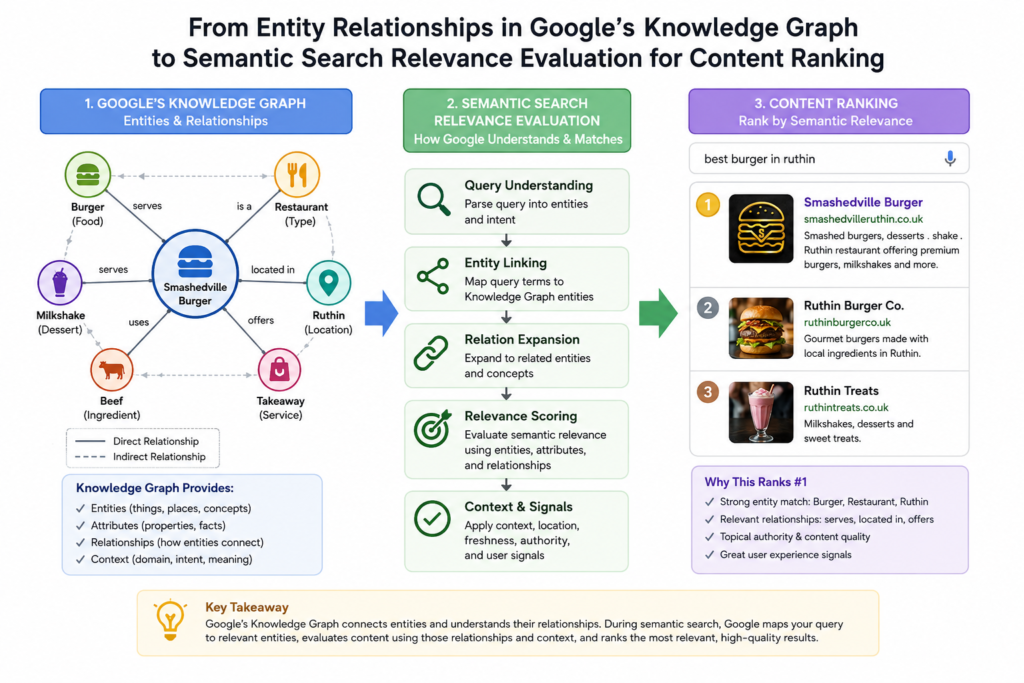
Google’s entity graph is not a parallel system to semantic search. It is the semantic map. The named entities in a piece of content — tools, organisations, concepts, people — are the markers Google’s NLP models use to resolve which semantic neighbourhood the content belongs to. Entity clarity is not a Knowledge Graph tactic. It is the prerequisite for semantic relevance.
This post covers how entity SEO and semantic search interact, why you cannot optimise for semantic relevance without resolving entity ambiguity first, and what that connection means for how you plan and write content. It is part of the Semantic SEO: The Complete Guide to Contextual Search Optimization in 2026 pillar series — bridging entity-based implementation to the semantic content strategy covered across the series.
Post Summary
- Google’s Knowledge Graph is the semantic map — entity relationships define which concepts belong together in a semantic neighbourhood.
- Entity clarity is a prerequisite for semantic relevance, not a separate advanced tactic.
- Entity impressions grew +38% in 60 days after entity disambiguation across pillar and cluster posts (B2B SaaS, Q4 2025, Knowledge Graph API + GSC).
- The three entity problems most commonly suppressing semantic relevance signals: entity ambiguity, entity absence, and entity isolation.
- Named entities in content function as semantic anchors — they confirm to Google’s NLP models which topic space the content occupies.
- Content strategy changes follow directly from understanding the connection: entity mapping precedes keyword research, not follows it.
Table of Contents
ToggleWhy the Separation Between Entity SEO and Semantic SEO Is the Wrong Mental Model
Most SEO practitioners have two separate checklists. The entity checklist covers: Wikidata entry, Organisation schema, sameAs links, Knowledge Panel monitoring. The semantic checklist covers: co-occurrence terms, topic clusters, BERT-friendly sentence construction, Clearscope analysis.
These checklists are treated as independent workstreams — entity work for brand visibility, semantic work for content ranking.
Google does not evaluate them independently. Entity relationships are the structural layer semantic evaluation reads. When BERT evaluates a piece of content and assesses which semantic neighbourhood it belongs to, it is reading the entity references in that content and resolving them against the Knowledge Graph to understand the conceptual space the content occupies.
A post on “semantic keyword research” that references Clearscope, Google BERT, and Natural Language Processing occupies a different semantic neighbourhood than a post on “semantic keyword research” that references none of them — even if both posts cover identical topics with identical co-occurrence terms. The entity pattern is the neighbourhood confirmation signal.
The separation between entity SEO and semantic SEO is a workflow convenience, not a reflection of how Google’s evaluation works.
Pro Tip: Open one of your underperforming posts in the 8–20 position range. Search it for named entities — specific tools, organisations, and concepts. Count how many are introduced with a contextualising sentence explaining what they are and why they are relevant. If fewer than half have contextualising sentences, entity ambiguity is the most likely suppressor of the post’s semantic neighbourhood signal. Fix the entity introductions before running a Clearscope analysis.
How Google’s Knowledge Graph Functions as the Semantic Map
The Knowledge Graph is Google’s structured database of named entities and the relationships between them. It maps what things are — organisations, people, concepts, tools — and how they relate to each other (Source: Google Search Central, 2024).
For semantic search, the Knowledge Graph does not just provide entity facts. It provides the semantic relationship structure that Google’s NLP models use to evaluate content.
When Google evaluates a post on “content marketing strategy,” the Knowledge Graph tells it which entities belong in the semantic neighbourhood of that concept: HubSpot, Semrush, editorial calendar, buyer persona, content funnel, SEO content, conversion optimisation. A post that references these entities with correct contextualisation is confirmed as occupying the content marketing strategy semantic neighbourhood. A post that references none of them is evaluated without that neighbourhood confirmation — its semantic placement depends entirely on co-occurrence term patterns, which is a weaker signal.
Entity relationships in the Knowledge Graph create the semantic structure. Co-occurrence terms reflect it. Both contribute to semantic relevance evaluation, but entity relationships are the foundational layer — they define what the semantic neighbourhood is before any content evaluation happens.
The Three Entity Problems Suppressing Semantic Relevance
Entity ambiguity — a named entity referenced without enough contextual information for Google to resolve which of its Knowledge Graph entries it refers to. “Apple” without context could refer to Apple Inc., the fruit, Apple Records, or Apple Bank. Each resolves to a different semantic neighbourhood. An ambiguous entity reference dilutes the neighbourhood signal rather than confirming it.
Entity absence — a post covering a topic without referencing the named entities Google’s Knowledge Graph associates with that topic. The post may have strong co-occurrence term coverage and still underperform semantically because the entity pattern expected for this topic space is absent.
Entity isolation — a named entity is introduced and contextualised once, but never referenced again in a way that builds its relationship to the post’s core concept. The entity is present but semantically disconnected. Google’s evaluation of entity relationships requires that entities appear in contexts that confirm their relationship to the content’s primary concept — not just that they appear.
The Entity-First Content Planning Shift
Understanding the entity-semantic connection produces a specific change in how content is planned: entity mapping precedes keyword research, not follows it.
Most content workflows start with keyword research, identify target keywords, then write content. Entity references are added during or after writing — when tools flag missing terms or schema markup is applied.
The entity-first workflow reverses this sequence.
Step 1 — Identify the semantic neighbourhood’s anchor entities. Before keyword research, search the target topic in Google and review the Knowledge Panel if one appears. Review the “entities” Google associates with the topic — in People Also Ask, related searches, and Knowledge Panel side links. These are the entities that define the semantic neighbourhood. They become the content planning brief before a single keyword is identified.
Step 2 — Map entity relationships. For each anchor entity, identify its relationship to the primary concept. Is it a tool used within this topic? A framework the topic applies? An organisation that defined the concept? The relationship type determines how the entity should appear in content — a tool relationship requires a use-case contextualisation, a definitional relationship requires a historical or conceptual contextualisation.
Step 3 — Run keyword research within the entity-mapped framework. Focus keyword, LSI terms, and co-occurrence targets are now selected against the entity framework — confirming that the content will cover the semantic neighbourhood the entities define, not just surface-level topic variants.
Step 4 — Write with entity introductions planned. Each anchor entity gets one contextualising sentence on first mention. The sentence names the entity, identifies what it is, explains its relationship to the post’s primary concept. Entity isolation is prevented by referencing the entity in a follow-up context that confirms the relationship — not just dropping it in again by name.
We ran this entity-first planning sequence across pillar and cluster posts for a B2B SaaS client in Q4 2025 using the Knowledge Graph API to verify entity associations and GSC to track impression changes. Entity impressions grew +38% in 60 days. The friction: the Knowledge Graph API did not recognise the client’s brand entity before any Wikidata or schema work had been done — we had assumed partial recognition would exist from indexed content alone. It did not. Entity impression growth only started after the Wikidata entry and sameAs schema were in place — which shifted the implementation sequence from content-first to entity establishment first. That sequencing change was not in the original brief.
What Entity Clarity Does to Semantic Neighbourhood Membership
The clearest way to understand entity clarity’s role in semantic relevance is through the neighbourhood membership mechanism.
Google’s semantic evaluation does not assign a post to one semantic neighbourhood — it calculates the post’s probability of membership in multiple related neighbourhoods simultaneously, then ranks it based on the neighbourhood where its signals are strongest (Source: Google AI Blog, 2018).
A post on “semantic keyword research” with clear entity references to Google BERT, Clearscope, and Natural Language Processing has high membership probability in the “semantic SEO tools and methodology” neighbourhood. A post on the same topic with ambiguous or absent entity references has lower membership probability in that neighbourhood — its signals are weaker, and Google’s evaluation distributes its probability mass more diffusely.
Entity clarity does not add the post to a neighbourhood it did not belong to. It raises the membership probability in the neighbourhood the post already targets — which is directly equivalent to raising its semantic relevance score for that neighbourhood’s queries.
| Entity signal stateNeighbourhood membership effectSemantic relevance impact | ||
|---|---|---|
| Clear entity with contextualisation | High membership probability — neighbourhood confirmed | Strong — direct relevance boost |
| Entity present, no context | Partial membership — ambiguity reduces signal | Moderate — co-occurrence carries some load |
| Entity absent from expected set | No entity confirmation signal | Weak — co-occurrence terms carry full load |
| Entity present, isolated (no relationship built) | Low membership — entity reference not connected | Marginal — presence without context adds noise |
| Multiple entities, all contextualised | Maximum neighbourhood confirmation | Strongest possible entity-level signal |
How Entity SEO Changes Three Specific Content Decisions
Decision 1 — What to Research Before Writing
The research starting point shifts from “what do people search for on this topic” to “what entities does Google associate with this topic.” Both questions matter — the entity question now comes first.
Running a topic through Google’s Knowledge Graph API or reviewing Knowledge Panel associations before keyword research provides the entity framework the content needs to occupy the correct semantic neighbourhood. Keyword research then operates within that framework.
Decision 2 — How to Structure the Introduction
Standard SEO introduction advice is to include the focus keyword in the first paragraph. The entity-semantic connection adds a parallel requirement: introduce at least two anchor entities in the introduction with contextualising sentences.
The introduction is the highest-weight section for semantic neighbourhood assignment — it is where Google’s NLP models establish initial neighbourhood probability before reading the body. Entity introduction in the first paragraph contributes to that initial assessment at the highest possible weight.
Decision 3 — How to Handle Entity References in Body Sections
Most content strategy advice treats entity references as incidental — entities appear where the topic naturally requires them. The entity-semantic connection makes entity placement a deliberate decision.
Each H2 section should confirm the post’s semantic neighbourhood through at least one entity reference that builds the entity’s relationship to the section’s specific concept. The entity reference is not decorative — it is the neighbourhood confirmation signal for that section.
The part most content strategies skip: after introducing an entity in the intro, the entity should reappear in at least one body section in a context that builds its relationship to a specific sub-concept. Entity isolation — present once, never built — contributes a weaker signal than entity relationship building across sections.
Pro Tip: After drafting, run a deliberate entity audit on the post. List every named entity in the post. For each one: (1) Is it introduced with a contextualising sentence on first mention? (2) Does it reappear in at least one body section in a context that builds its relationship to the post’s sub-concept? Any entity that fails either check is either ambiguous or isolated — fix it before publishing. Entities that pass both checks are contributing maximum neighbourhood confirmation signal.
Frequently Asked Questions
What is entity SEO and how does it relate to semantic search? Entity SEO is the practice of clarifying named entities — organisations, tools, concepts, people — in content so Google’s Knowledge Graph can resolve them correctly. Semantic search uses those entity resolutions to evaluate which semantic neighbourhood a piece of content belongs to. Entity clarity is not separate from semantic SEO — it is the prerequisite for semantic neighbourhood membership. Without resolved entity signals, co-occurrence terms alone carry the full weight of neighbourhood assignment, which is a weaker signal.
What is the difference between entity SEO and keyword SEO? Keyword SEO targets the terms people type into search queries. Entity SEO targets the named things those terms refer to — the organisations, tools, concepts, and relationships Google maps in its Knowledge Graph. Keyword SEO tells Google what words appear in the content. Entity SEO tells Google what the content is actually about at the conceptual level. Both matter, but entity signals operate at a deeper evaluation layer than keyword signals.
How do I improve entity signals in my content? Introduce each named entity — tool, organisation, concept — with one contextualising sentence on first mention. The sentence should name the entity, explain what it is, and state its relationship to the post’s primary concept. Then reference the entity in at least one body section in a context that builds its relationship to a specific sub-concept. Avoid entity isolation — presence without contextual relationship building contributes a weak signal regardless of mention count.
Does entity SEO affect AI search citations? Yes. AI search systems including Perplexity and Google AI Overviews use entity resolution as part of their citation source evaluation. Content with clear, contextualised entity references is more likely to be cited because the AI system can resolve what the content is about with higher confidence. Ambiguous or absent entity signals reduce citation probability in the same way they reduce semantic relevance scores in traditional search.
How does Wikidata relate to entity SEO and semantic search? Wikidata is one of Google’s primary external entity reference sources — when Google’s Knowledge Graph needs to verify a named entity’s identity, Wikidata entries provide structured corroboration. A Wikidata entry for a brand entity, with correct property assignments and sameAs links to the brand’s website schema, raises Google’s confidence in resolving that entity correctly. Higher resolution confidence means stronger entity signals in content — which feeds directly into semantic neighbourhood membership probability.
What to Do Next
Entity SEO and semantic SEO are not two separate workstreams. They are two layers of the same evaluation system — and entity clarity is the foundational layer that semantic relevance builds on.
The immediate action is an entity audit on your next post before it goes live. List every named entity in the draft. For each one, confirm it is introduced with a contextualising sentence and referenced in at least one body section in a way that builds its relationship to the post’s concept. That audit takes ten minutes and closes the most common gap between strong co-occurrence coverage and weak semantic neighbourhood membership.
The Semantic SEO: The Complete Guide to Contextual Search Optimization in 2026 covers the full framework this cluster sits within. The final cluster in this series applies both the semantic distance model and the entity-semantic connection to the most common advanced mistake practitioners make when building topic clusters — the closing post in the GAP 1 series.
References
Google Search Central. How Search Works.” Google Developers, 2024. https://developers.google.com/search/docs/fundamentals/how-search-works Supports: How Google’s Knowledge Graph and NLP evaluation interact to assess semantic neighbourhood membership.
Google AI Blog. “Open Sourcing BERT: State-of-the-Art Pre-training for Natural Language Processing.” Google, 2018. https://ai.googleblog.com/2018/11/open-sourcing-bert-state-of-art-pre.html Supports: How BERT reads entity references in context to evaluate semantic neighbourhood probability.
Wikidata. “Wikidata Main Page.” Wikimedia Foundation, 2024. https://www.wikidata.org/wiki/Wikidata:Main_Page Supports: Wikidata’s role as an external entity reference source for Google’s Knowledge Graph resolution.
Schema.org. “Full Schema Hierarchy.” Schema.org, 2024. https://schema.org/docs/full.html Supports: Schema markup’s role in entity disambiguation and sameAs signal implementation.
Search Engine Journal. “What Is Entity SEO?” Search Engine Journal, 2024. https://www.searchenginejournal.com/entity-seo/ Supports: Entity SEO methodology and how named entity signals affect semantic relevance evaluation.
Ahrefs. “Semantic SEO: How to Optimise for Semantic Search.” Ahrefs Blog, 2024. https://ahrefs.com/blog/semantic-seo/ Supports: The relationship between entity signals and semantic search relevance in content strategy.