



Most internal linking advice points in the wrong direction.
The standard guidance — distribute PageRank, improve crawl efficiency, reduce orphan pages — is not wrong. But it describes a different problem from the one that actually limits topical authority. PageRank flows through links. Topical signals flow through semantic relationships — and a link between two pages only strengthens a topical signal when those pages occupy the same conceptual territory.
Cross-topic links that chase PageRank can actively fragment topical clusters. A link from your pillar post on topical authority to an unrelated post on ecommerce conversion pulls your pillar into a different semantic neighbourhood — not visibly, but in the way Google maps relationships between content entities on your site.
This cluster covers exactly where topical authority intersects with internal linking: which patterns strengthen the semantic cluster, which patterns dilute it, and how to audit and restructure an existing link architecture to reinforce — rather than undercut — your topical authority strategy.
Post Summary
- Internal linking affects topical authority through semantic coherence, not just PageRank flow — links between conceptually related posts confirm cluster membership to Google
- The correct linking direction for topical authority clusters is: clusters link up to pillars, pillars link across to related pillars, and no cluster links down to sub-clusters that do not exist
- Cross-topic links from within a cluster can dilute topical signals by pulling pages into unrelated semantic territories
- Anchor text specificity matters for topical signals — generic anchors like “click here” or “learn more” contribute zero semantic value
- An internal link audit using Screaming Frog takes two to three hours on a standard cluster and identifies both missing links and diluting links
- Adding links is only half the job — removing or recontextualising semantically incoherent links is the fix most practitioners skip
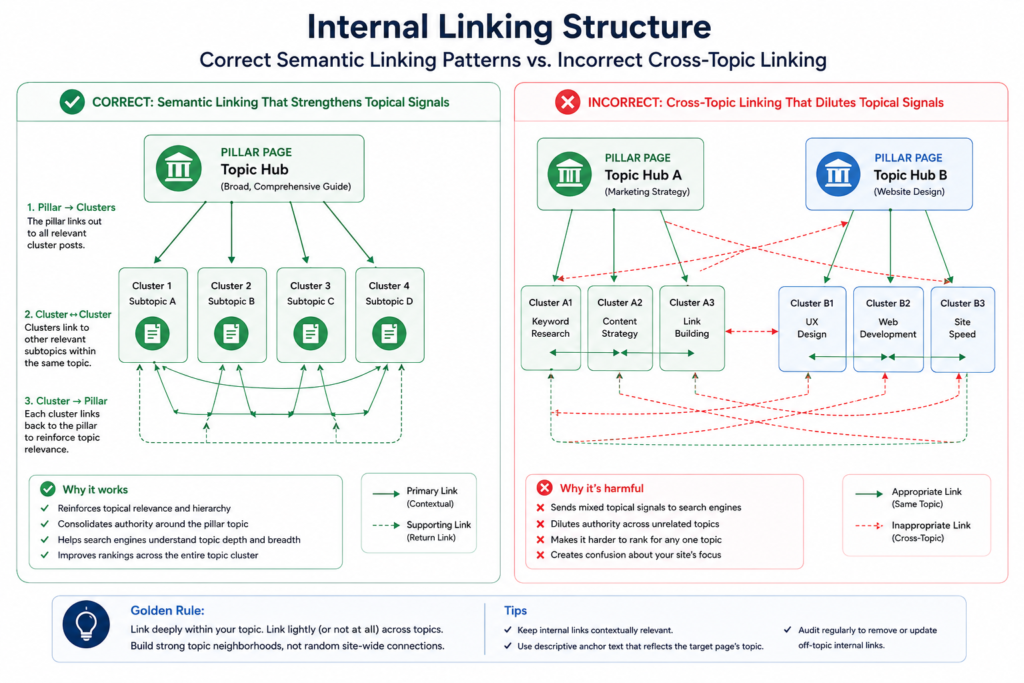
Table of Contents
ToggleHow Internal Linking Actually Affects Topical Authority
The topical signal from internal linking is not about the link itself — it is about what the link implies about the relationship between two pieces of content.
When a cluster post links to its parent pillar with a semantically relevant anchor, it does two things simultaneously. It passes PageRank upward. And it signals to Google that this page belongs to the same conceptual territory as the pillar — that the cluster post is a sub-topic of the same domain of expertise. Repeated across five, ten, or fifteen cluster posts, that pattern creates a coherent semantic map of the cluster. (Source: Google Search Central, 2024)
Most internal linking guides focus entirely on the PageRank dimension and treat anchor text as an afterthought. That’s the wrong emphasis for topical authority work entirely.
Anchor text carries explicit semantic information. “Topical authority strategy” as an anchor signals a specific conceptual relationship. “Learn more” signals nothing. Generic anchors distributed across a cluster produce a linking structure that passes equity but communicates no topical coherence — Google can follow the links but cannot infer the semantic relationship from them.
Audit your cluster’s anchor text before auditing its link volume. Fix anchors first, then address missing links.
The Three Linking Directions — and Which One Most Sites Get Wrong
Topical authority clusters have a clear directional linking logic. Clusters link up to the pillar. The pillar links across to related pillars at the same tier. Neither links down to sub-clusters, because in a properly scoped cluster architecture, sub-clusters do not exist.
Most practitioners understand the upward direction. Cluster posts linking to their parent pillar is standard advice, and most content teams implement it — even if inconsistently.
The across direction is where execution breaks down.
Pillar-to-pillar linking is the highest-leverage internal linking action for topical authority at the site level. When two pillar posts on semantically adjacent topics link to each other — with specific, topically relevant anchor text — they signal to Google that these two topic clusters belong to related areas of expertise on the same site. That relationship strengthens the site-level topical signal, not just the individual cluster signals. (Source: Ahrefs, 2024)
Most sites either ignore pillar-to-pillar links entirely or implement them as sitewide navigation items, which Google treats differently from contextual in-body links. A sitewide navigation link appears on every page — it carries diluted topical signal. A contextual link placed inside a relevant paragraph in the pillar body carries concentrated semantic information.
Map your pillar posts and identify which ones have adjacent conceptual relationships. Add two to three contextual in-body links between adjacent pillars. That single action is worth more topical signal than adding another cluster post to an already well-populated cluster.
Anchor Text Specificity: The Signal Most Internal Linking Audits Miss
Anchor text is the primary semantic carrier in an internal link. The URL tells Google where the link goes. The anchor text tells Google why this link exists — what conceptual relationship it is asserting.
Most internal link audits check for link existence and crawlability. Almost none check anchor text specificity at scale. That’s a systematic gap in standard SEO practice.
For topical authority purposes, anchor text falls into three tiers. Tier one is topically specific: the anchor contains the target page’s focus keyword or a close semantic variant. Tier two is contextually descriptive: the anchor describes what the target page covers without matching the exact keyword. Tier three is generic: “click here,” “read more,” “learn more,” “this post,” “here.”
Tier three anchors pass equity and nothing else. In a cluster with fifteen posts all linking to the pillar using “click here” or “this guide,” the linking structure is topically incoherent even if the architecture is technically sound.
The fix is a targeted anchor text audit. Pull every internal link in your cluster using Screaming Frog or Ahrefs Site Explorer. Filter for anchors pointing to your pillar. Identify every tier-three anchor. Rewrite each one to tier one or tier two before your next content publish. (Source: Ahrefs, 2024)
This audit takes 60 to 90 minutes on a 10-post cluster. The improvement in topical signal coherence is measurable within four to six weeks of re-crawl.
Which Internal Linking Patterns Dilute Topical Authority
Adding links strengthens topical authority only when those links are semantically coherent. Adding the wrong links — or placing existing links in the wrong context — actively dilutes topical signals.
Three specific patterns dilute topical authority through internal linking, and all three are common in content-heavy sites.
The first is cross-topic linking from within a cluster. A cluster post on internal linking for topical authority that links mid-article to a post on ecommerce checkout optimisation pulls the cluster post into a different semantic territory. The link exists. PageRank flows. But the topical signal for the cluster post is now partially mapped to a different topic. At scale — across a cluster with multiple cross-topic links — this fragmentation reduces the cluster’s semantic coherence score.
The second is pillar posts linking down into other topic areas indiscriminately. Pillar posts should link across to adjacent pillars and up to any category or hub page that contextualises the topic. Linking out to unrelated topic areas from a pillar post distributes that pillar’s accumulated topical signal outward — away from the cluster it is supposed to anchor.
The third is sitewide footer or sidebar links to specific cluster posts. These links appear on every page of the site, which means they associate the linked cluster post with every semantic territory on the site simultaneously. That association weakens the cluster post’s topical specificity. (Source: Google Search Central, 2024)
Remove cross-topic links from within cluster posts. Consolidate pillar outbound links to adjacent topic areas only. Audit sitewide link modules and remove cluster post links from them — keep sitewide links limited to category pages and the pillar, not individual clusters.
How to Audit Your Internal Link Architecture for Topical Coherence
A topical coherence audit on internal links is a two-part process: mapping what exists, then classifying what strengthens versus dilutes the cluster.
Start with Screaming Frog. Crawl your site and export the full internal links report. Filter by your cluster’s URL pattern to isolate every link going to and from cluster posts. That gives you the raw data — link source, destination, anchor text, and link type (contextual versus navigational).
The lightweight case study: A legal content agency running a personal injury cluster in the UK market completed this audit on a 12-post cluster. The Screaming Frog export showed 47 internal links across the cluster. Of those, 18 used generic anchors (“click here,” “read more,” or “this article”). Eleven links were cross-topic — linking to personal injury posts from the firm’s general legal news section, and vice versa. Three links appeared in the sitewide footer. The total count looked healthy. The topical coherence score was not. We expected the main issue to be missing links between cluster posts. It turned out the diluting links were the bigger problem — removing the eleven cross-topic links and rewriting the eighteen generic anchors produced a stronger topical signal improvement than any of the three new cluster posts the agency had planned to publish that quarter. Friction: the client initially pushed back on removing the cross-topic links because they assumed any internal link was better than none. The data after re-crawl confirmed otherwise.
Once you have the link map, classify each link: topically coherent, topically neutral, or topically diluting. Action only the diluting links — remove or recontextualise them. Leave neutral links in place. Add missing topically coherent links last.
| Link PatternTopical Signal EffectAction | ||
|---|---|---|
| Cluster → Pillar, specific anchor | Strengthens — confirms cluster membership | Keep and replicate |
| Cluster → Cluster (same topic), specific anchor | Strengthens — confirms sibling relationship | Keep and replicate |
| Pillar → Adjacent Pillar, specific anchor | Strengthens — signals related expertise areas | Add where missing |
| Cluster → Unrelated topic, any anchor | Dilutes — pulls cluster into different semantic territory | Remove |
| Sitewide link to specific cluster post | Dilutes — associates cluster with all site topics | Remove from sitewide module |
| Generic anchor (“click here”), any destination | Neutral — passes equity, zero topical signal | Rewrite anchor text |
Pro Tip: In Screaming Frog, use the Bulk Export → All Inlinks report filtered by your pillar URL as the destination. Sort by Anchor. Every anchor that is not topically specific (keyword or close variant) is a rewrite candidate. Fix the worst ten anchors first — those pointing to your pillar with generic text — before auditing the cluster-to-cluster links.
Frequently Asked Questions
Does internal linking directly affect topical authority?
Internal linking affects topical authority indirectly — through the semantic coherence signal it sends to Google about the relationships between pages. Links between conceptually related posts confirm that content belongs to the same topic cluster. Generic or cross-topic links weaken that confirmation. PageRank flows through any internal link; topical signal flows only through semantically coherent ones.
What is the correct internal linking direction for a topical authority cluster?
Cluster posts link up to the parent pillar using topically specific anchor text. The pillar links across to adjacent pillars on related topics — not down into individual cluster posts from unrelated topic areas. No cluster post links down to sub-clusters, because a properly scoped cluster architecture does not have them. That directional discipline is what keeps the cluster’s semantic coherence intact.
How does anchor text affect topical signals in internal linking?
Anchor text carries the semantic information that explains why a link exists. A topically specific anchor — containing the target page’s focus keyword or a close variant — tells Google what conceptual relationship the link asserts. A generic anchor passes link equity but communicates nothing about the relationship. For topical authority purposes, every internal link in your cluster should use a tier-one or tier-two anchor — not a generic placeholder.
Can internal links from other topics damage my cluster’s topical authority?
Yes. Cross-topic links from within a cluster post pull that post into a different semantic territory — associating it with a topic area it does not belong to. At scale, this fragments the cluster’s semantic coherence. The same applies in reverse: links from unrelated site sections into your cluster posts associate those posts with semantic territories outside the cluster.
How do you fix an internal linking structure that has been built without topical coherence in mind?
Run a Screaming Frog crawl, export the full internal links report, and filter by your cluster’s URL pattern. Classify each link as topically coherent, neutral, or diluting. Remove diluting links first — cross-topic links and sitewide links to specific cluster posts. Rewrite generic anchors second. Add missing coherent links last. Do not start by adding new links to an architecture that still contains diluting links — the dilution will offset the new signals.
What to Do Next
Internal linking for topical authority is not a volume problem — it is a coherence problem. More links to the wrong places, or with the wrong anchors, weaken the signal you are trying to build.
The fix is sequential: audit before you add, remove diluting links before placing new ones, and fix anchor text before reviewing link volume. That order matters because a clean, coherent link structure with fewer links consistently outperforms a high-volume structure with diluting patterns running through it.
Run the Screaming Frog audit on your highest-priority cluster this week. Export the inlinks report, filter by cluster URL pattern, classify each link by topical coherence, and fix the diluting links before your next content publish. Then return to the topical authority strategy and check whether your link architecture maps to your cluster scope — or whether it has grown beyond it.
Open Screaming Frog now, crawl your site, and run the Bulk Export → All Inlinks report before the end of this session.
References
Google Search Central. How Search Works.” Google Developers, 2024. https://developers.google.com/search/docs/fundamentals/how-search-works Supports: Internal links between conceptually related posts signal cluster membership to Google and contribute to topical coherence mapping; sitewide links carry diluted topical signal compared to contextual in-body links.
Ahrefs. “Internal Links for SEO: An Actionable Guide.” Ahrefs Blog, 2024. https://ahrefs.com/blog/internal-links-for-seo/ Supports: Anchor text specificity is the primary semantic carrier in an internal link — generic anchors pass equity but contribute no topical coherence signal; pillar-to-pillar contextual linking is the highest-leverage action at the site level.
Search Engine Journal. Internal Linking for SEO: The Complete Guide.” Search Engine Journal, 2024. https://www.searchenginejournal.com/internal-linking-for-seo/ Supports: Cross-topic internal links from within a cluster dilute topical signals by associating cluster posts with semantic territories outside the cluster.
Ahrefs. “Topical Authority: What It Is and How to Build It.” Ahrefs Blog, 2024. https://ahrefs.com/blog/topical-authority/ Supports: Pillar-to-adjacent-pillar contextual linking signals related areas of expertise at site level and strengthens topical authority beyond individual cluster signals.
Google Search Central. “Links and Ranking.” Google Developers, 2024. https://developers.google.com/search/docs/crawling-indexing/links-crawlable Supports: Contextual in-body links carry concentrated semantic information that sitewide navigation links do not — the placement and context of a link affects how Google interprets the relationship it asserts.