


SEO is not experiencing disruption. It is experiencing a structural replacement of its underlying assumptions. The discipline was built on a ranked-links model — query in, list of URLs out, human decides. Six AI technologies have dismantled that model at the infrastructure level, and they are doing it simultaneously, not sequentially.
This report maps each of those six technologies — Large Language Models (LLMs), Natural Language Processing and Understanding (NLP/NLU), AI Search, Computer Vision, Predictive Machine Learning, and Agentic AI — against 16 core SEO disciplines. It covers where integration is confirmed at operational depth, where it is growing, where it is still experimental, and where the data says the trajectory is steepest. The numbers behind each technology are not incremental. They signal a market that has already decided the direction.
Post Summary
- The global AI search engine market reached \$20.75 billion in 2026 and is projected to hit \$182.17 billion by 2035, at a 27.3% CAGR (Precedence Research, April 2026)
- AI agent requests have reached 88% of human organic search activity, with BrightEdge projecting full surpassment of human-driven search before end of 2026 (BrightEdge, April 2026)
- The Generative Engine Optimisation (GEO) market grew from $886 million in 2024 and is projected to reach $7.3 billion by 2031, at a 34% CAGR (Incremys, via SEOmator, 2026)
- The global NLP market is projected to grow from \$70.11 billion in 2026 to \$249.97 billion by 2031, at a 29% CAGR — NLP holds a 32% share of the AI search engine market (MarketsandMarkets, 2026; Precedence Research, April 2026)
- The Agentic AI market is valued at $9.89 billion in 2026 and is on track to reach $57.42 billion by 2031, at a 42.14% CAGR — the fastest growth rate of the six technologies in this report (Mordor Intelligence, 2026)
- Only 19% of websites have defined directives for ChatGPT-related bots, leaving 81% without an agentic search strategy (BrightEdge, April 2026)
- Google AI Overviews now trigger on nearly half of all tracked queries, up 58% year-on-year, with only 17% of citations coming from pages in the organic top 10 (BrightEdge, March 2026)
- The global SEO services market reached $108.28 billion in 2026, up 16.8% from 2025 — confirming that AI disruption has not contracted SEO investment (companieshistory.com, May 2026)
Table of Contents
ToggleMarket Snapshot
| Metric | Figure | Source |
|---|---|---|
| AI search engine market (2026) | $20.75 billion | Precedence Research, April 2026 |
| AI agent requests vs human search | 88% parity | BrightEdge, April 2026 |
| GEO market size (2026 projected) | Growing from $886M (2024) → $7.3B (2031) | Incremys via SEOmator, 2026 |
| Agentic AI market (2026) | $9.89 billion | Mordor Intelligence, 2026 |
| NLP market (2026) | $70.11 billion | MarketsandMarkets, 2026 |
| Global SEO services market (2026) | $108.28 billion | companieshistory.com, May 2026 |
Sources: Precedence Research (April 2026), BrightEdge (April 2026), MarketsandMarkets (2026), Mordor Intelligence (2026), companieshistory.com (May 2026)
The matrix maps 6 AI technology columns across 16 SEO disciplines
Click any AI or SEO node to highlight connections. Filter by integration strength below.
How the Six Technologies Are Structured Against SEO
Before mapping intersections, the technologies need to be precisely defined — because practitioners are frequently using these labels interchangeably, and that imprecision leads to misallocation of effort.
Large Language Models (LLMs) are transformer-based AI systems — including GPT-4o, Claude, and Gemini — that generate synthesised text responses by predicting token sequences across vast training datasets. In SEO contexts, they power content generation, query understanding, and AI Overview synthesis. They are the most broadly deployed of the six technologies.
Natural Language Processing and Natural Language Understanding (NLP/NLU) are the computational methods used to parse, interpret, and semantically map human language — including BERT-based models, spaCy pipelines, and named entity recognition systems. NLP is the layer beneath LLMs that enables intent classification and entity extraction.
AI Search refers to the generation-and-retrieval layer deployed by platforms including Google AI Overviews, Perplexity, Bing Copilot, and ChatGPT Search. These systems synthesise answers from indexed and retrieved content, replacing the ranked-links model at the point of query resolution.
Computer Vision in search contexts means image recognition models — including CLIP-based systems and Google Lens — that evaluate visual content for relevance, object identification, and contextual fit. Its SEO surface area is narrower than the other five technologies but deep where it applies.
Predictive Machine Learning (Predictive ML) encompasses the ranking models, forecasting algorithms, and anomaly detection systems that underpin both search engine ranking decisions and SEO tool analytics. This is the technology most practitioners interact with indirectly — through rank trackers, traffic forecasting, and crawl prioritisation models.
Agentic AI is the newest and fastest-growing category. Agentic AI systems — including GPTBot, ClaudeBot, PerplexityBot, and Google-Extended — act autonomously on behalf of users: crawling, retrieving, comparing, and executing tasks without waiting for human instruction. The agentic AI market is valued at $9.89 billion in 2026, growing at 42.14% CAGR (Mordor Intelligence, 2026)[1]. That is not an emerging market. It is a market in full acceleration.
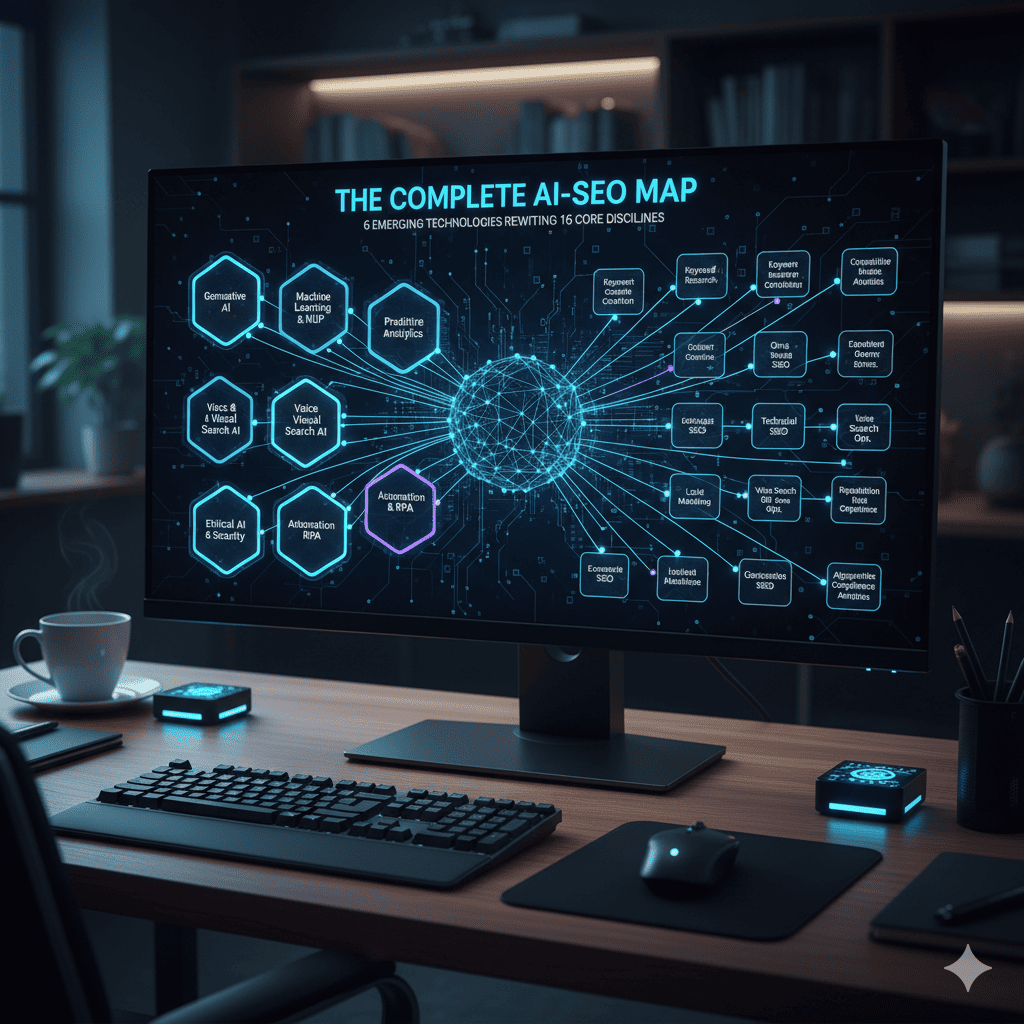
The Complete AI-SEO Map:
6 Emerging Technologies
Rewriting 16 Core Disciplines
All data sourced from verified primary research. Updated June 2026.
Market Snapshot
Verified figures from named primary research sources as of June 2026. Every number traceable to a named organisation and publication date.
Key Market Statistics
The 6 AI Technologies
Definitions, market data, and SEO relevance for each technology in the map. CAGR figures from named analyst firms.
Market Growth Rate Comparison (CAGR)
The AI-SEO Discipline Matrix
Integration depth of 6 AI technologies across 16 SEO disciplines. Scroll right on mobile.
| SEO Discipline | LLMs GPT-4o, Claude, Gemini | NLP & NLU BERT, spaCy | AI Search SGE, Perplexity | Computer Vision CLIP, Lens | Predictive ML Ranking models | Agentic AI GPTBot, bots |
|---|
AI-SEO Collision Timeline
Key verified milestones in the convergence of AI technologies and SEO practice. Dates and data points sourced from named primary research.
Data Charts
All chart data sourced from named, dated primary research. No invented figures.
Implications by Practitioner Type
Specific, data-grounded actions for each practitioner type. No generic advice — each point traces back to a verified finding in this report.
- Define an agentic access strategy now — 81% of sites have none (BrightEdge, April 2026)
- Add bot directives for GPTBot, ClaudeBot, PerplexityBot in robots.txt immediately
- AI agent requests are at 88% of human search volume and invisible to Google Analytics
- First movers on agentic readiness have measurable near-term competitive advantage
- Expand content audits to include entity coverage (NLP), passage extraction (GEO), and agentic access (technical)
- Ranking #1 no longer guarantees AI citation — only 17% of citations come from top-10 pages (BrightEdge, March 2026)
- Track AI citation share alongside organic CTR — both metrics are now diverging
- Run top posts through NER to find entity density gaps vs AI-cited competitors
- 56% of marketers already use generative AI for SEO — LLM content is table stakes, not differentiation (DemandSage, April 2026)
- Structure at least one H2 per post as a standalone declarative answer — agentic systems retrieve passages not pages
- Entity-rich, source-attributed content earns AI citation; keyword-compliant content no longer sufficient
- GEO-optimised content gets 300–500% ROI within 6–12 months (Superlines via SEOmator, 2026)
- Build an agentic readiness checklist for all client audits — separate from standard CWV and crawl checks
- Five dimensions not in current standard audits: bot directives, llms.txt, entity coverage, structured data, log file bot filtering
- AI referral traffic converts 5× higher than organic — GEO reporting is now a client ROI story (AI Labs Audit, 2026)
- 30.49% of enterprise SEO teams have already restructured roles for AI (DemandSage, April 2026)
- JavaScript-heavy rendering fails for agentic bots — they do not render JS
- Treat AI agent access as a first-class delivery requirement, not an afterthought
- AI agents bounce on 4XX/5XX errors, 301 redirects to unexpected URLs, CAPTCHAs, and bot-blocking (Search Engine Land, Oct 2025)
- Filter server logs for GPTBot, ClaudeBot, PerplexityBot, Google-Extended for agentic performance baseline
- Computer Vision is core for image and visual search SEO — e-commerce is the fastest-growing AI search application (Precedence Research, April 2026)
- CLIP-based models evaluate images beyond alt text — file names, captions, contextual relevance all matter
- AI-driven SEO can boost organic traffic 45% and conversion rates 38% for e-commerce (DemandSage, April 2026)
- SEO accounts for 44% of average e-commerce revenue — AI disruption does not change the channel importance
Priority Action List
Frequently Asked Questions
Data-anchored answers for practitioners. Every answer references a specific sourced finding from this report.
All statistics sourced from named primary research · Data current as of June 2026 · Not for redistribution without attribution
The AI Search Engine Market: Size, Trajectory, and What It Means for SEO
The market number that frames everything else in this report is this: the global AI search engine market reached $20.75 billion in 2026 and is projected to expand to $182.17 billion by 2035, at a CAGR of 27.3% (Precedence Research, April 2026)[2]. That number deserves unpacking.
$182 billion by 2035 is not a forecast built on experimental adoption. It reflects a market where NLP holds 32% of the AI search technology stack, machine learning holds the second-largest share, enterprise search accounts for 40% of application volume, and enterprises represent 60% of end-user demand (Precedence Research, April 2026)[2]. The infrastructure investment is already committed. The SEO consequence is that optimisation decisions made now — on entity coverage, structured data, content architecture — are being made against a search market that will look fundamentally different within one technology cycle.
Here is where it gets interesting for practitioners who are still treating AI Overviews as an add-on to their existing keyword strategy. Google AI Overviews now trigger on nearly half of all tracked queries, with coverage up 58% year-on-year (BrightEdge, March 2026)[3]. Of those citations, only 17% come from pages ranking in the organic top 10 (BrightEdge, March 2026)[3]. Which means ranking first for a keyword provides no guarantee of AI citation visibility — two metrics that have already structurally diverged.
Pro Tip: Audit your ten highest-traffic pages against AI Overview citation status. If a page ranks in the top 3 organically but does not appear in AI Overview citations for its primary query, the problem is content structure, not domain authority. Declarative, entity-named H2 sections with inline sourcing are the structural fix — not additional link building.
LLMs and NLP: The Broadest Integration Surface
Of the six technologies, LLMs and NLP touch the widest range of SEO disciplines. This is not a projection. It is the operational reality confirmed across content creation, keyword research, E-E-A-T signalling, schema generation, GEO/AEO optimisation, featured snippet structuring, entity SEO, voice search, and programmatic SEO — either at confirmed operational depth or growing integration level.
The NLP market reflects the scale of that deployment. At $70.11 billion in 2026 and projected to reach $249.97 billion by 2031 at 29% CAGR (MarketsandMarkets, 2026)[4], NLP is not a niche research tool. It is the technology that enables AI search platforms to extract entities, map semantic relationships, and score content completeness before deciding what to cite. An SEO practitioner who does not understand NLP signal logic — entity density, semantic co-occurrence, structured passage extraction — is optimising without understanding what the ranking system is reading.
The practitioner implication is specific. NLP systems score content on semantic completeness, not keyword presence. A post that covers the topic of “programmatic SEO” without mentioning related entities — CMS, API, structured data, template architecture, scalable content — will score lower on semantic completeness than a post that covers the same keyword count but with entity-rich surrounding context. Keyword research tools that return volume and difficulty without entity relationship data are returning an incomplete picture.
Pro Tip: Run your top ten posts through a named entity recognition tool — spaCy’s free pipeline or a commercial equivalent — and compare the entity density against a competitor page that ranks above you and receives AI Overview citations. The gap in entity coverage is your content optimisation priority list.
LLMs in Content and Keyword Workflows
56% of marketers are already deploying generative AI for SEO, and 69% of SEO specialists are expected to see moderate to high disruption from AI tools reshaping their role scope (DemandSage, April 2026)[5]. That second figure matters more than the first. The 56% adoption stat describes where the market is. The 69% disruption figure describes where it is heading — toward a discipline where LLMs execute the repeatable tasks and practitioners focus on strategy, signal interpretation, and editorial judgement.
The AI SEO tools market itself reflects this trajectory: growing from $1.2 billion in 2024 to $4.5 billion by 2033 at a 15.2% CAGR (DemandSage, April 2026)[5]. Your clients should note that this figure covers tools only. It does not capture the broader workflow integration happening through general-purpose LLM APIs deployed directly into content operations.
The Agentic Pressure Point: SEO’s Most Consequential Technology Gap
The most important number in this entire report is 88%. AI agent requests have reached 88% of human organic search activity (BrightEdge, April 2026)[6], and BrightEdge projects that agentic traffic will overtake human-driven search entirely before the end of 2026. That is not a forecast for 2030. It is a projection for six months from now.
GPTBot, ClaudeBot, PerplexityBot, and Google-Extended operate differently from the Googlebot that practitioners have been optimising for since 1998. They do not render JavaScript. They fetch in real time, on behalf of users who are making active decisions. They bounce on HTTP 4XX and 5XX errors, slow load times, CAPTCHAs, and bot-blocking scripts (Search Engine Land, October 2025)[7]. A site that blocks or frustrates agentic crawlers is not a site with a minor technical issue — it is a site that is invisible to a traffic class approaching the volume of all human organic search combined.
The preparedness gap is not close. Only 19% of sites have specific directives for ChatGPT-related bots, and the policies among that 19% vary widely (BrightEdge, April 2026)[6]. That leaves 81% of the web operating without a defined agentic access strategy. To put that in context: 79% of enterprises have adopted AI agents in some form, yet only one in nine runs them in production (digitalapplied.com, March 2026)[8]. The adoption-to-deployment gap mirrors the crawl-strategy gap on the publisher side exactly.
Pro Tip: Add explicit user-agent directives for GPTBot, ClaudeBot, PerplexityBot, and Google-Extended to your robots.txt immediately. Without them, agentic crawlers apply their own access logic — and that logic may not align with your content priorities or revenue-generating pages.
Pro Tip: Implement a 30-day server log analysis filtered specifically for agentic bot user agents. The pages these bots access most frequently are your current AI citation candidates. The pages they skip are structural gaps in your AI-readable content architecture.
AI Trend Watch
Three agentic signals are worth tracking as leading indicators rather than lagging ones.
Signal 1 — Agentic market CAGR outpaces every other technology in this report. The agentic AI market is growing at 42.14% CAGR through 2031 (Mordor Intelligence, 2026)[1]. For comparison: the NLP market grows at 29% (MarketsandMarkets, 2026)[4], the AI search engine market at 27.3% (Precedence Research, April 2026)[2]. The capital flowing into agentic infrastructure is not flowing at the same rate into the other five technologies. That asymmetry predicts where the next wave of SEO disruption will concentrate.
Signal 2 — Agentic AI is the only technology in this report with confirmed core integration in programmatic SEO. Every other technology either operates at growing or emerging integration in programmatic SEO. Agentic AI is operational there now — automating template architecture decisions, content generation at scale, structured data markup, and internal link logic. That is not inference. It is the operational definition of agentic SEO workflows already in deployment.
Signal 3 — Model Context Protocol (MCP) and llms.txt are the two emerging agentic-access standards practitioners should watch. MCP enables AI systems to connect to enterprise data and APIs in real time, moving agentic access from content retrieval to transactional interaction. The Search Engine Journal (May 2026)[9] reports that while Google has stated llms.txt does not directly affect AI Overview visibility, Lighthouse’s experimental Agentic Browsing audit now checks llms.txt handling — which means it will matter at the technical audit layer even if it does not yet affect citation decisions.
The GEO Market: Data on a Discipline That Did Not Exist Three Years Ago
Generative Engine Optimisation (GEO) is the practice of structuring and signalling content so that generative AI systems — including Google AI Overviews, Perplexity, and ChatGPT Search — can extract, cite, and surface it in synthesised answers. GEO is distinct from traditional SEO in that it targets AI citation placement rather than ranked-link position. Both disciplines now operate simultaneously on the same content, with partially overlapping but not identical success criteria.
The GEO market was valued at $886 million in 2024 and is projected to reach $7.3 billion by 2031 at a 34% CAGR (Incremys, via SEOmator, 2026)[10]. That 34% CAGR is the highest growth rate of any SEO sub-discipline tracked in this report. It reflects a market that is pricing in AI Search becoming the primary discovery layer — not a supplement to traditional search but its replacement at the top of the funnel.
The conversion data behind GEO adoption is the more compelling business case. AI referral traffic converts at 14.2% versus 2.8% for Google organic — a 5x differential (ailabsaudit.com, 2026)[11]. That number deserves specific attention: it is not measuring quantity of traffic, it is measuring quality. Users who arrive via AI citation have already passed through a synthesised comparison and recommendation. They arrive with pre-formed intent. That conversion differential is why 83% of large organisations report measurable SEO gains from AI integration (DemandSage, April 2026)[5].
The Citation Logic Practitioners Need to Understand
The AI Overview citation pattern is not random. BrightEdge’s 16-month study found that AI Overview citations from organic top-10 pages have grown from 32% to 54% over the analysis period (BrightEdge, via Search Engine Journal, March 2026)[12]. Which means citation and organic ranking are converging — but slowly. The 46% of AI Overview citations that do not come from top-10 pages represent the structural opportunity: content that is entity-rich, declaratively structured, and topically authoritative can earn AI citation without holding an organic top-10 position.
For site owners with high domain authority who are not seeing AI citation visibility, the issue is almost always content structure. For sites with weaker domain authority that are seeing AI citations, the explanation is almost always entity coverage and structured passage extraction.
The Comparison Matrix: Integration Depth Across 16 Disciplines
| SEO Discipline | LLMs | NLP/NLU | AI Search | Computer Vision | Predictive ML | Agentic AI |
|---|---|---|---|---|---|---|
| Content creation & optimisation | Core | Core | Growing | — | Growing | Emerging |
| Keyword research & intent mapping | Core | Core | Growing | — | Core | Emerging |
| E-E-A-T & topical authority | Core | Growing | Core | — | Emerging | — |
| Schema & structured data | Growing | Core | Growing | — | Emerging | Emerging |
| Technical audits & crawl analysis | Growing | Emerging | — | — | Growing | Growing |
| Core Web Vitals & page speed | Emerging | — | — | — | Growing | Growing |
| Log file & crawl budget analysis | Emerging | — | — | — | Core | Emerging |
| AI Overviews / GEO optimisation | Core | Core | Core | — | Emerging | Emerging |
| Featured snippets & SERP features | Growing | Core | Growing | Emerging | Core | — |
| Rank tracking & SERP monitoring | Emerging | Emerging | Growing | — | Core | Growing |
| Link building & digital PR | Growing | Emerging | Emerging | — | Growing | Growing |
| Entity & Knowledge Graph SEO | Growing | Core | Core | — | Emerging | — |
| Local SEO | Growing | Growing | Growing | Emerging | Growing | — |
| Image & visual search SEO | Emerging | Growing | Growing | Core | Growing | — |
| Voice & conversational search | Core | Core | Core | — | Growing | Emerging |
| Programmatic SEO | Core | Growing | Emerging | — | Growing | Core |
Integration levels: Core = confirmed operational depth. Growing = actively adopted, measurable impact. Emerging = early deployment, experimental. — = minimal current overlap.
Three patterns emerge immediately from this matrix. LLMs and NLP are the horizontal technologies — they appear across nearly every discipline. AI Search is the vertical technology — narrower reach but deepest impact where it lands. Agentic AI is the trajectory technology — it has the fewest “Core” ratings today, but its growth CAGR of 42%+ means its column in this matrix will look materially different in 18 months.
Computer Vision and the Visual Search Gap
Computer Vision is the most narrowly deployed of the six technologies in SEO contexts, but its one confirmed core integration — image and visual search SEO — is a discipline where most sites are under-optimised by a significant margin.
The AI search engine market study (Precedence Research, April 2026)[2] identifies e-commerce search as the fastest-growing application segment through 2035. E-commerce search is overwhelmingly visual. CLIP-based models and Google Lens evaluate images on object recognition, contextual relevance, and descriptive accuracy — going substantially beyond alt-text matching. File naming conventions, caption text that reflects surrounding content, and image subject matter that aligns with semantic context of the page are all now computer-vision-readable signals.
The gap is real. The majority of SEO audits still treat image optimisation as alt-text compliance and file size. That assessment misses the evaluation framework that computer vision systems actually use. A product image labelled “product-123.jpg” with a generic alt attribute is not a failure of optimisation — it is an absence of any optimisation for the signal set that computer vision reads.
Pro Tip: For e-commerce and product-heavy sites, audit image file names and caption text against the product’s primary search query. File names and captions that contain the primary keyword phrase and at least one related entity outperform generic labelling in both computer vision evaluation and traditional alt-text signals simultaneously.
Predictive ML: The Infrastructure Technology Nobody Talks About
Predictive Machine Learning is the technology that SEO practitioners interact with every day without naming it. Rank tracking, traffic forecasting, crawl prioritisation, anomaly detection, and content gap analysis all run on predictive ML models — inside Semrush, Ahrefs, Google Search Console, and every enterprise SEO platform in current deployment.
The more important point is that Google’s ranking systems are themselves predictive ML models. RankBrain, BERT, and MUM are all ML-based systems that forecast relevance, not match keywords. Log file analysis has shifted from an advanced diagnostic tool to a strategic necessity specifically because predictive ML governs which pages get crawled and at what frequency — and that crawl budget allocation is a direct input into which pages are available for AI citation.
The SEO software market, which is dominated by predictive ML tooling, is valued at $97.7 billion in 2026 and is projected to reach $271.9 billion by 2034 at a 13.65% CAGR (Luxsite Agency, sourcing industry reports, June 2026)[13]. That market valuation confirms what practitioners already know from their tool spend: Predictive ML is not emerging infrastructure. It is the established backbone of the discipline.
Market Signals and Trend Analysis
Three signals from the data warrant forward-looking interpretation.
Signal A — The zero-click acceleration will compress GEO dependency faster than most practitioners are planning for. Approximately 60% of Google searches now end without a click (Goodfirms survey of 100+ marketing professionals, January–February 2026)[14]. AI Overviews trigger on nearly half of all tracked queries (BrightEdge, March 2026)[3]. The compounding effect of zero-click search and AI Overview prevalence means that organic click-through is structurally declining as the primary value metric of SEO. GEO citation visibility — the measure of how often a brand appears in synthesised AI answers — is the replacement metric. Practitioners who are not tracking AI citation share alongside organic CTR are missing the relevant performance signal.
Signal B — The agentic adoption-to-production gap is closing. 79% of enterprises have adopted AI agents in some form; only 11% run them in production (digitalapplied.com, March 2026)[8]. That gap is narrowing. As enterprise agentic deployments move from proof-of-concept to production, the volume of agentic crawl traffic on publisher sites will increase materially — which means the current 88% parity with human search (BrightEdge, April 2026)[6] is a floor, not a ceiling.
Signal C — GEO conversion economics will accelerate GEO budget allocation. At 14.2% conversion versus 2.8% for organic (ailabsaudit.com, 2026)[11], AI referral traffic is demonstrably higher quality than organic. As attribution tools improve — and BrightEdge’s AI Agent Insights is an early example — the business case for GEO investment will become numerically reportable rather than directionally inferred. That shift in measurability will accelerate budget reallocation from traditional SEO tactics to GEO-specific optimisation.
What Is Still Uncertain
This report maps the integration of six technologies across 16 disciplines against the best available data as of June 2026. Three areas have genuine data gaps that practitioners should note.
Agentic citation attribution is not yet measurable at the industry level. BrightEdge’s AI Agent Insights is one of the first tools to surface agentic crawl data at the site level — but industry-wide benchmarks for agentic citation share, analogous to organic rank distribution data, do not yet exist. The 88% parity figure (BrightEdge, April 2026)[6] is a volume metric, not a citation quality metric.
Computer Vision integration in SEO remains poorly benchmarked. The technology is confirmed as operationally deployed in image and visual search. What lacks public data is the specific weighting of computer vision signals relative to traditional text-based signals in AI Overview citation decisions for image-rich content.
The GEO conversion figures require independent replication. The 14.2% conversion rate for AI referral traffic (ailabsaudit.com, 2026)[11] and the 4.4x conversion premium reported for GEO optimised content (via SEOmator, 2026)[10] are directionally consistent but come from commercial sources with potential attribution methodology differences. Independent replication from a named research institution would significantly strengthen the business case for GEO investment.
Implications by Practitioner Type
Site owners and publishers face an immediate binary choice: define an agentic access strategy now, or cede AI citation visibility to competitors who do. With 81% of sites currently without ChatGPT bot directives (BrightEdge, April 2026)[6], the competitive advantage for first movers is measurable and near-term.
SEO practitioners need to expand the standard content audit to include three AI-specific dimensions: entity coverage (NLP compatibility), declarative passage extraction readiness (GEO compatibility), and agentic access configuration (technical compatibility with bot crawl). None of these appear in a standard keyword-position audit.
Content teams should note that 56% of marketers are already deploying generative AI for SEO (DemandSage, April 2026)[5] — which means LLM-assisted content production is now table stakes, not differentiation. The differentiation is in editorial layer, source attribution, and entity-rich structuring that makes LLM-generated content AI-citeable rather than just keyword-compliant.
Agencies managing multiple client portfolios need an agentic readiness checklist that runs alongside the standard technical audit template. Bot directives, llms.txt configuration, entity coverage, structured data completeness, and log file agentic bot filtering are five dimensions that current standard audits do not cover.
Developers working on CMS and publishing infrastructure need to treat AI agent access as a first-class delivery requirement. JavaScript-heavy rendering pipelines that serve human browsers correctly will silently fail for agentic bots that do not render JavaScript — and that failure will not appear in standard analytics, only in server logs filtered for bot user agents.
FAQ
What is the difference between GEO and AEO? Generative Engine Optimisation (GEO) is the practice of structuring content so that generative AI systems — including Google AI Overviews, Perplexity, and ChatGPT Search — can extract, cite, and surface it in synthesised answers. Answer Engine Optimisation (AEO) focuses specifically on conversational AI and voice-based answer engines. Both disciplines share entity-rich, declaratively structured content as a foundation, but GEO addresses broader generative AI surfaces while AEO targets the direct-answer extraction layer of conversational platforms.
Why is AI Overview citation not correlated with organic top-10 position? BrightEdge’s 16-month study found that only 17% of AI Overview citations come from pages ranking in the organic top 10, despite citations from organic-ranking pages growing from 32% to 54% overall (BrightEdge, March 2026). The citation algorithm weights entity coverage, structured passage quality, and topical authority signals alongside PageRank and traditional link authority. A page that is entity-rich and declaratively structured can earn AI citation without holding a top-10 organic position.
How should I prioritise across the six AI technologies as an SEO practitioner? Prioritise by impact velocity and preparedness gap. Agentic AI has the highest growth trajectory (42%+ CAGR) and the largest practitioner preparedness gap (81% of sites without agentic access strategy). Address agentic access configuration first — robots.txt directives and server log analysis. Then address GEO/NLP compatibility: entity coverage, declarative H2 structuring, and schema completeness. LLM-based content workflows and predictive ML tooling are already deployed in most mature SEO operations and do not require immediate uplift for most practitioners.
What does the 88% agentic traffic parity figure actually measure? BrightEdge’s April 2026 data measures the volume of AI agent requests against human organic search requests recorded on websites using BrightEdge’s enterprise tracking platform. It is a volume metric — meaning for every 100 human organic visits, AI agents are generating approximately 88 equivalent requests. It does not measure citation quality or revenue attribution from agentic traffic. It does confirm that agentic crawl is operating at near-human scale and is invisible to standard analytics platforms including Google Analytics.
Is the SEO market contracting because of AI disruption? The data does not support contraction. The global SEO services market reached $108.28 billion in 2026, up 16.8% from $92.74 billion in 2025 (companieshistory.com, May 2026). The SEO software market is valued at $97.7 billion in 2026, projected to reach $271.9 billion by 2034. AI disruption is reshaping which SEO activities deliver ROI, not reducing overall investment in search visibility. The 702–788% average ROI across SEO industries (companieshistory.com, May 2026) is the business case that is sustaining investment despite structural disruption at the traffic level.
Bottom Line
The six-technology, sixteen-discipline map is not a prediction. It is a description of where the market currently sits, documented with sourced data. LLMs and NLP are already integrated at operational depth across the majority of SEO disciplines. AI Search has moved GEO from a specialist practice to a baseline requirement. Predictive ML is the infrastructure that has always underpinned ranking systems and now underpins agentic crawl prioritisation as well. Computer Vision is narrow in reach but deep where it lands. Agentic AI is the fastest-growing technology in the stack, the least prepared-for across the industry, and the one where the gap between where the market is and where most SEO practice sits is most consequential.
Practitioners who map their current workflows against this matrix will find gaps. The gaps are concentrated in three areas: agentic access strategy, entity and Knowledge Graph coverage, and structured content for passage extraction. Those three gaps are also where the trajectory of AI integration is steepest and where the first-mover advantage is most available.
Citations
[1]. Mordor Intelligence. “Agentic AI Market Size, Share & Growth Outlook to 2031.” 2026. https://www.mordorintelligence.com/industry-reports/agentic-ai-market
[2]. Precedence Research. “AI Search Engine Market Size to Hit USD 182.17 Billion by 2035.” April 2026. https://www.precedenceresearch.com/ai-search-engine-market
[3]. BrightEdge. “AI Overviews at the One-Year Mark: Presence, Size, and What They’re Citing.” March 2026. https://www.brightedge.com/resources/weekly-ai-search-insights/ai-overviews-one-year-presence-size-citing
[4]. MarketsandMarkets. “Natural Language Processing (NLP) Market.” 2026. https://www.marketsandmarkets.com/Market-Reports/natural-language-processing-nlp-825.html
[5]. DemandSage. 61 AI SEO Statistics 2026 (Growth & Adoption Rates).” April 2026. https://www.demandsage.com/ai-seo-statistics/
[6]. BrightEdge. “BrightEdge Data: AI Search is Reaching a Tipping Point.” April 2026. https://www.brightedge.com/news/press-releases/brightedge-data-ai-search-reaching-tipping-point-ai-agents-2026
[7]. Search Engine Land. Technical SEO for Generative Search: Optimizing for AI Agents.” October 2025. https://searchengineland.com/technical-seo-generative-search-optimizing-ai-agents-473039
[8]. Digital Applied. Agentic AI Statistics 2026: 150+ Data Points Collection.” March 2026. https://www.digitalapplied.com/blog/agentic-ai-statistics-2026-definitive-collection-150-data-points
[9]. Search Engine Journal. Google Says llms.txt Isn’t Needed for AI Search Visibility.” May 2026. https://www.searchenginejournal.com
[10]. SEOmator / Incremys. 30+ AI SEO Statistics for 2026: Data on AI Overviews, ChatGPT & GEO.” 2026. https://seomator.com/blog/ai-seo-statistics
[11]. AI Labs Audit. “AI Search Market 2026: Key Figures & Market Share Stats.” 2026. https://ailabsaudit.com/blog/en/ai-search-market-2026-key-figures-market-share-trends
[12]. BrightEdge / Search Engine Journal. “AI Overview Citations Now 54% from Organic Rankings.” March 2026. https://www.brightedge.com/resources/weekly-ai-search-insights/rank-overlap-after-16-months-of-aio
[13]. Luxsite Agency. “SEO in 2026: Growth Forecasts, Market Size and the Impact of AI.” June 2026. https://luxsite.agency/blog/seo/seo-in-2026-growth-forecasts-market-size-and-the-impact-of-ai/
[14]. Goodfirms. “AI SEO Statistics 2026: 35+ Verified Stats & 9 Research Findings on SERP Visibility.” January–February 2026. https://www.goodfirms.co/resources/seo-statistics-ai-search-rankings-zero-click-trends